Read More
As presented in this column several weeks ago, we have entered the best time of the year to enjoy France’s Marennes Oleron oysters along with Franciacorta sparkling wine.
ADVERTISEMENT
SCROLL TO CONTINUE WITH CONTENT
Speaking of seasonal products for the autumn and winter, how can we forget Alba white truffle?
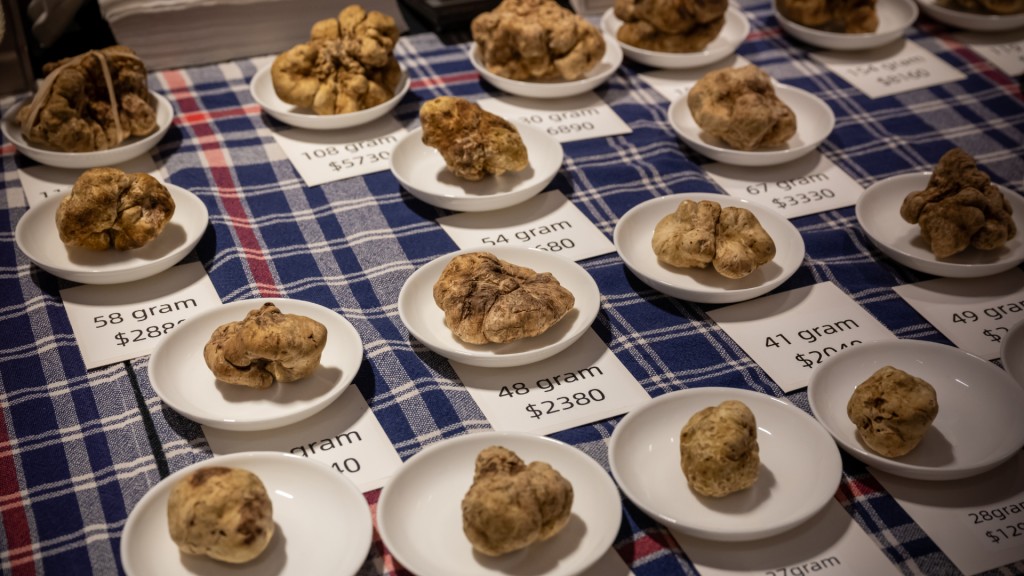
In early November, Hong Kong once again won the most prestigious lot at the XXVI World White Truffle Auction of Alba. At €110,000 (HK$1 million), the very rare triple white truffle of 1,009 grams, unearthed in the Roero area of Piedmont, was auctioned off and benefited our local charity Mother’s Choice. At the same auction, three other pieces of Alba white truffle weighing 249g, 331g, and 402g respectively were also sold to various buyers. The event raised a total of €502,000 for various charity projects in Italy and worldwide. Historically, Hong Kong had frequently been the successful bidder of the biggest piece of truffle at the annual auction in Italy.
There are over 100 types of truffle species around the world, although only about a dozen are considered suitable for cooking. Broadly speaking, black and white truffles mainly come from Italy, France, Poland, Australia, and the US.
Why is Alba white truffle, also named tuber magnatum pico, particularly expensive? The answer comes down to the law of supply and demand, and the premium quality of the precious fungus.
Many black truffles in the market today are cultivated in a controlled environment, which makes the product far more common. On the other hand, it is extremely challenging to farm white truffles. White truffles require a host tree to provide the roots for the truffle spores to colonize.
This will only happen with certain species of trees such as oak, hazelnut or chestnut trees. And even with that, the growth rate of white truffle is still unpredictable, as other factors such as the pH level of the soil and humidity also have an impact on its development. In reality, most white truffles are grown in the wild in its natural habitat, making them extremely rare.
Finally, to make the process even more enchanting, these golden tuber are to be discovered only between October and December by professionally trained truffle hunting dogs. With all these variables, it is not difficult to understand why white truffles can cost at least twice as much as their black relatives.
White truffles can be found in various parts of Europe such as Croatia, Slovenia, Hungary, Switzerland, and even in many different parts of Italy, but by far the ones from the town of Alba in northwest Italy are the most prestigious.
Alba white truffle boasts its unique aroma which is pleasantly pungent and filled with earthiness. The flavor profile is rich and extremely complex; some are garlicky and musky, while others show notes of honey and nuttiness. Just a few shavings of 3-5g of the “white diamond” is enough to elevate the entire course.
The tips for wine pairing with Alba white truffle depends on the style of the dishes. Some prefer simple items that allow white truffle’s magnificent aroma to stand out. Others choose heavier ingredients that complement the strong character of the fungus. Nevertheless, nothing beats the culinary principle of “what grows together, goes together.” Below are three pairing suggestions featuring wines made from native Piedmontese grape varieties for three signature Alba white truffle dishes.
Timorasso X Fried Eggs with White Truffle (Uova al Tartufo)
How about waking up on a cold winter morning to the smell of white truffles? Egg (fried, poached or scrambled) is one of the most popular choices to serve with Alba white truffle. The umami flavor of eggs is ideal for the earthy, fresh fungus. The texture of the yolk, be it the sponginess of a sunny-side up or the creaminess of the scrambled version, provides an interesting contrast to the delicate truffle shaves. Try this recipe with a Timorasso, an exciting white wine that has gone through a major renaissance since the turn of the century. The wine does not have a pronounced fruit profile that would overwhelm the truffle. Instead, its mineral and diesel notes echo with the tone of Uova al Tartufo, its round body aligns with the mouthfeel of the dish, yet its high acidity refreshes every bite.
Barbera X Tagliolini with White Truffle (Tajarin al Tartufo)
Tajarin is the Piedmontese version of Tagliolini, a fresh egg pasta that is thinner than tagliatelle. Because of the generous use of egg yolk (30-40 yolks for every kilogram of flour!), Tajarin has a special velvety texture and bright color. The simplicity yet richness of this dish once again highlight the elegance of Alba white truffle. To balance with this robust pasta dish, an aged Barbera with smooth tannins, integrated dried fruits and a hint of forest floor would be just right.
Barolo X Fassona Beef Tartare with White Truffle (Tartare di Fassona al Tartufo)
For those looking for a more sophisticated dish to match with the caliber of Alba white truffle, turn to Fassona Beef Tartare. A premium quality of lean meat with a high proportion of prime cuts, Fassona comes from a breed of cattle native to Piedmont. In this case, the sweetness and meatiness of Fassona resonate with the powerful aroma of Tartufo Bianco d’Alba. The beloved pairing for this dish is, without any doubt, a Barolo of more than 10 years of bottle age which gives the heavenly pleasure of leather, potpourri, coffee grounds and… truffle!
Alice Wong is a certified wine educator based in Hong Kong