Even with the advance of modern technology and the extra help of artificial intelligence such as DeepSeek it is still not possible to predict an earthquake with any certainty.
That is why nobody could predict the recent massive earthquake that devastated Myanmar. It was as if even the gods had conspired to heap more misery on a country that is being torn apart by a long and brutal civil war.
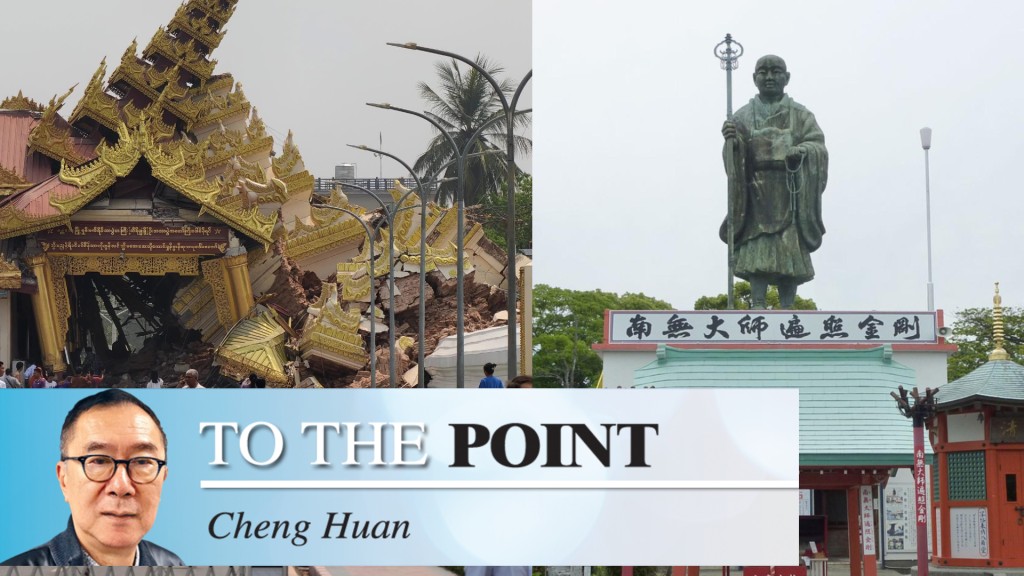
Sadly, the earthquake’s epicenter was very near the historic city of Mandalay in the north of Myanmar.
Many of its ancient temples appear to have fallen into ruin and the loss of life must have been far higher than the country’s highly superstitious government is ready to admit.
The great Mahamuni pagoda in Mandalay with its huge golden bronze image of Buddha was badly shaken by the 7.7 strong earthquake, though the government, again probably for superstitious reasons, has been predictably reluctant to admit anything negative.
While Mandalay’s Mahamuni pagoda was being shaken, I was by coincidence visiting another earthquake prone city, Lhasa in Tibet, and was strolling around the city’s ancient Jokhang temple, which has withstood countless earthquakes and political upheavals since its foundation 1,400 years ago.
Also coincidentally, since visiting Tibet I have been to another earthquake prone country, Japan, or to be more precise, the island of Shikoku and its Unesco heritage trail connecting the 88 temples that were founded by the pilgrim saint Kukai 1,300 years ago.
This was my second visit and timed to coincide with the sakura cherry blossom season when the temples’s gardens are at their best. Thankfully, I felt no tremors though the government seismological agency has issued one of its periodic predictions that a major quake will shake Japan in the near future.
Kobo Daeshi, affectionately referred to as Kukai, was a humble teacher and preacher who achieved fame after making a pilgrimage to China during the Tang dynasty where he collected and translated into Japanese a collection of Buddhist sutras, or prayers, that were previously unknown in Japan.
Many of Shikoku’s temples are so well preserved that, despite all the earthquakes that must have shaken them, they still date back to Kukai’s time.
Renovation and rebuilding as a result of fire and the destruction caused by man-made disasters such as conflicts and war have kept them in remarkably fine condition. Despite the fact that Shikoku sits perilously close to the crack in the earth’s crust known as the Nankai trough, hardly any of the 88 temples have been affected by earthquakes in more than a thousand years.
While in Shikoku I did feel comforted that, if there was an earthquake, Japan is probably the world’s best prepared place to be and the Japanese are famously resilient when dealing with disaster.
Japan, where every corner of the country is vulnerable to earthquakes, is proof of what can be achieved.
The country has a culture of preparedness, where every citizen has been indoctrinated on how to survive a quake.
Moreover there are strict seismic building codes and even gas lines have automatic shut off valves in the event of a strong tremor. If the ground shakes, Japan’s trains stop automatically.
How frustrating it must be for the Japanese that they cannot predict earthquakes with precise exactitude.
Precision and intricacy are skills at which the Japanese excel in all walks of life – in their art, food preparation, technology, design, architecture, even their tidiness, and much else besides.
The best example of this Japanese obsession with perfection is the system to declare the start of the sakura season.
At the end of March every year an official from the Japan Meteorological Agency will make daily visits to examine a particular cherry tree at Tokyo’s Yasukuni shrine.
The official’s job is to count the blossoms and as soon as five blossoms have opened on the tree, the commencement of the sakura season will be pronounced.
This year the opening was declared on March 25 or five days earlier than last year.
Other cities from the south to the north of the country have similar systems of their own. Japan really is unlike any other place, which is one of the reasons why it has become a tourist hot spot – that and yen that is wonderfully weak.
Cheng Huan is an author and a senior counsel who practices in Hong Kong