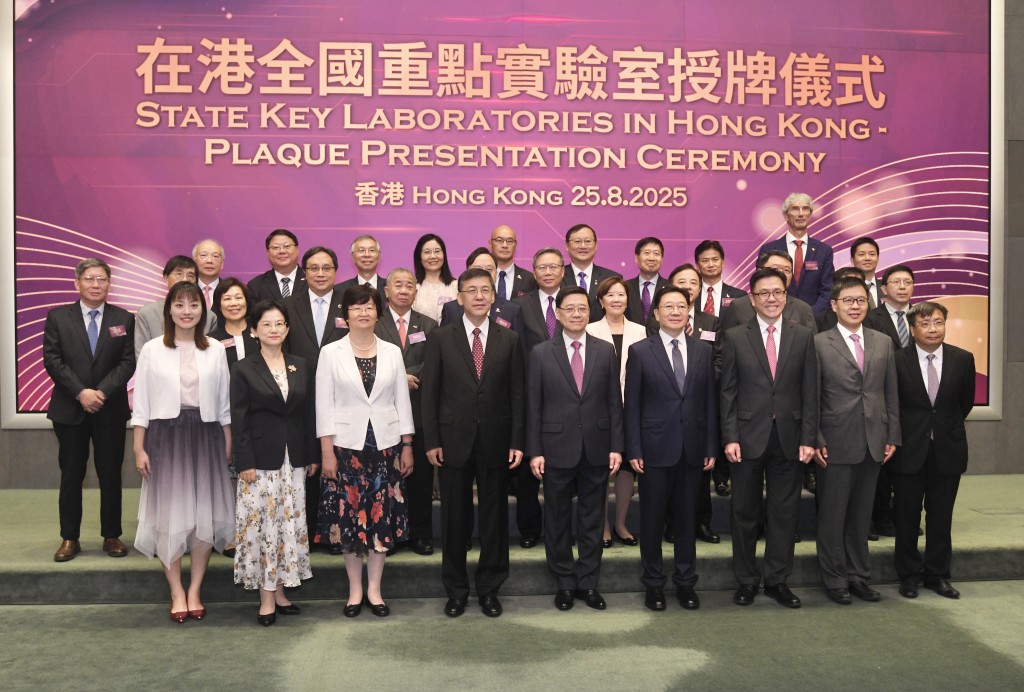
Hong Kong could cultivate world-changing tech visionaries like Alibaba founder Jack Ma Yun and the wealthiest American Elon Musk, said presidents of the city’s leading universities, as the mainland's Ministry of Science and Technology designated 15 State Key Laboratories in the city.
The appointments follow a restructuring initiative launched in late 2023 by Hong Kong’s Innovation and Technology Commission to align with national strategies. Of the 15 labs, 12 were reorganized from existing facilities and three are newly established.
They are based at five publicly funded universities – the University of Hong Kong, the Chinese University of Hong Kong, the Hong Kong University of Science and Technology, the Hong Kong Polytechnic University, and City University of Hong Kong.
Their research focuses include medical technology, disease research, synthetic chemistry, climate and sustainability issues, quantum materials, optoelectronics and other frontier sciences.
Speaking at the designation ceremony yesterday(Mon), Minister of Science and Technology Yin Hejun urged Hong Kong’s scientific community to “unleash its potential” in supporting the country’s goal of becoming a global tech leader by 2035.
He called on the labs to tackle major scientific challenges, explore new research frontiers, and strive for breakthrough innovations.
Yin also emphasized leveraging Hong Kong’s international research environment to attract top global talent, especially young scientists, and to deepen collaboration with mainland institutions to accelerate practical applications.
Liaison Office Director Zhou Ji highlighted Hong Kong’s strengths in basic research, noting its five top-100 universities and 24 national innovation platforms. He encouraged the city to aim for more “zero-to-one” breakthroughs.
Chief Executive John Lee said the labs underscore Hong Kong’s research excellence and will help transform it into a high-end talent hub through global cooperation.
Each laboratory will receive an annual funding of HK$20 million from the government, with host universities providing at least HK$4 million in matching resources.
The approved laboratories are also mandated to submit detailed five-year plans with clear targets and performance indicators.
When asked about the possibility of cross-border data transfer or biological resource sharing with the mainland, Secretary for Innovation, Technology and Industry Sun Dong said scientists raised the issue during a meeting with Minister Yin, who pledged further discussion to facilitate resource flow between Hong Kong and the mainland.
HKU president Zhang Xiang noted that the institution has established a new School of Innovation to support young entrepreneurs, aimed at cultivating more talents like Jack Ma and Elon Musk.
CUHK president Dennis Lo Yuk-ming emphasized integrating basic and applied research with commercialization, particularly leveraging Greater Bay Area clinical resources.
HKUST president Nancy Ip Yuk-yu expressed confidence that cross-border data sharing, especially in life sciences, would be achieved under a newly formed research consortium.
| Name of state key laboratories | Hosting university |
| SKL of Emerging Infectious Disease | HKU |
| SKL of Translational Oncology | CUHK |
| SKL of Terahertz and Millimeter Waves | CityU |
| SKL of Agrobiotechnology | CUHK |
| SKL of Ultra-precision Machining Technology | PolyU |
| SKL of Nervous System Disorders | HKUST |
| SKL of Marine Environmental Health | CityU |
| SKL of Liver Research | HKU |
| SKL of Synthetic Chemistry | HKU |
| SKL of Pharmaceutical Biotechnology | HKU |
| SKL of Digestive Disease | CUHK |
| SKL of Displays and OptoElectronics | HKUST |
| SKL of Optical Quantum Materials | HKU |
| SKL of Quantum Information Technologies and Materials | CUHK |
| SKL of Climate Resilience for Coastal Cities | PolyU, HKUST |