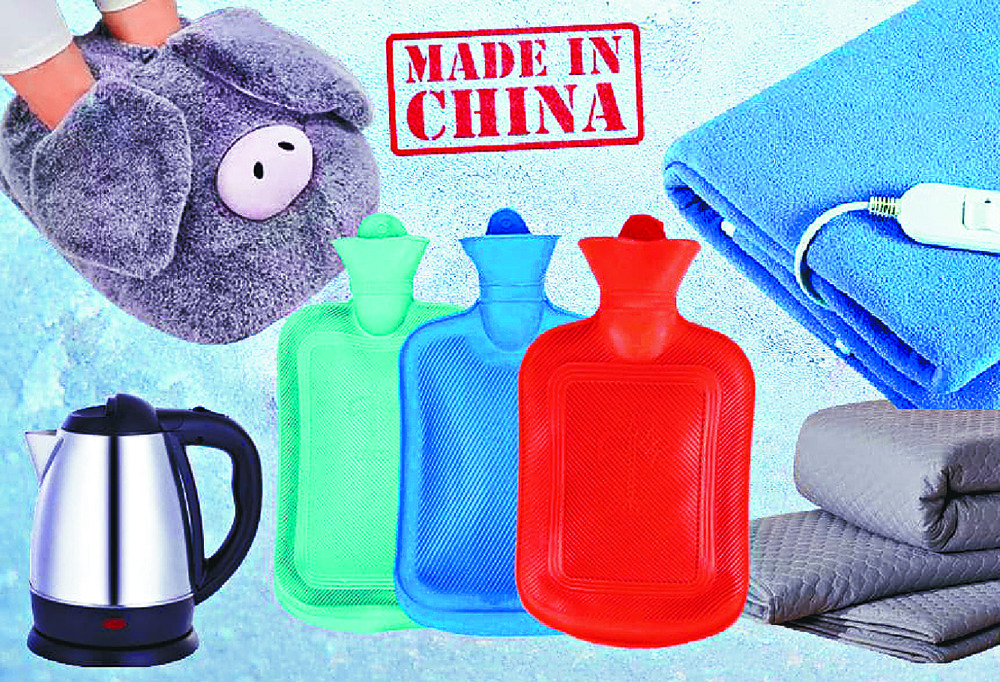
Over the past few months Europe has been furiously buying Chinese winter wear and electric heaters with people looking for every possible way to protect themselves from the cold as winter fast approaches, amid fears of widespread energy shortages.
But analysts say the demand for winter gear might run out of steam, with gas prices now declining from record highs as storage fills up to capacity amid a supply glut.
Thermal underwear, socks, pajamas, hot water bottles, hand warmers, room heaters, electric blankets and turtleneck jumpers have been in hot demand this year with the European Union importing 1.29 million electric blankets in July alone, up 150 percent year-on-year, according to statistics from the General Administration of Customs of China.
Sales of thermal underwear and socks meanwhile increased by 246 percent and 131 percent respectively month-on-month, according to data from AliExpress, a Chinese cross-border e-commerce platform.
And sales of other winter accessories in Europe, including hot water bottles, hand warmers and heaters, have soared more than three times month-on-month, the data shows.
Manufacturers of room heaters and electric blankets say their order books are full until the end of January next year, or even later.
To meet demand, many factories in China have been operating round the clock with three shifts, and some manufacturers have hired extra hands just to keep up with the unprecedented demand, according to reports.
SOARING GAS PRICES
Most of the demand has been triggered by soaring energy prices on the back of Russia's war in Ukraine.
Natural gas is used to heat about half of European households and in 2021, a third of Europe's energy - used for generating electricity, transport and heating - came from burning gas
Russia, which supplies the lion's share of natural gas to Europe, cut gas supplies after it was hit with sanctions following its invasion of Ukraine in February this year.
As a result, European gas prices have soared more than tenfold this year, hitting a record high above EUR343 (HK$2,680) per megawatt hour in August.
In Germany, some 600,000 heaters were sold in the first six months of 2022, according to market research firm GFK - a 35 percent increase from the same period last year, with residents preparing for a possible energy crisis this winter.
The huge demand for electric heaters across Europe has been largely driven the soaring price of natural gas, Zhou Nan, the secretary-general of the household electric appliances branch at the Chinese Chamber of Commerce for Import and Export of Machinery and Electronic Products, told the Global Times newspaper.
Data from the chamber also showed that China's heater exports to Europe in the first eight months were worth US$695.63 million (HK$5.4 billion), up 25.28 percent year-on-year.
STOCKS ON A ROLL
Meanwhile, the sharp rise in overseas demand has led to an uptick in share prices of some winter goods manufacturers.
Shares of Caihong, an electric blankets producer in the mainland, jumped 1.25 times to 40.22 yuan on October 18 compared to 17.88 yuan on September 1, while its market capitalization soared to 4.29 billion yuan from 1.88 billion yuan in early September.
Amid the significant movement in its price, Caihong informed the Shenzhen Stock Exchange that the company has obtained export orders of electric blankets this year but the quantity is small and will not significantly impact revenue.
Overseas sales of household heating products including electric blankets were worth only 210,000 yuan in the first six months of the year and current orders at hand are about 1.33 million yuan, accounting for 0.13 percent of the company's total operating revenue in the previous year, it revealed.
But despite its stock plummeting by nearly 30 percent to 26.16 yuan after the 20th party congress in China, it has overall risen by more than 23 percent this year.
Shares of other winter gear manufacturers have also been on the rise with Solareast Holdings and Guangdong Vanward New Electric rising 25.81 percent and 21.99 percent to 6.63 yuan and 9.43 yuan, respectively.
However, down jackets manufacturer Bosideng International (3998) saw its price fall 14.1 percent to HK$3.48 on October 30 from HK$4.05 on September 1, but its sales are expected to surge over the Double Eleven shopping festival, ahead of the upcoming winter season.
Shares of Haier Smart Home (6690) have fallen by 14.79 percent to HK$20.45 in the past month amid negative market sentiment. In the first three quarters, its overseas markets performed well, achieving year-on-year revenue growth of 54.02 percent.
CASHING IN ON DEMAND
Meanwhile, several companies are seizing the day amid the demand for winter merchandise in Europe and even rolling out expansion plans on the continent.
Hisense (0921) recently launched its entire range of Hi-Therma household air source heat pumps - a 2022 German Red Dot Design Award in the Heating and Air Conditioning Technology category for its design and function - across Italy, Poland, Spain, Germany and France.
Electric blanket manufacturer Rainbow has been marketing its products on its online platform as "energy saving and environmentally friendly" and has set up an overseas marketing department and service team. And since May this year, the company has started winning export orders for its electric blankets.
Electrical appliance giant Midea has broken ground for a heat pump plant in Italy. With an investment of 60 million euros (HK$463.55 million), the plant will open around the second quarter of 2024 and include production lines, support facilities and a research and development center.
However, Jiang Han, a senior researcher at Pangoal Institution, says the sales boom in winter goods may not last, as European countries have rolled out contingency plans to cope with the energy crisis.
If Europe's energy crisis eases, the demand for winter good will decrease and some producers might be left holding a large amount of unsold stock, he warns.
Also, a cross-border e-commerce retailer for home appliances points out there are several manufacturers of home appliances and electric blankets scattered across the mainland and while their products may meet Chinese standards, they may not always conform to EU standards.
And gas prices are now falling.
Last week, European gas prices slumped below EUR100 for first time since Russia cut supplies amid nearly-full storage levels, easing fears over winter shortages and mild weather.
Prices even briefly turned negative in the spot market with suppliers paying buyers EUR16 to take gas off their hands, as orders for liquefied natural gas supplies made in the summer kept arriving by tankers in Europe when storage facilities were nearly full.
But while, prices have now fallen as much as 70 percent from their peak, with Europe using more coal and renewables to produce energy, analysts say the continent should not think the worst is over and that prices could rise sharply again by December and January as the weather turns colder.
IN DEMAND: Chinese winter goods are selling like hot cakes in Europe.