Read More
JD.com, China's second-largest e-commerce company, has raised HK$30.1 billion in its Hong Kong secondary listing, the biggest initial public offering in the city after Alibaba's (9988) mega public share sale in November.
ADVERTISEMENT
SCROLL TO CONTINUE WITH CONTENT
The Beijing-based company priced its IPO at HK$226 apiece, representing a 3.9 percent discount of the closing price on Nasdaq last Wednesday.
The floatation attracted 397,000 retail investors to place HK$285 billion worth of orders, representing nearly 180 times oversubscription, that's compared with Alibaba's 41 times and NetEase's (9999) 360 times.
JD was founded in 1998 by billionaire Richard Liu Qiangdong, who spent 12,000 yuan (HK$13,156.4) to lease a four-square-meter retail space in Beijing. Seeing opportunities amid the SARS epidemic in 2003, Liu shut all his brick-and-mortar stores and launched an e-commerce website, which has grown to become China's second-largest online retailer by gross merchandise volume (GMV). JD's GMV reached 2.09 trillion yuan in 2019, with 387.4 million active customers for the year ended March.
JD generated more than 88 percent of revenue from its online direct sales segment. It is running the business with an Amazon-like model, purchasing products from suppliers before selling and delivering them to customers.
In comparison, its domestic arch-rival Alibaba has adopted an eBay-style model, providing an online marketplace platform to connect merchants and 726 million consumers, before making profits from commissions and advertising.
The Chinese e-commerce market had been nearly a duopoly of the two giants for years, before being broken up by Pinduoduo. The Nasdaq-listed firm, operating on a marketplace model similar to Alibaba, has been sacrificing its margins to fight competitors with heavy subsidies.
In 2019, Alibaba took 55.9 percent in retail e-commerce sales in mainland China, while JD had a 16.7 percent share, followed by Pinduoduo's 7.3 percent, according to New York-based research firm eMarketer.
Thanks to the direct sales model, JD is possessing significant strengths in electronics and home appliances sales, which contributed over half of its total revenue. The company is the top home appliance online retailer in China, holding 22.39 percent market shares last year, almost double that of Alibaba's Tmall, data from China Household Electric Appliances Research Institute showed.
But that also raised some concerns about whether JD could sustain sales growth in consumer discretionary products amid the virus-hit economy, as China dropped its GDP growth target with a rising unemployment rate.
Fortunately, JD's strong in-house logistics ability enabled its first-quarter earnings to beat market expectations, driving its US share price up by over 60 percent so far this year to the highest level on record.
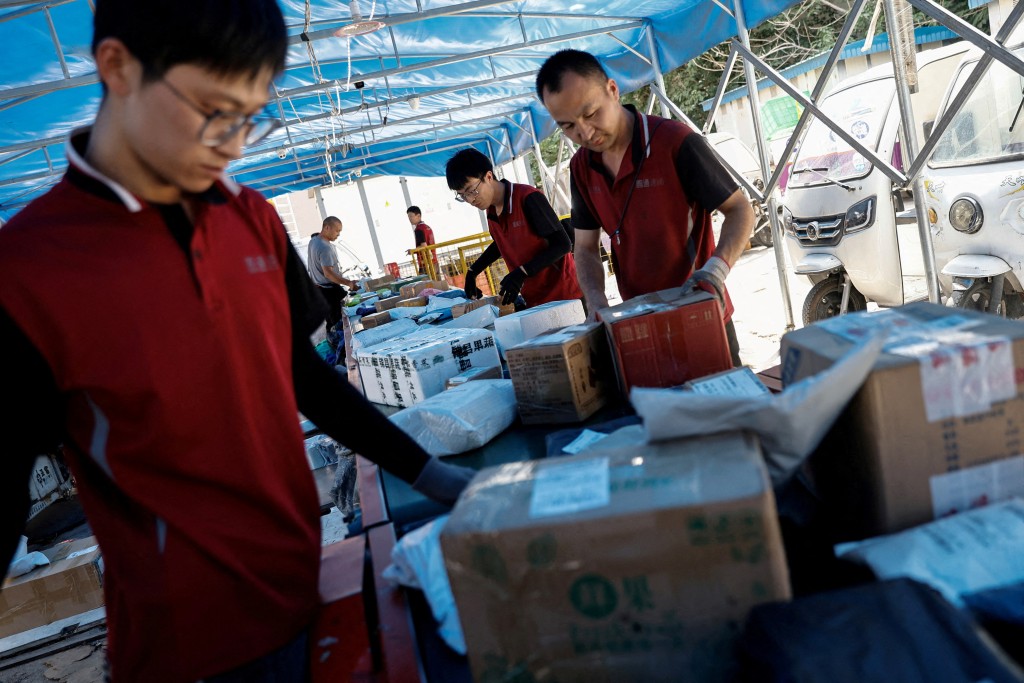
The company has built a network of over 700 warehouses in 89 cities, with 132,200 delivery personnel and 43,700 warehouse staff as of December. That makes JD easier than any other competitor to deliver groceries and daily goods to customers' homes amid the virus lockdown. Its revenue grew by 20.7 percent year-on-year to 146.2 billion yuan in the first quarter, with general merchandise revenues surging by 38.24 percent.
Thanks to better economies of scales, JD's gross profit margin also beat estimates, improving to 15.4 percent from around 14.5 percent in the past three years, as cost per delivery hit an "all-time low" in the first quarter given rising order volume amid the virus, according to chief financial officer Sidney Huang Xuande.
The 22-year-old firm achieved its first annual profit from continuing operation last year. But it reported a non-GAAP net profit of 3 billion yuan in the first quarter, down 9 percent from a year ago, that's only 13 percent of Alibaba's.
Maintaining profitability is not guaranteed, as the company has been investing heavily in technology and logistic infrastructure, it warns.
And it plans to use the net proceeds from IPO for key supply chain-based technology initiatives.
JD's ambition does not stop in the online retail space. It partnered with Tencent (0700) to launch online marketplace channel JingXi last year, directly confronting Pinduoduo. It is also building an "omni-channel" network to connect online and offline business. Its offline grocery store chain 7Fresh is competing with Alibaba's Freshippo. Furthermore, JD is working with American retail giant Walmart to integrate their platforms, strategic investment in electronic retailer Gome Retail (0493) to complement their supply chain.
The company has a significant advantage in speed delivery. JD-backed Dada Nexus, which just debuted in Nasdaq after US$320 million (HK$2.5 billion) IPO, has been cooperating with JD Logistics to provide on-demand and last-mile delivery services of groceries. Again, that is challenged by Alibaba, which launched one-hour delivery service in 16 major cities earlier this month and promised to cover nationwide by the end of this year.