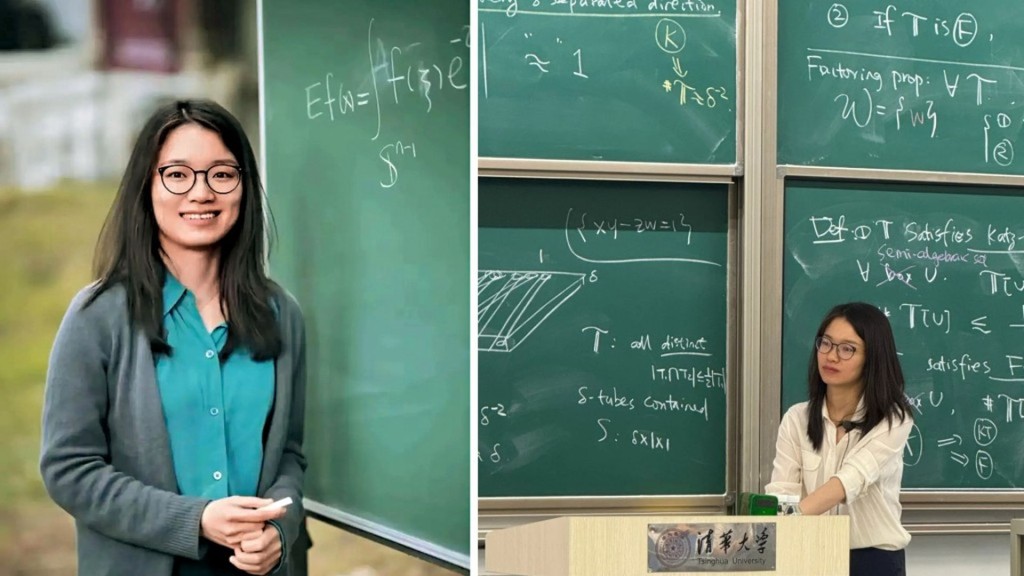
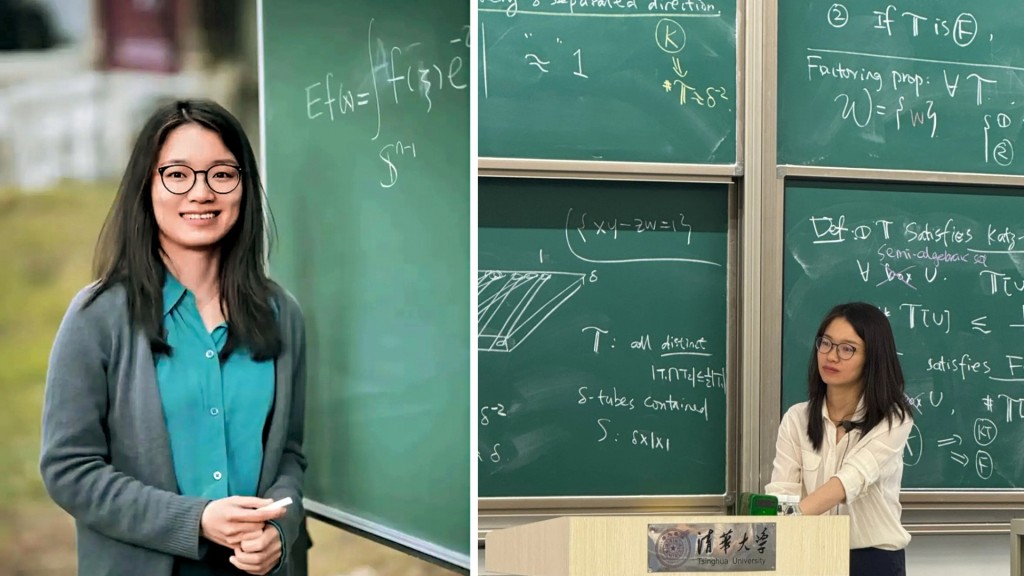
Wang Hong, a 35-year-old Chinese mathematician at New York University, secured two of mathematics' most prestigious awards within four days, solidifying her position as a top contender for the 2026 Fields Medal.
On April 18, the Breakthrough Prize Foundation announced Wang as the winner of its 2026 New Horizons in Mathematics Prize, a US$100,000 award for early-career researchers. She was recognised for contributions to harmonic analysis, partial differential equations and geometric measure theory, including work on the local smoothing conjecture, the Furstenberg set conjecture and the Kakeya conjecture.
Just four days earlier, on April 14, the Clay Mathematics Institute named Wang among four recipients of a 2026 Clay Research Award. The institute honoured the group for proving both the planar Furstenberg set conjecture and the three-dimensional Kakeya conjecture.
Wang's most significant breakthrough came in February 2025, when she and Joshua Zahl posted a 127-page paper resolving the three-dimensional Kakeya conjecture – a problem first posed by Japanese mathematician Soichi Kakeya in 1917 that remained unsolved for over a century. Terence Tao, the 2006 Fields Medalist, called the result "spectacular progress in geometric measure theory."
Born in Guilin, Guangxi, to schoolteacher parents, Wang skipped two primary school grades. At 16, she scored 653 on China's national college entrance exam and gained early admission to Peking University, later transferring to mathematics. She earned degrees from France's École Polytechnique and Paris-Sud University before completing a PhD at MIT in 2019.
Wang is now a professor at NYU's Courant Institute and a permanent professor at France's Institut des Hautes Études Scientifiques.
The 2026 Fields Medal will be awarded at the International Congress of Mathematicians in Philadelphia from July 23 to 30. Only two women have won the medal in its 90-year history.