With the rapid development of the city, do you recall those old places buried beneath?
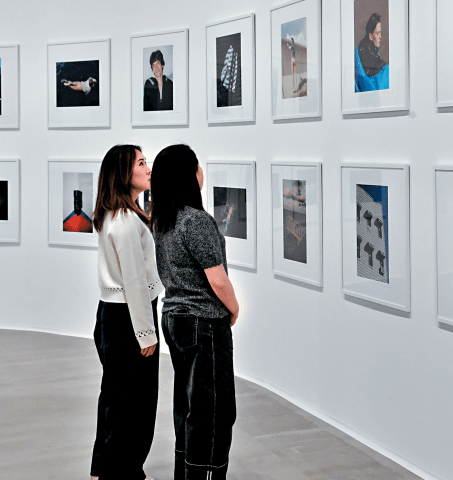
The Hong Kong Arts Development Council’s collective exhibition Marginal Notes at its new location in Wong Chuk Hang aims to provide visitors with a glimpse of the less-known aspects of this district.
Presenting the works of 12 local artists, Marginal Notes covers a wide range of mediums including textiles, installations, prints, digital art, paintings and sculptures.
Wong Chuk Hang is a fascinating district with a large amount of fertile land and a natural “isolation” due to its distance from Central. A source of food since the 1900s, it became a light industrial area following government development in the 1960s.
In the millennium, its low-cost industrial space attracted artists and galleries.
“This exhibition is divided into three parts that showcase artists’ responses to the district’s myths, their research and expressions on the historical transformations, and their insights on urban life developments,” said curator Kwok Ying.
Collaborative artwork Lost Landscape opens the exhibition. Visitors are invited to stitch along the lines drawn on canvas by Eastman Cheng based on historical maps.
“Maps are often the first medium to help you learn about an area. As you engage in drawing them, you will get a deeper understanding of how Wong Chuk Hang is changing,” she said.
A photographic and video installation created by Tang Kwong-san and Yuen Nga-chi goes deeper – Landscape of Consciousness shows the sea world under the Wong Chuk Hang nullah.
Inspired by Ocean Park and water elements in this area, Ocean Leung’s Multiple Colors and 99 Blues display shades of blue with nine screens showing nine to 99 seconds of video footage shot in Wong Chuk Hang.
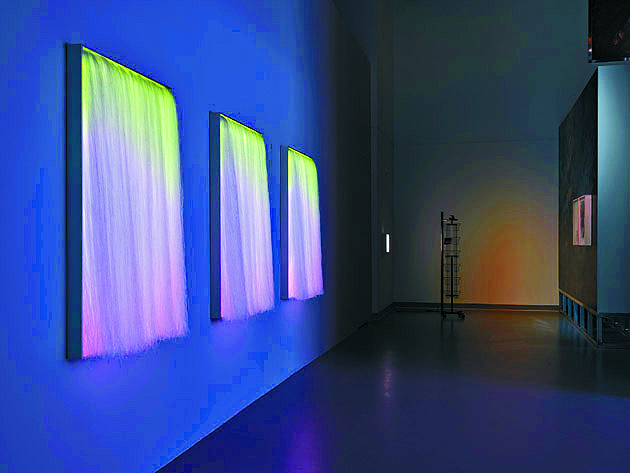
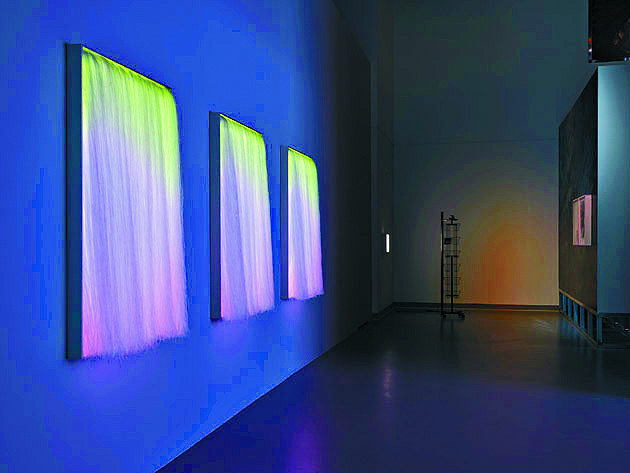
Other artists focus on the disappearance of natural landscape brought about by industrialization. Tap Chan’s Three Riddles (Apparitions) is an installation of windows made of colorful LED light boxes with nylon curtains. “This is a response to the urban environment, where the LED lights symbolize the fl ashy neon signs and the fl owing curtains represent a sense of dreamy feeling,” she said.
Echoing Chan’s work is Mark Chung’s Dead End 01, which presents glass windows of an industrial building emitting glaring light. The radiant illumination evokes a sense of artificiality and exclusion.
You may yearn for natural light after this.
However, you will find the largest floor-to-ceiling window in the exhibition space is blocked by plastic suction cups. Holders was created by Kong Chun-hei to express nostalgia for his hometown.
“The window reminds me of the Wong Chuk Hang public housing I grew up in,” he said. “Sunlight seen through these suckers are like projections of broken city memories.”
Mark Chung’s Stitch, a billboard from an old industrial building in Tin Wan, carries his reflection on history’s transformation. Wong Chuk Hang was once the site of many tobacco and ice factories. Despite being weathered by wind and sun, the billboard retains its text and graphics, preserving a relic for this area.
What happens to a place when those who lived there are no longer present? Margaret Chu’s Gather and Scatter, a representation of an old Chinese house made entirely out of cardboard, pays tribute to a district which was once called Hong Kong Village.
The experience is not contained in just the venue. Visitors can sign up for bus tours is provided by Lam Siu-wing, the only artist in Hong Kong who holds a bus license.
“Buses have been the main public transport in this district for more than 80 years,” he said. “That’s why I designed the routes of 73A to Stanley and 74 to Wan Chai, which goes past some of the most rewarding sights, stories and history of the district.”
Marginal Notes will be on until October 1 and tickets for Lam’s tours are available on hkadc-landmarksouth.hk.