Read More
British Prime Minister Boris Johnson has a plan for lifting one of Europe's strictest national lockdowns, but millions of Britons eager for a haircut or an evening out still face a long wait.
ADVERTISEMENT
SCROLL TO CONTINUE WITH CONTENT
Johnson aims to ease coronavirus restrictions in increments, starting by reopening schools in England on March 8. People will be allowed to meet one friend or relative for a chat or a picnic outdoors beginning the same day.
Three weeks later people will be able to meet outdoors in groups of up to six, and amateur outdoor sports can resume. But restaurants, pubs, gyms and hairdressers are likely to remain closed until at least April.
The measures apply to England. Scotland, Wales and Northern Ireland, though all have slightly different lockdown rules.
Britain has had Europe's deadliest coronavirus outbreak, with more than 120,000 deaths.
Faced with a dominant virus variant that scientists say is more transmissible and more deadly than the original one, the UK has spent much of the winter under clamps, including a ban on travel.
Hopes for a return to normality rest largely on a fast-moving inoculation program that has given more than 17.5 million people - a third of the United Kingdom's adult population - the first of two doses of vaccine.
The aim is to give every adult a shot by July 31 and to protect the over 50s and the medically vulnerable by giving them a first vaccine jab by April 15.
But authorities warn a return to social and economic life will be slow.
Johnson's Conservative government was accused of reopening the country too quickly after the first lockdown in the spring and of rejecting scientific advice before a short "circuit-breaker'' lockdown in the autumn.
It does not want to make the same mistakes again, though Johnson is under pressure from some Conservative lawmakers and business owners, who argue that restrictions should be lifted quickly to revive the economy.
Vaccines minister Nadhim Zahawi said issues include priority being given to returning children to schools. "The second priority is obviously allowing two people on March 8 to meet outside for a coffee to address some of the issues around loneliness."
The government says further easing will depend on vaccines proving effective at lowering hospitalizations and deaths, infection rates remaining low and no new virus variants emerging that throw plans into disarray.
A Scottish study released yesterday showed the vaccination program led to a sharp drop in hospitalizations.
Scientists from the University of Edinburgh, the University of Strathclyde and Public Health Scotland found that in the fourth week after an initial dose, the Pfizer-BioNTech vaccine reduced hospital admissions by as much as 85 percent and the Oxford-AstraZeneca vaccine by up to 94 percent.
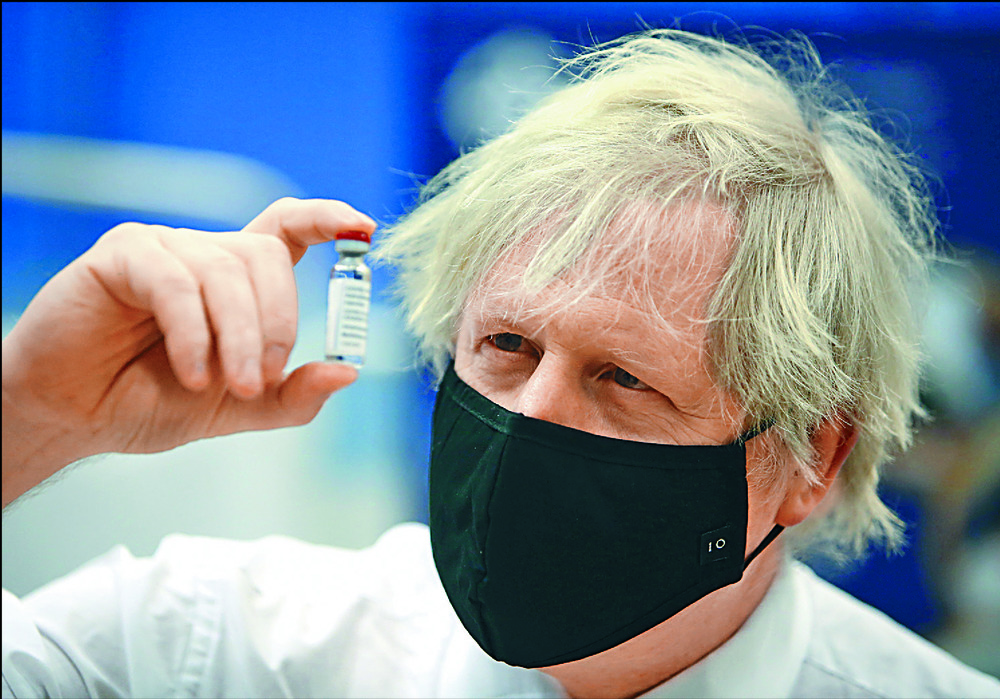
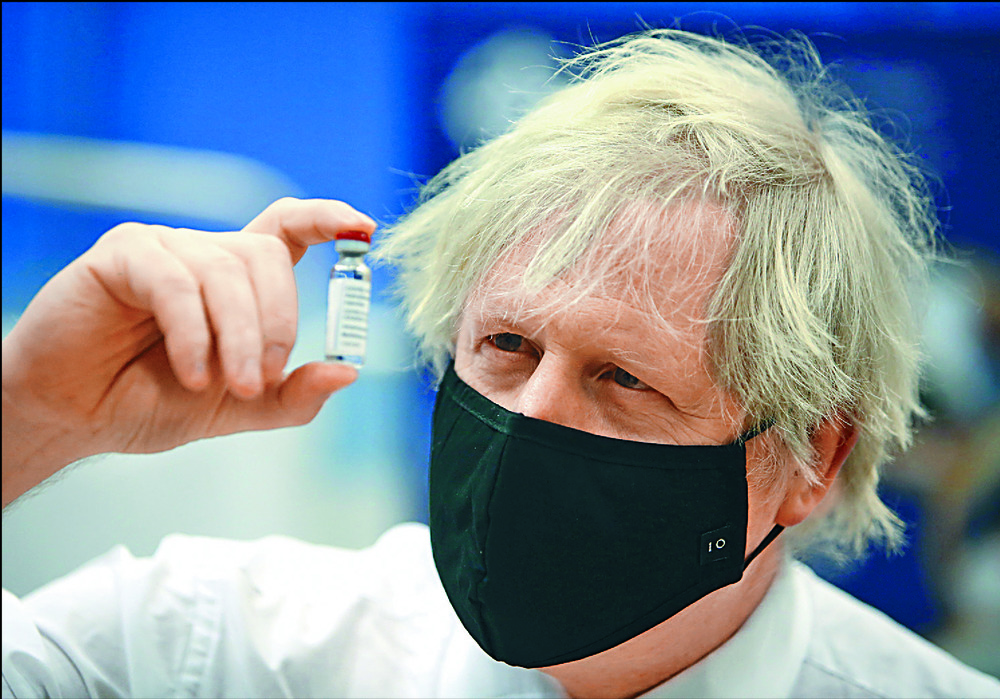
Boris Johnson aims to ease coronavirus restrictions in increments. REUTERS