Read More
Voters went to polls to cast ballots for new mayors in Seoul and Busan, South Korea's two biggest cities, on Wednesday in by-elections deemed a critical bellwether for next year's presidential contest, Yonhap reports.
ADVERTISEMENT
SCROLL TO CONTINUE WITH CONTENT
Voting began at 6:00 a.m. at 3,459 polling stations across the country and will last till 8:00p.m. Besides the two mayoral seats, 19 other regional public posts are up for grabs, including the county governor for Uiryeong in South Gyeongsang province and a ward office head in the southeastern city of Ulsan.
In Seoul, a total of 8.4 million voters are eligible to vote in the mayoral election while the Busan mayoral poll has slightly more than 2.9 million qualified voters.
The turnout rate for early voting for the by-elections, conducted from last Friday and Saturday, reached 20.54 percent, a record high for any by-election.
As of 9 a.m. Tuesday, the turnout rate was 6.2 percent, down 1.5 percentage points from the tally of the same time during the 2018 local elections. It is also lower than 8 percent of the April 15 general elections last year and 6.4 percent of the by-elections in 2019.
In the early morning, some voters were already waiting in line in front of a polling station in Sillim-dong, southern Seoul, to cast their ballots before going to work.
They stood one meter apart from each other to maintain social distancing and were seen using hand sanitizers placed at the station to protect against the coronavirus.
The mayoral elections, especially in Seoul which is home to nearly 10 million of the country's total 52 million population, are seen as definite harbingers of public opinion ahead of the presidential election set for March 2022.
The by-elections take place as President Moon Jae In and his ruling party have been grappling with public outrage and falling public support ratings over spiking housing prices.
A land speculation scandal involving public officials at LH, the state housing developer, which erupted about a month ahead, further pummeled public sentiment against the ruling bloc.
The main opposition People Power Party (PPP) has been harnessing the Moon government and the ruling Democratic Party (DP)'s real estate policy blunders to rally support for its election campaign to "pass judgment" against the ruling bloc.
The DP is also on weak moral standing as the two mayoral by-elections were called after the previous mayors -- Park Won-soon in Seoul and Oh Keo Don in Busan, both affiliated with the liberal party -- left the posts last year amid sexual harassment allegations.
Ex-mayor Park apparently took his own life in July last year and Oh stepped down from the Busan mayoral seat in April, both in the face of sexual harassment accusations raised by female subordinates.
The new mayors of the two cities will serve out the remaining 14 months of the former mayors' four-year terms.
The latest opinion polls, disclosed before the imposition of a ban on such polls' release for one week before election day, showed Oh Se Hoon, the PPP's Seoul mayoral candidate, leading DP rival Park Young-sun by a formidable margin of about 20 percentage points.
The opposition party's pre-election opinion poll dominance was pronounced in Busan as well, where PPP candidate Park Heong Joon was running well ahead of DP opponent Kim Young Choon.
Rough results of the elections are expected to start emerging around midnight Wednesday.
As the by-elections are held amid a wave of new infections in the country, health authorities urged voters to wear masks throughout their polling processes, except for identity checking purposes, and keep distance from other voters at polling stations.
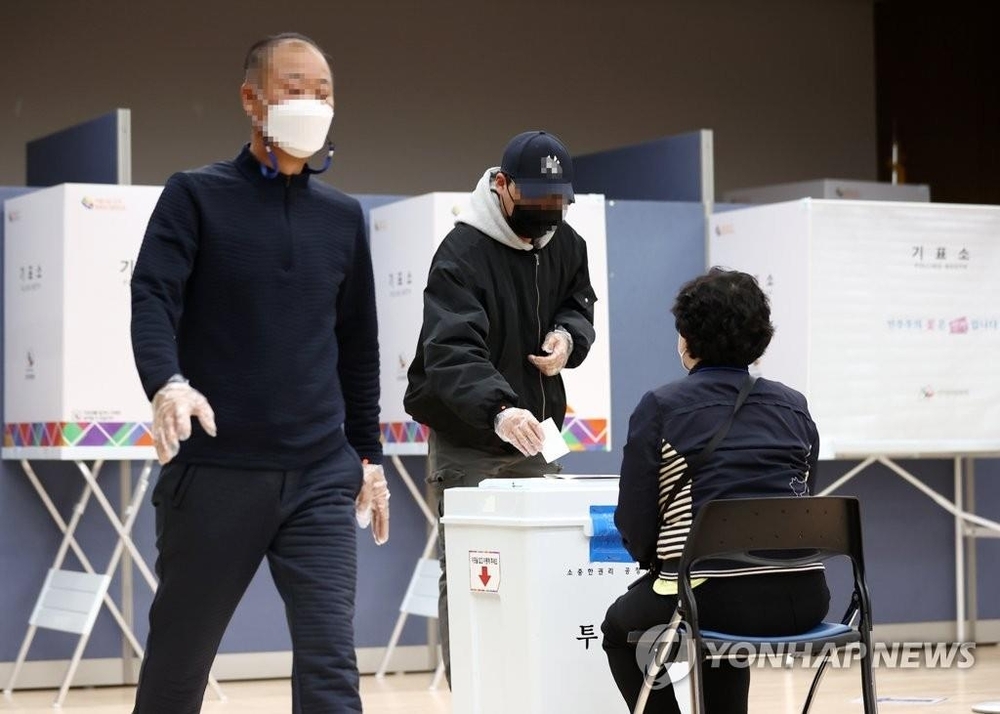
South Koreans cast their ballots to elect a new Seoul mayor at a polling station in western Seoul on April 7, 2021.