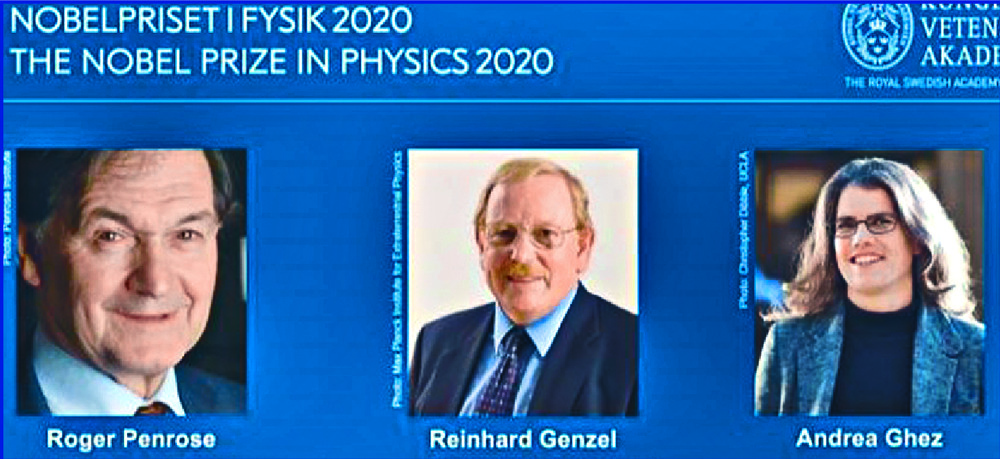
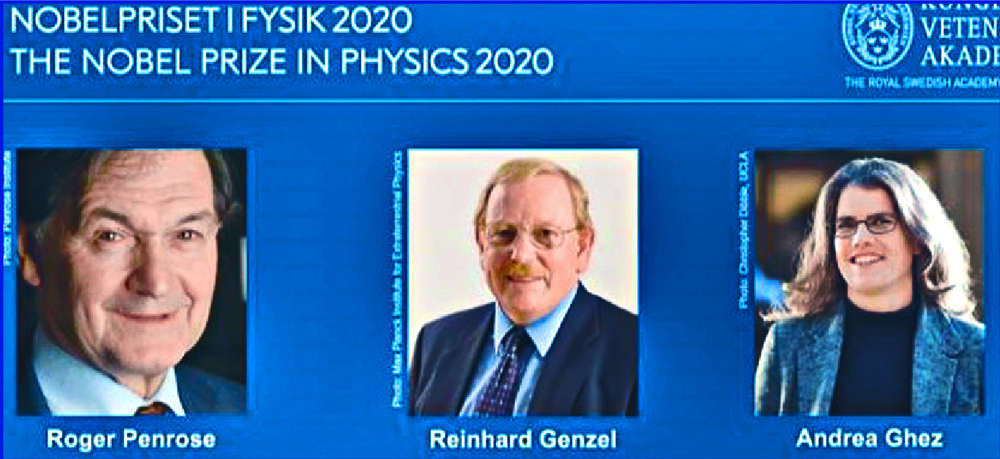
Roger Penrose of Britain, Reinhard Genzel of Germany and Andrea Ghez of the United States won the Nobel physics prize yesterday for their research on black holes.
The physicists were selected "for their discoveries about one of the most exotic phenomena in the universe, the black hole," the Nobel Committee said.
Penrose, 89, was honored for showing "that the general theory of relativity leads to the formation of black holes," while Genzel, 68, and Ghez, 55, were jointly awarded for discovering "that an invisible and extremely heavy object governs the orbits of stars at the center of our galaxy," the jury said.
Asked about the discovery, Ghez, who is just the fourth woman to receive the physics prize ever, said: "The first thing is doubt."
"You have to prove to yourself that what you are really seeing is what you think you are seeing," she said in a call with the committee.
"It's that feeling of being at the frontier of research when you have to always question what you are seeing."
Penrose used mathematical modeling to prove back in 1965 that black holes can form, becoming an entity from which nothing, not even light, may escape.
Genzel and Ghez have led research since the early 1990s, focusing on a region called Sagittarius A* at the center of the Milky Way.
Using the world's largest telescopes, they discovered an extremely heavy, invisible object - around four million times greater than the Sun's mass - that pulls on surrounding stars, giving our galaxy its characteristic swirl.
The trio will share the Nobel prize sum of 10 million Swedish kronor (HK$8.7 million), with half going to Penrose and the other half jointly to Genzel and Ghez.
They would normally receive their prize at a formal ceremony in Stockholm on December 10, but the in-person ceremony has been canceled this year and replaced with a televised ceremony where laureates receive the awards in their home countries.