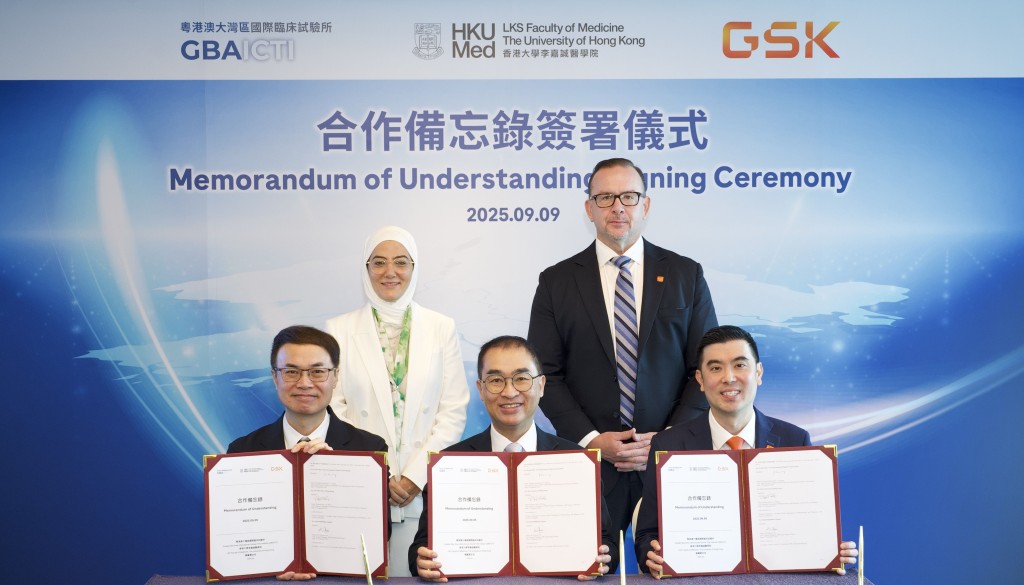
A tripartite Memorandum of Understanding (MOU) was signed by the Greater Bay Area International Clinical Trial Institute (GBAICTI), the Department of Pharmacology and Pharmacy, LKS Faculty of Medicine, The University of Hong Kong (HKUMed), and GlaxoSmithKline (GSK). The MOU aims to develop Hong Kong into a leading region and international hub for real-world studies (RWS), and to actively explore the use of real-world data to support drug registration and listing in mainland China.
This collaboration will begin in Hong Kong by launching high-quality research and sharing scientific findings. It will then gradually expand to other Greater Bay Area cities, such as Macau and Shenzhen, to promote the use of real-world data for optimizing treatment protocols and enhancing the efficiency of healthcare systems.
In addition to talent cultivation and organising local and international academic exchanges, this collaboration will also develop and promote new methods for real-world studies. Professor Bernard Cheung Man-yung, Chief Executive Officer of GBAICTI, stated that they are committed to conducting clinical research at the highest level and he hopes to accelerate the translation of innovative local research findings into concrete and feasible medical solutions to benefit more patients. Regarding the importance of the real-world data, Professor Cheung explained that when a new drug is being tested, it goes through Phase I, II, and III clinical trials. If the data from all three phases prove the drug is effective, it is approved for use. However, some rare side effects or newly discovered benefits might only be found after the drug has been approved and is in use, which is where real-world data (RWD) becomes particularly helpful. In recent years, the importance of real-world data has gained widespread international recognition. With advanced technology, this data can now be analyzed by computers, allowing drug regulatory authorities worldwide to use RWD to make informed decisions on drug regulation and approval.
Professor Ian Chi-Kei Wong, Department of Pharmacology and Pharmacy, LKS Faculty of Medicine, University of Hong Kong, added, “Based on the strong research foundation of the Department of Pharmacology and Pharmacy at the LKS Faculty of Medicine, we are committed to co-developing and executing high-impact real-world studies. Our first-phase plan will explore the long-term benefits of the herpes zoster (shingles) vaccine, including its effects on cardiovascular diseases and cognitive impairment, using data from certain healthcare settings in the Greater Bay Area.” The proposed method for executing the first-phase plan involves HKU acting as a coordinator to develop analytical programs. The GBAICTI will then work with collaborators in the Greater Bay Area to execute these programs locally without transferring personal data. Once the data is ready, the collaborators will send the results to HKU for combination, and to GSK to review the feasibility of the methods and advise on improvements. Professor Wong emphasized that this study will be conducted in phases. The first phase will be a one-year pilot to establish the methodology, determine how to conduct the study, and recruit centers across the Greater Bay Area to execute the research. However, the long-term benefits of the study will only become evident after approximately three to four years.
Mike Crichton, Senior Vice President of GSK International, also stated that with continuous advancements in science and technology, we have the ability to prevent diseases and alter their course more quickly and effectively. Leveraging their expertise, experience, and vision in vaccines and various specialty areas, this innovative collaboration was launched to evaluate the long-term benefits of adult vaccines and explore the development of innovative treatments.