Our world is changing rapidly. The increasing emphasis on STEM has created a growing demand for STEM-related job positions and curricula. In response to these evolving market needs and the rising demand for specific job roles, The Chinese University of Hong Kong (CUHK) has introduced the Learning Design and Technology (LDTE) programme to offer students more diverse options for exploring their interests.
The Learning Design and Technology (LDTE) programme
With the growing demand for talent in STEM, AI, and education, the Learning Design and Technology (LDTE) programme launched at CUHK since 2022 is designed to equip students with a diverse range of skills and knowledge, preparing them for careers in digital learning, STEM education, and educational technology.
The programme offers a well-rounded multidisciplinary curriculum, enabling students to explore courses across engineering, education, and the sciences, while maintaining a balanced focus on each area.
Professor Chiu Kin-fung, LDTE Programme Coordinator, Faculty of Education emphasizes that one of the programme’s greatest advantages is that “students will not only develop expertise in one discipline but will also become professionals capable of integrating and applying knowledge from all three areas.”
Another key feature of the programme is the internship opportunity available in the third and fourth years, allowing students to gain practical experience in settings such as schools, NGOs, and EdTech companies.
Emphasizing on innovation and research, the programme encourages students to evaluate educational technologies and apply research platforms to develop new ideas in their fields. Students will glean knowledge on diverse topics from different faculties, such as computer programming, robot development, educational design research, as well as general physics and chemistry.
Upon graduation, students will possess the necessary qualifications and knowledge to pursue careers such as learning technology specialists, STEM education designers, educational data analysts, e-learning consultants, or trainers. Additionally, those interested in teaching can articulate with the teacher professional programmes to be science or technology educators.
Dr Tong Shiu-sing from the Faculty of Science shares that his teaching philosophy is centered on hands-on, project-based learning. He believes that while theoretical knowledge is essential, the focus should be on applying this knowledge to practical problems. Tong emphasizes the importance of strong presentation skills, which enable students to communicate complex concepts effectively. “I always encourage my students to think like reporters, breaking down intricate ideas into simple, digestible messages for better understanding,” he explains.
To ensure students are career-ready upon graduation, the programme integrates real-world applications into its curriculum. “It’s essential to connect theories with real case studies,” says Professor Li Ling-fei from the Faculty of Engineering. He emphasizes the importance of relating theoretical concepts to current events and incidents in the world today.
Some courses also include weekly lab sessions where students can apply theoretical knowledge to practical scenarios. Additionally, the programme regularly consults with industry professionals to keep the curriculum aligned with market demands. Graduate feedback is also gathered to facilitate continuous improvement of the programme.
Olif, a second-year student in the LDTE programme, shares the specific courses she particularly enjoys during her studies. “In my first year, I thoroughly enjoyed a course named ‘Introduction to Learning Sciences,’ which deepened my understanding of how the brain works. The professor introduced us to various theories, and this knowledge significantly enhanced my skills as an instructional designer.” In her second term, she took a course on instructional design, where a key assignment involved creating a semester-long lesson plan as if she were a teacher. “This project helped me think critically about how to structure learning for future students and highlighted the importance of effectively integrating educational technologies.”
Olif applied for this programme because, since high school, she has been interested in both teaching and science-related subjects. “Although I was unsure about becoming a teacher, this programme offers me the opportunity to explore the intersecting fields of science, engineering, and education simultaneously,” she points out.
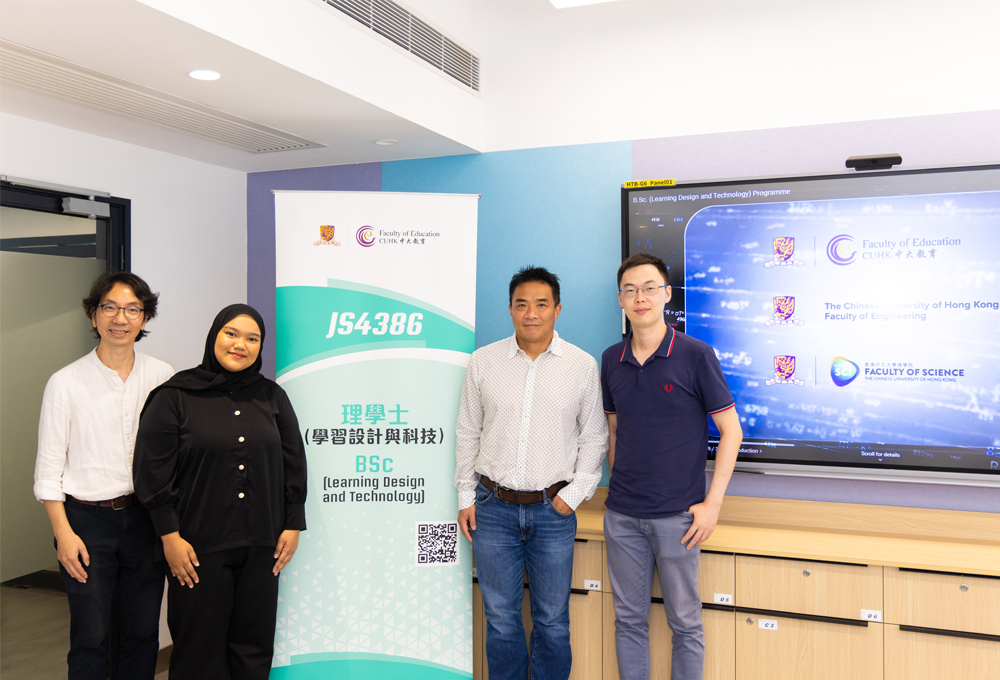
(From left) Dr. Tong Shiu-sing from the Faculty of Science; Mazaya, Naura Olif, LDTE Year 2 student; Professor Chiu Kin-fung, LDTE Programme Coordinator, Faculty of Education; Professor Li Ling-fei from the Faculty of Engineering.