The tower crane is probably the most vital piece of equipment for building construction. Erected on site before building construction starts, they stand looking like a giant robot to help to transport materials to each location. They gradually climb taller as the construction work gets to the higher floors and could be one of the last pieces of equipment to be removed after the main building structure and facade have been put in place.
Traditionally, these cranes are operated from the control cabs which are usually located at the shorter end of the jib, near the balance weights. Although this position offers the operator a vantage point to oversee the lifting operation, it has many disadvantages.
Firstly, the high position and the angle of view vis-a-vis the objects being lifted invariably result in parallax errors, which requires a skillful crane operator to adjust to allow the lifting hook to accurately pick up the load, lift, and swing it to the delivery position, with the operator’s vision often blocked by some parts of the building structure already in place.
Secondly, the crane operator needs to climb up through a cat ladder integral with the tower structure all the way from ground level to the cab located up to 100 meters at every shift. It could take 15 minutes to reach. The operator therefore will be reluctant to get back to the ground during his shift, often carrying his meal box and containers to carry human refuse. The condition is definitely not hygienic nor comfortable.
This is why tower crane operators attract high wages and are often short in availability.
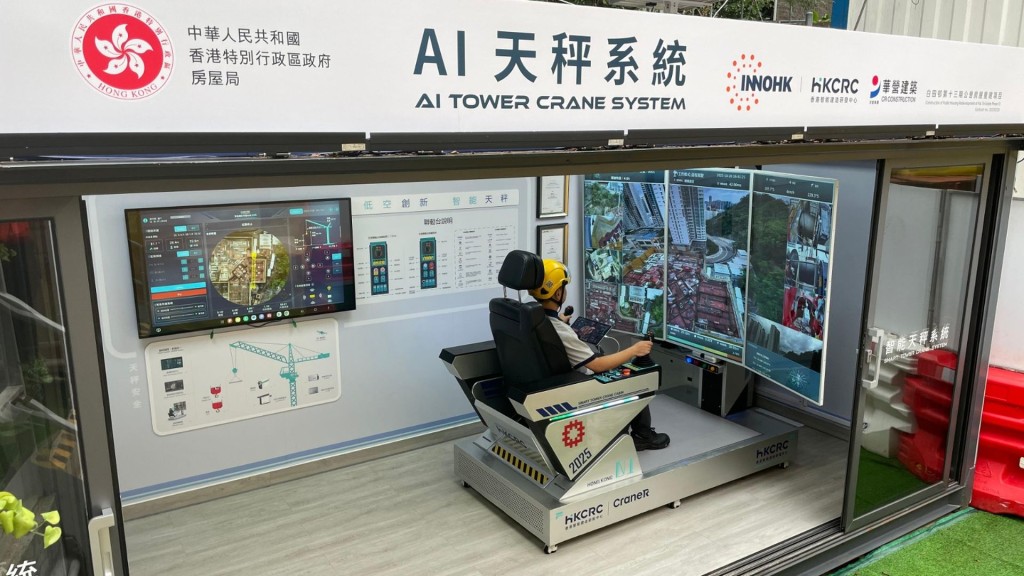
The Housing Department has recently applied AI technology to tower cranes, with groundbreaking features that significantly enhance operational capabilities, dispensing with the above-mentioned problems, to ensure a safer and more congenial working environment for operators.
One of the striking features is the remote-control system, which allows operators to control the crane’s movements in an air-conditioned control room at ground level remote from the crane. The system is equipped with multiple cameras that offer clear views from different angles. This enhanced visibility not only ensures operational accuracy but also reduces risks. The system also provides real-time alerts to potential hazards.
Another remarkable feature is the AI Stable Hook, which utilizes sophisticated algorithms and automatic controls to leverage machine learning to stabilize the hook from swaying during lifting operations. The technology analyzes the movement patterns of the load and actively compensates for any swaying or instability. This is particularly useful to less experienced operators, as it allows them to perform lifting tasks with greater confidence and precision.
It results in safer and more efficient lifting operations without the need for highly skilled operators, minimizing the risks of accidents and improving overall productivity on site. It also facilitates the changing of operators whenever required with no downtime.
The AI Stable Hook also provides safety monitoring. The system is designed to automatically identify the environment surrounding the hook, pinpointing the presence of workers, machinery, and construction equipment in the vicinity. When potential hazards are detected, the system actively alerts the operator, providing ample time for intervention and correction. In critical situations, it can initiate an automatic stop function to prevent accidents from occurring, significantly enhancing safety.
The AI Assisted Path Planning feature is even more of a game-changer for tower crane operation. Equipped with lidar, satellite positioning, and multi-camera viewing capabilities, it can automatically plan routes and detect obstacles to program the safest and most efficient lifting path, again reducing the need for highly skilled operators all the time. The operator’s role becomes that of a supervisor, selecting automated operation, but with the ability to deactivate the automatic mode when necessary.
By minimizing the risks of irregular operations commonly caused by human error, the AI control system not only ensures safety, but enhances efficiency. Widespread application of artificial intelligence for tower crane control also provides a larger bank of data to allow continuous improvements, laying a firm foundation for further automation of lifting activities in the future.
It is gratifying to see technology increasingly applied to construction activities. It improves efficiency and enhances safety, and thereby helps to reduce costs and construction time. The additional safety assurances provided by AI technology will be a major step in reducing site casualties.
This transformation of worksite construction led by the HD – from an old-fashioned, traditional trade to one infused with innovative technology – is a heartening development. We hope this will attract the younger generation to engage in construction work, as it will no longer carry the image of a dirty, dangerous, and uncomfortable environment.
Veteran engineer Edmund Leung Kwong-ho casts an expert eye over features of modern life