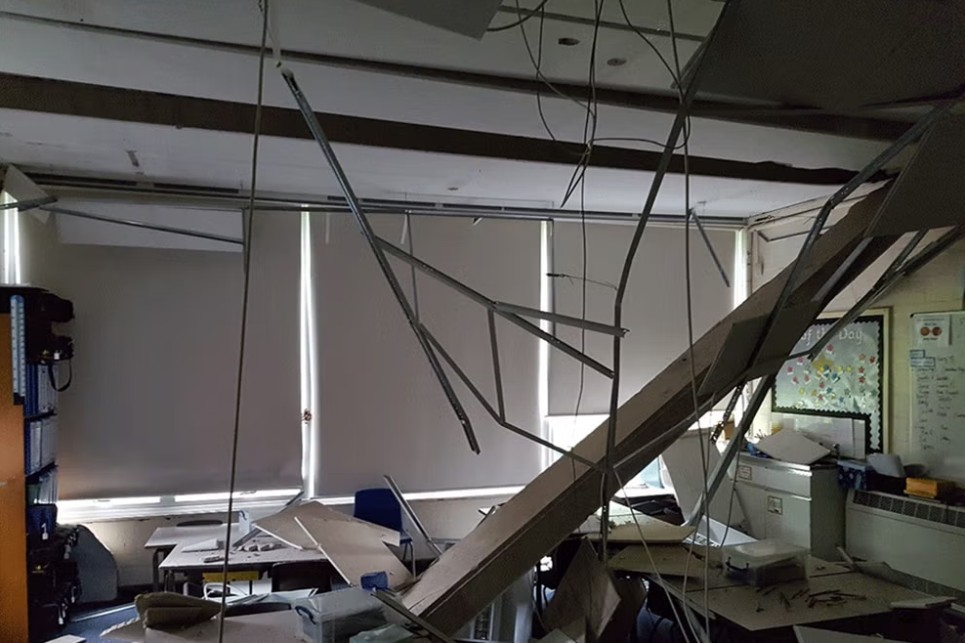
Last month, there were widespread worries and frustrations among UK children and parents about sudden closures of school campuses due to deterioration of reinforced autoclaved aerated concrete.
This is a safety measure imposed on school buildings to prevent injuries from potential collapsing roofs.
RAAC is a material commonly used in buildings for flat roofs that is adopted mainly due to its low cost, light weight and superior thermal insulation quality.
At the time it was applied to UK schools and hospitals, it was meant to be an innovation and replaced dangerous asbestos materials, hence its extensive use from around 1950 to 1990.
Unfortunately, it has a limited life span, requiring replacement in 30 years, as otherwise the risks of failure leading to collapsed roofs become significant.
To understand the problem, let us examine how RAAC is made.
Like ordinary concrete, cement is mixed with sand and then allowed to set.
The difference is that aluminum filings are thrown into the mix during construction. The chemical reaction of aluminum with the lime in the concrete creates hydrogen, producing tiny air pockets in the concrete blocks through aeration.
The blocks or slabs are then cured in a pressurized oven to make a novel building material with superior features favored in that era.
RAAC was therefore extensively used in flat roofs as slabs and beams for single-story municipal buildings, mainly hospitals and schools.
But in time, rain and effect of solar heat allows moisture to get into the concrete and corrode the steel reinforcements.
The problem may also affect normal reinforced concrete, but in this case, its corroded steel component expands with rust and causes spalling, which is easily spotted and allows repairs to be done before failure occurs.
But as RAAC contains air pockets, it often absorbs or hides the spalling effect and deterioration can occur for a long time before it becomes visible, and without warning, a roof or beam can fail suddenly.
Thus the urgency in declaring these buildings unsafe and taking them out of service for inspections and repair.
Fortunately for Hong Kong, we do not use RAAC, probably because of its lower structural strength and poor bonding between concrete and steel reinforcements brought about by air pockets.
A spate of severe concrete spalling in buildings built in the 1970s was mainly due to the use of sea sand in concrete mix by unscrupulous builders. But most of these buildings have since been dismantled or effectively repaired.
Engineers often try out innovative materials and building methods for better building efficiency and lower costs. They reduce construction time and, in most cases, improve quality or durability.
The extensive use of steel structures and curtain walls in commercial buildings shortens construction time, and recent application of modular construction are brilliant examples of innovation.
But such ideas have usually been subject to extensive prototype tests and been carefully examined by the Buildings Department before approval.
We may sometimes feel these stringent procedures curtail rapid development and use of modern technology and materials, but we should be thankful they have ensured a safe living environment.
The ultimate proof is that, so far, we have not seen many building collapses in Hong Kong, showing we might have struck a fine balance between innovation and conservative control.
Veteran engineer Edmund Leung Kwong-ho casts an expert eye over features of modern life
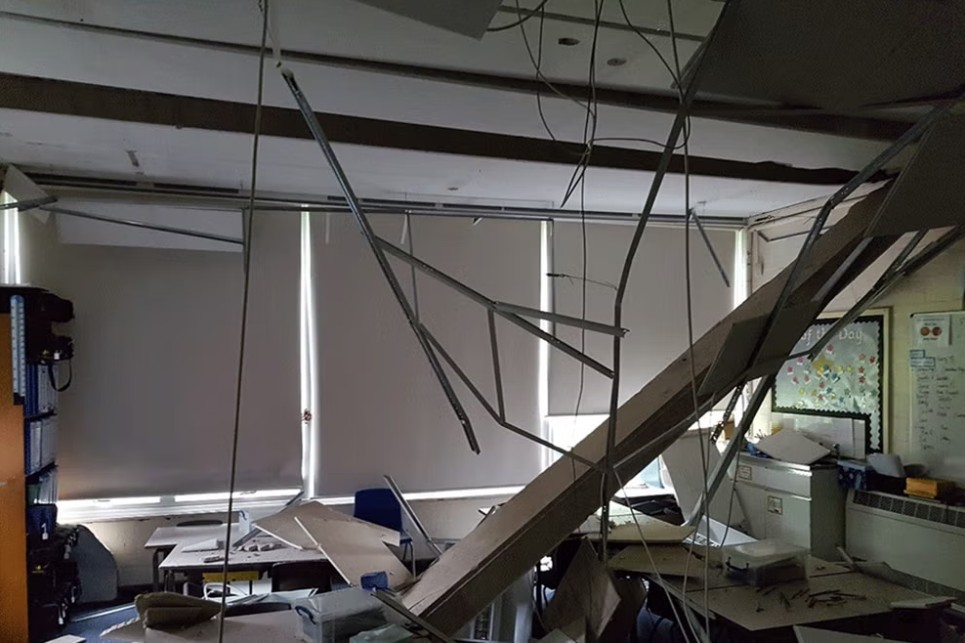
The danger from the collapse of a roof built with reinforced autoclaved aerated concrete is obvious at a school in Kent.