The Air Accident Investigation Authority (AAIA) released a preliminary report on Tuesday concerning the fatal cargo plane crash at Hong Kong International Airport last month, which was categorized as an “accident.”
The report stated that the weather conditions were suitable for aircraft operation at the time of the accident, while available evidence is consistent with a normal flight up until the runway excursion.
Visibility was also good, which was 10 km or more. All relevant communications, navigation, and surveillance and air traffic control equipment/facilities were serviceable and operating normally.
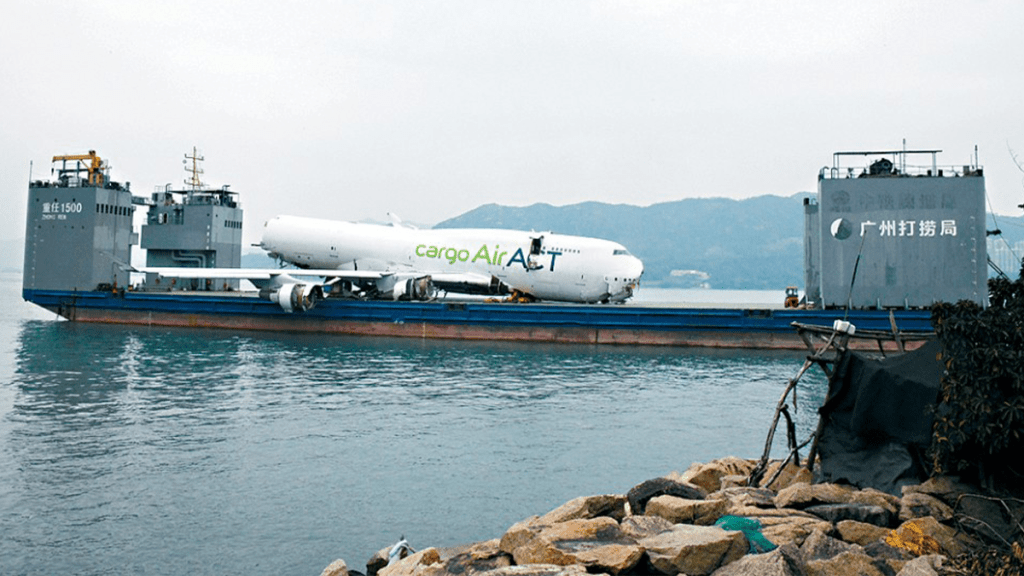
The investigation noted that at approximately 03.52 am on October 20, an ACT Airlines Boeing 747-481 BDSF freighter aircraft operating on behalf of Emirates SkyCargo landed on Runway 07L. The co-pilot was the Pilot Flying, and the captain was the Pilot Monitoring.
After landing, while the aircraft was decelerating, an AUTOBRAKES alert appeared on the Engine Indication and Crew Alerting System (EICAS) display in the cockpit. The captain then took over control from the co-pilot.
The aircraft veered to the left, resulting in a runway excursion near Taxiway C6. It subsequently collided with a stationary security vehicle positioned at a designated observation point along the airport’s perimeter road.
The impact caused the ground vehicle to enter the sea, and the aircraft continued through the perimeter fence and also entered the sea, where it came to rest.
All four crew members survived the accident. The two security staff in the ground vehicle perished.
As the investigation progresses, the AAIA will collect further data and conduct a detailed analysis. A key focus will be the reason the Number 4 engine thrust lever was found in the full forward thrust position.
The thrust lever panel and related modules have been disassembled and sent to the aircraft manufacturer for detailed analysis to determine whether any technical issues exist in the circuitry or mechanical systems.
The AAIA will also investigate other technical aspects, including the aircraft’s speed, system status, operational control at the time of the accident, and the condition and performance of the aircraft engines, landing gear, and associated brake systems.
Despite the fact that investigations of a similar scale typically require several years, the AAIA aims to complete a comprehensive report within one year.






![A person holds a Palestinian flag during the annual Quds Day (Jerusalem Day) in Cape Town, South Africa on April 14, 2023 [File: Reuters/Esa Alexander]](https://image.hkstandard.com.hk/f/1024p0/0x0/100/none/0d42c4ddc55e4c1fe22596f58d5cbcca/2025-11/i_10.jpg)