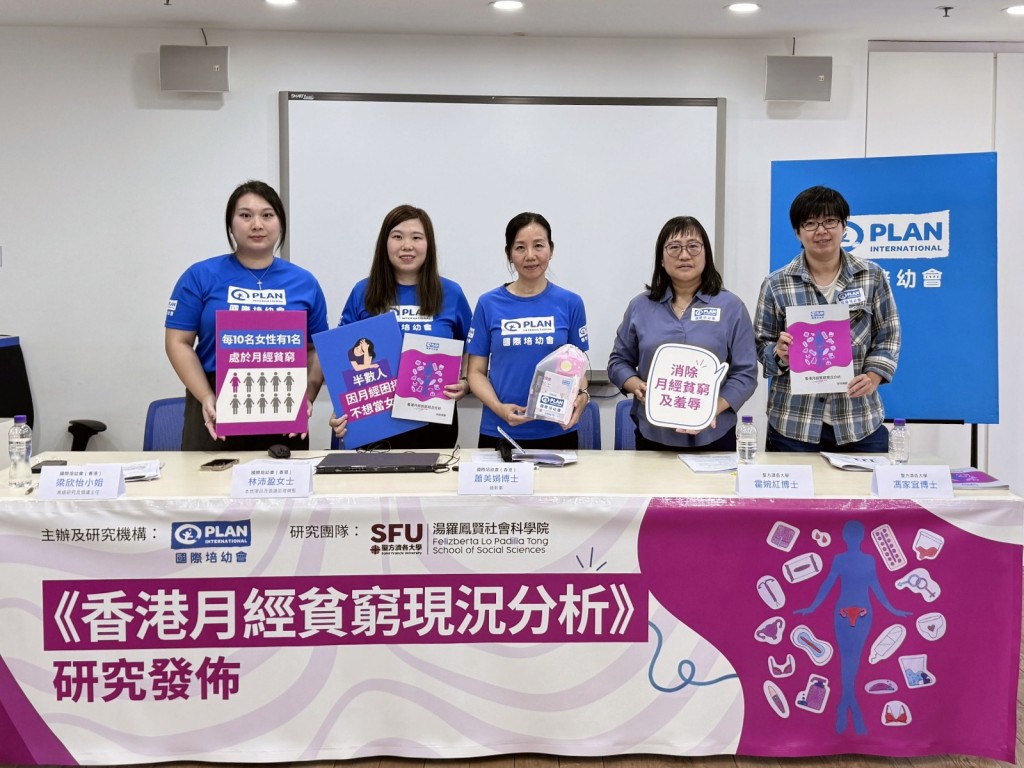
A study on period poverty of Hong Kong revealed that one in ten respondents has difficulty affording or obtaining menstrual products due to financial constraints, which extrapolates to a population of approximately 236,000 women aged 12 to 54 in Hong Kong living in period poverty.
According to the definition by the UN Women, period poverty refers to the lack of access to menstrual products, basic facilities, and accurate information.
The study, jointly conducted by the Plan International Hong Kong and Saint Francis University and titled “Situation Analysis Study on Period Poverty in Hong Kong,” gathered opinions from 1,000 women aged 12 to 54 in Hong Kong from August to September.
It was found that over 27 percent of women and nearly 30 percent of girls and young women have had to reduce their use of related sanitary products due to economic pressure, having experienced some form of period poverty.
The survey found that about a quarter of respondents change their menstrual products only three times a day, far below the recommended standard.
Doris Fok and Fung Ka Yi, Assistant Professors from the School of Social Science of Saint Francis University, pointed out that, according to the recommendations by the Hong Kong Family Planning Association, sanitary pads should be changed at least every four hours, amounting to no fewer than six changes a day to maintain basic hygiene and reduce infection risks.
further revealed that many grassroots girls reduce their consumption of products to save costs, often resorting to methods like “frequently going to the bathroom to release the blood” or “adding tissue to sanitary pads” to extend usage. These coping strategies born out of economic pressure may alleviate financial burden temporarily but could increase health risks, highlighting the deep impact of period poverty on women’s hygiene behaviors and health management.
The survey also indicates that period shaming is prevalent in Hong Kong, with nearly two-thirds of women having heard or experienced negative comments; nearly half of respondents expressed that, due to the physical and mental distress caused by menstruation, they would “rather not be a woman.”
Among them, the situation of period shaming is most severe in the 12 to 24 age group, with 34.8 percent of respondents under 18 feeling embarrassed or ashamed about menstruation, the highest proportion across all age groups.
An underprivileged woman shared her day-to-day difficulties experiencing period poverty. “The monthly cost of sanitary products is overwhelming for us,” she explained, “I only purchase them when they are on sale. During my period, I usually stay at home so that I can visit the bathroom more often to release the blood and reduce the need for frequent pad changes. However, my young daughter doesn’t yet understand how to conserve, and her higher usage only deepens our financial burden.”
Jessica Lam, Assistant Director, Hong Kong Program and Advocacy recommended to include menstrual products in CSSA and other poverty alleviation policies to provide ongoing support.
Also, it is suggested to enhance public awareness of menstrual health services provided by the newly established “Women Wellness Satellites” through targeted promotion, and conduct regular user data analysis to monitor menstrual health in Hong Kong, to guide future strategies and educational initiatives.
Lam emphasized the importance of education, “To alleviate the pressures and discrimination caused by period shaming, stigma, and cultural taboos surrounding menstruation, we recommend integrating menstrual health into school curricula, covering physiological, psychological, stigma, discomfort management, and societal issues like period poverty.”
Plan International Hong Kong targets to implement a one-year menstrual product support program, distributing sanitary products quarterly to 500 girls under 18 who face financial difficulties. The fundraising goal is HK$500,000, aimed at alleviating the economic burden on vulnerable girls and serving as a starting point for long-term advocacy, hoping to alleviate period poverty among local girls and women.