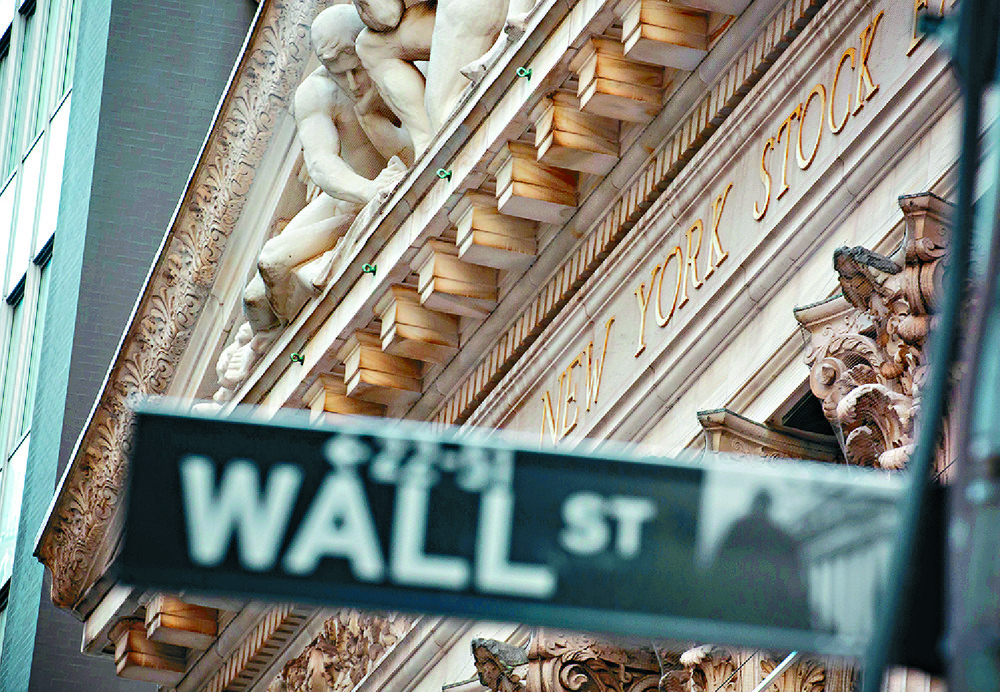
After a standout 2024, US stocks are tipped to continue their bull run in 2025 and outperform the rest of the world though some analysts warn that high valuations could trigger a correction right out of the blue.
And while Hong Kong and Chinese stocks may lag amid US protectionist threats and challenges to their economies, there are opportunities to be found in chips, tech and undervalued stocks.
Other hot bets include gold and cryptocurrency darling bitcoin, both of which set records last year, with the latter breaking past the US$100,000 (HK$780,000) mark for the first time ever.
TRUMP THREAT
The S&P 500 gained more than 23 percent in 2024 after rising 24 percent in 2023 and analysts expect the index to rise by around 10 percent in 2025 and offer returns of 8 to 10 percent.
But investors must be wary of trade protectionism and the US Federal Reserve's monetary policy.
Incoming US President Donald Trump's plan for higher tariffs and stricter immigration could impact businesses, dampen demand and trigger inflation.
Analysts expect the US economy will continue to grow, and corporate earnings are projected to see further expansion, but they say valuations of US stocks are above historical averages, with the bull market primarily driven by the Magnificent Seven tech giants - Apple, Nvidia, Microsoft, Amazon, Alphabet, Meta and Tesla.
The say US stocks will sustain gains in the first quarter but may face volatility in the second quarter as risks from Trump's policies and a potential downturn emerge.
Bank of America strategist Michael Hartnett prefers US small-capitalization stocks as they are well-positioned for gains due to the inflationary effects of tariffs, immigration curbs and tax cuts.
Alex KY Wong Asset Management's founder Alex Wong Kwok-ying believes the AI theme will continue to bolster the tech sector.
For conservative investors, he recommends Google owner Alphabet as it is relatively undervalued compared to its peers.
Meanwhile, if US bond yields rise to 5 percent it would present a good buying opportunity, but disorderly increases in yields pose the greatest threat to stocks, Hartnett says.
However, Pacific Investment Management is bearish on US long-term Treasury bonds due to a potential worsening of the US deficit.
GREENBACK AND GOLD SHINE
The greenback is expected to continue to strengthen in 2025, after the US Dollar Index yearly rose by about 7 percent in 2024, the largest increase in nine years.
Craig Chan, global head of FX strategy at Nomura Securities, anticipates the index could rise by more than 3 percent in the first half of 2025 and currencies outside of the US dollar depreciate on the back of Trump's tariffs.
Hartnett also warns that Trump's "America First" mantra could trigger a second wave of inflation forcing the Fed to raise interest rates.
He recommends increasing allocations in gold and commodities and advises buying the precious metal if it falls below US$2,500 a ounce.
Spot gold has risen about 30 percent over the past year and peaked at a record US$2,790.1 in October. It is currently trading at US$2,640.
Wall Street banks Citi, Goldman Sachs and Bank of America expect gold to hit US$3,000 this year. Citi targets gold at US$2,800 in three months and US$3,000 within six to 12 months.
When it comes to the yuan, Chan projects the US dollar to reach 7.6 against the offshore yuan by the second quarter of 2025, as China's foreign direct investment has a significant deficit and the corporate sector may face negative developments if US tariffs are raised, with exporters hoarding US dollars and importers increasing demand.
Analysts expect China's economic growth target for 2025 to remain at 5 percent, but actual growth will slower around 4 percent.
JP Morgan estimates that Trump will announce tariffs on Chinese goods in the first quarter and implement them in the second quarter, potentially dragging down China's gross domestic product by around 2 percent for the year.
The imposition of tariffs is expected to negatively impact the GDP of the US, with Canada, China, Mexico, South Korea and Germany being the most affected, and the full impact on the global economy expected to be felt by 2026, according to Fitch.
Investment banks view Chinese stocks as a flexible option in their diversification strategies, as it is one of the most undervalued stock markets globally.
Futu Securities chief analyst Arnold Tam Chi-lok believes the correlation between Chinese and US assets is likely to be low amid geopolitical tensions, and suggests keeping an eye on Hong Kong stocks, US stocks and cryptocurrency assets to diversify risk.
HONG KONG CHOICES
For Hong Kong stocks, which ended a four-year losing streak with a gain of 18 percent in 2024, Tam recommended both tech and consumer sectors, as they offer stable cash flows and reasonable valuations.
He expects bitcoin and ethereum to dominate the crypto space, with bitcoin - which skyrocketed 150 percent in 2024 - targeting US$122,000 in the medium to long term.
Hartnett, too, favors crypto and undervalued China stocks, particularly those related to tech.
CMB International recommends companies with mature businesses and development potential in the Internet sector such as Tencent (0700), NetEase (9999), Alibaba (9988) and Meituan (3690).
The bank also highlights stocks with rapidly growing earnings that are already largely priced in, where valuation adjustments may offer opportunities such as Trip.com (9961), Kuaishou Technology (1024) and New Oriental Education & Technology (9901).
Meanwhile, it maintains an 'outperform' rating for the mainland semiconductor industry.
The new energy vehicle sector saw solid growth in 2024 but price wars could impact profits and gross margins, says Everbright Securities International strategist Kenny Ng Lai-yin.
He believes the sector's high-growth phase has passed and funds may flow toward other themes and automakers that manufacture both petrol and electric cars.
He recommends high-performance tech, large insurers, metal assets and high-dividend stocks, and his choices are Ping An Insurance (2318), AIA (1299), Jiangxi Copper (0358), Zijin Mining (2899), Tencent (0700), Lenovo (0992), CK Infrastructure (1038), and CLP (0002).
PRESSURE POINTS
Value Partners says Hong Kong equities, particularly rate-sensitive ones, will face near-term pressure due to uncertainty over US rate cuts and A-shares will be favored over offshore-listed stocks despite their higher valuations.
Zhao Wenli, head of research and chief strategist at CCB International Securities, also expects higher pressure in the first quarter, but the Two Sessions in March will be a key window for policy adjustments.
He says the Hang Seng Index will fluctuate between 18,000 and 23,000 points in 2025.
Analysts also note that the HSI is currently at a reasonable level, with price-to-earnings ratios and price-to-book ratios slightly below the five-year average.
China's blue-chip CSI 300 index rose nearly 15 percent last year, reversing declines from 2021, 2022 and 2023. The average daily trading volume of A-shares in 2024 reached a record 1.06 trillion yuan (HK$1.13 trillion), a 21.2 percent increase from 2023. This is only the third time in A-share history that daily trading volumes have surpassed 1 trillion yuan, following 2015 and 2021.
The Chinese market will further recover in 2025 as earnings will likely bottom with a lower base effect, Value Partners projects.
Amid the hype about US stocks, investors should also listen to David Kelly, chief global strategist at JP Morgan Asset Management, who last week warned that high valuations are a huge risk and that "a lot of castles in the sky have been built."
Pointing in specific to large-cap US socks and bitcoin, he told CNN that "there are a lot of very frothy markets," and "investors must think carefully about how much risk they are taking."