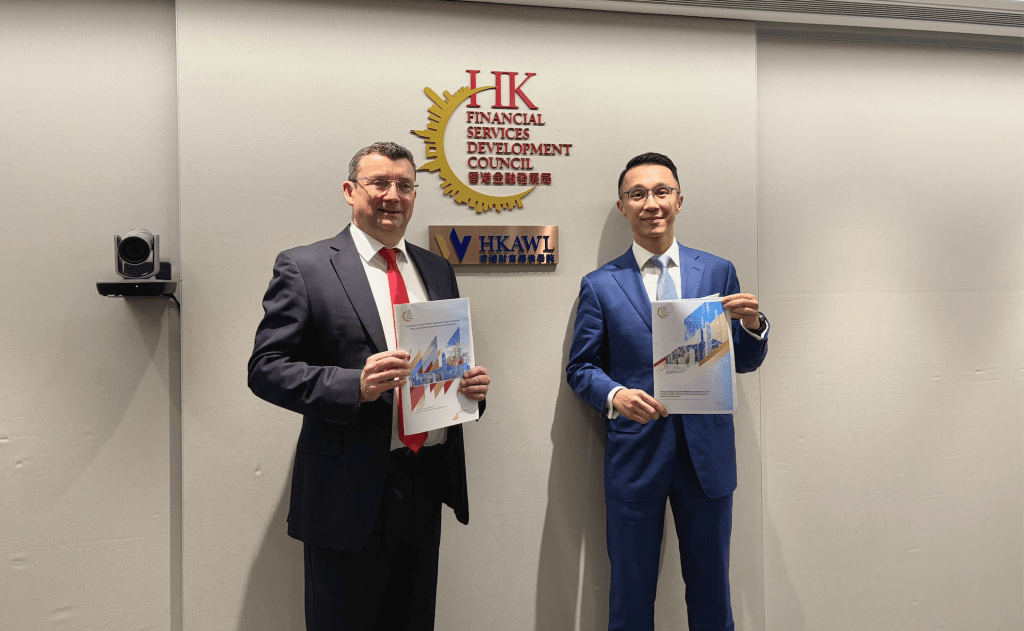
The Financial Services Development Council released a strategic roadmap on Tuesday to position Hong Kong as a "global capital nexus" for Asia, as geopolitical fragmentation and technological disruption reshape global capital flows.
The report, "Hong Kong's Capital Market Leadership 2.0: A Shared Action Agenda for Building Hong Kong's Global Capital Nexus," builds on the FSDC's December 2025 concept paper and outlines detailed recommendations for the short-, medium-, and long-term.
Short-term priorities include advancing the T+1 settlement implementation aligned with the Hong Kong Stock Exchange's 4Q 2027 milestone, modernising the Professional Investor definition to recognize digital asset holdings, and beginning mobilization of patient capital through expanded mandatory provident fund eligibility for alternatives and infrastructure investments.
FSDC’s vice chairman Andrew Weir noted that the advice is not aimed at changing MPF rules specifically, but rather at highlighting Hong Kong's vast pool of long-term capital seeking predictable, safe returns.
He said the report advocates developing more fixed-income vehicles to cater to this patient capital, and Hong Kong is opportune to serve as a gateway for mainland pension and insurance capital to invest globally through legal channels.
Rocky Tung Yat-ngok, executive director of the FSDC, added that the recent lifting of QDII quotas in late August was cited as a positive signal that institutional capital from the mainland is looking to Hong Kong.
Tung said MPF funds remain subject to a 10 percent investment ceiling for alternatives. Following industry discussions, the view is that the current approach may lack economies of scale, prompting calls to explore raising the allocation limit. He stressed that since MPF involves public savings, caution and safety are paramount, and noted that no implementation timetable has been set.
Tung added that broader investment choices benefit both the MPF ecosystem and international patient capital. He observed that many Asian funds favor fixed income products, yet Hong Kong's debt capital market remains far less developed than its equity market. He hopes offering more fixed income instruments can meet patient capital demand.
The report also calls for recalibrating the various Connect schemes for the next decade, including refining eligibility methodologies to better recognize dual primary listed foreign issuers and broadening Southbound product eligibility under Wealth Management Connect and ETF Connect.
The report also identified digitalization as critical for enhancing efficiency and liquidity, with immediate priorities including shortened settlement, uncertificated securities, and trading-unit reform. Long-term priorities include developing CMU OmniClear as a regionally significant international central securities depository and integrating digital instruments into mainstream workflows.
Furthermore, it recommended reforming Hong Kong's corporate rescue framework to support a "full-lifecycle capital formation center," enabling companies to manage restructuring and winding-down phases alongside initial public offerings.
The recommendations are being developed against the backdrop of the HKSAR Government's First Five-Year Plan for Economic and Social Development, with the FSDC maintaining ongoing engagement with mainland regulators and policymakers to coordinate implementation.
Benjamin Hung Pi-cheng, chairman of the FSDC, said global uncertainties are driving investors to look for opportunities that combine growth, market stability and risk diversification, and Hong Kong is one of the few places in the world that can offer these features.