Japan's Nikkei share average shot to a record high on Thursday and the nation's bonds rallied as financial markets reopened after holidays, catching up with optimism over strong technology earnings and signs of a potential peace deal in the Middle East.
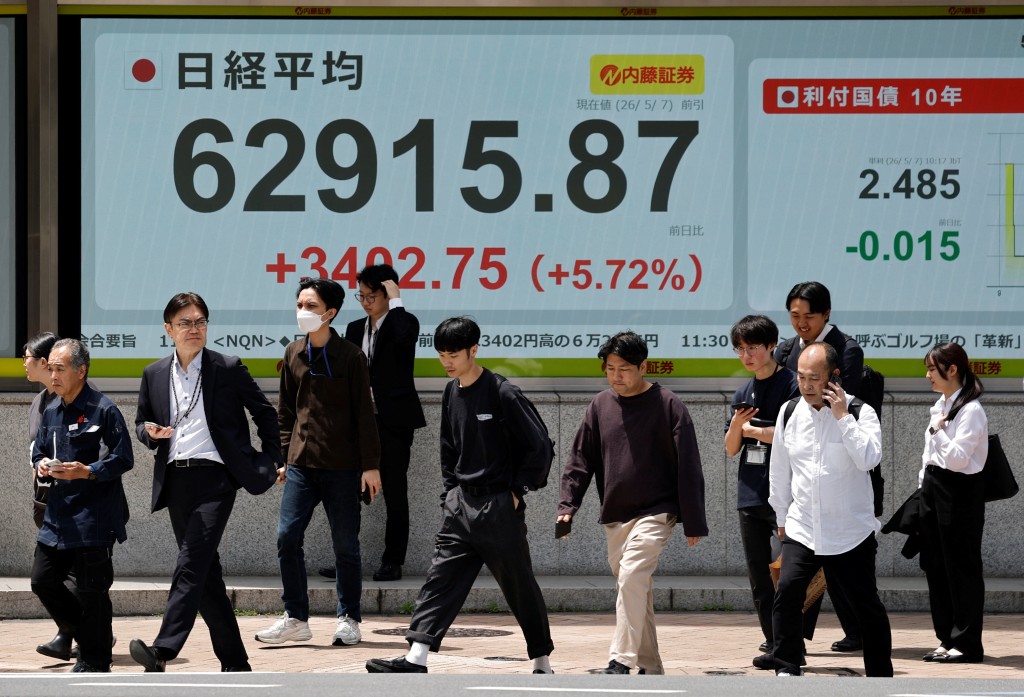
The benchmark Nikkei 225 Index rose 5.72 percent to 62,915.87, breaking through the 62,000 mark for the first time. The broader Topix climbed 2.12 percent to 3,807.84.
Japanese government bonds (JGBs) rose after a three-day trading break that saw the yen appreciate on suspected intervention by authorities in Tokyo.
The yen bought 156.33 per US dollar, largely steady a day after a sprint to a 10-week high of 155 fueled talk of further official support.
Wall Street indexes hit record highs overnight as positive results from Advanced Micro Devices propelled euphoria over the red-hot artificial intelligence sector. Iran said it is reviewing a U.S. proposal to end the more than two-month war, while President Donald Trump said the U.S. has had very good talks with Tehran.
"Today's sharp gain of the Nikkei was led by the strong performance of chip shares, driven by Advanced Micro Devices's strong forecast," said Takamasa Ikeda, a senior portfolio manager at GCI Asset Management. "The contents of the U.S.-Iran peace proposals are thin, but there is an expectation in the market that further military action will not take place."
There were 144 advancers on the Nikkei index against 78 decliners. The largest percentage gainers in the index were tech sector suppliers, led by Ibiden, up 15.9 percent, followed by Mitsui Kinzoku Ltd, gaining 15.3 percent, and Renesas Electronics, 12.8 percent higher.
Mining and exporter shares were broadly lower, however, marking a reversal from gains during the Iran conflict as energy prices surged and the yen weakened. Inpex, Japan's top oil and gas explorer, sank 5.9 percent, while Honda Motor lost 0.7 percent.
"The automakers remain weak as the environment has become severe with intensifying global competition," said Hiroyuki Ueno, chief strategist at Sumitomo Mitsui Trust Asset Management. "Besides that, they may not enjoy benefits of the weak yen in the current fiscal year."
Minutes released on Thursday of the Bank of Japan's March meeting showed many board members saw the need to raise interest rates if the Iran war-driven energy shock is prolonged.
The benchmark 10-year JGB yield fell 1.5 basis points (bps) to 2.485 percent. Yields move inversely to bond prices. The five-year yield fell 0.5 bps to 1.870 percent.
Reuters and Staff reporter