MicroPort CardioFlow Medtech Corporation, a spinoff of Microport Scientific (0853), has closed the retail book last Friday, receiving at least HK$53.16 billion through margin financing.
This means its retail portion is oversubscribed by nearly 211 times.
The company is on course to raise nearly HK$2.51 billion by offering 205.62 million shares as it reportedly eyes top-end pricing, which is HK$12.2 per share.
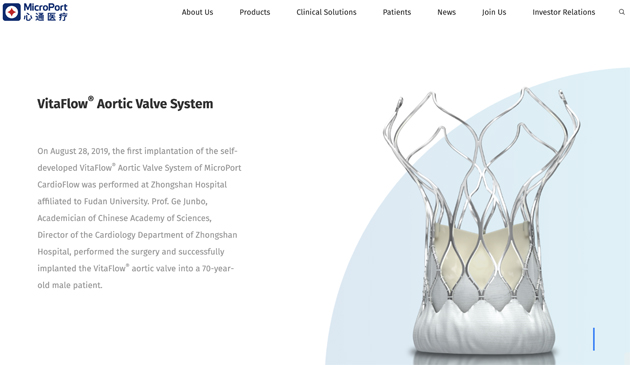
The medical device company, founded in 2015, aims to provide therapies for structural heart diseases. It mainly focuses on transcatheter aortic valve replacement surgery, a minimally invasive procedure that implants an artificial valve without removing the old one.
Its first-generation transcatheter aortic valve implantation (TAVI) product, VitaFlow, was approved by China's National Medical Products Administration in July 2019 and then commercialized in China in August 2019.
The key product to treat severe aortic stenosis has also been registered in Argentina and Thailand.
There were five approved or commercialized TAVI products in China, among which, VitaFlow is the first one using bovine pericardium as valve tissue, according to Frost & Sullivan.
However, the company warns that they have only recently begun commercializing their products and the sales currently rely on one product, VitaFlow.
The company sold 601 units of VitaFlow in the first seven months of 2020 with an average selling price of 80,600 yuan, (HK$95,803) generating revenue of 48.44 million yuan.
Meanwhile, its second-generation TAVI product, VitaFlow II, allows doctors to retrieve the prosthetic aortic valve if it is not placed accurately at the designated position, which will improve the overall success rate of the TAVI procedure.
It has applied for the registration to the NMPA in October 2020 and expects to complete the procedure in China by the end-2020.
It is expected that around 42,000 TAVI procedures will be performed in China in 2025 and that China's TAVI market will grow from 392 million yuan in 2019 to 5.05 billion yuan in 2025, the commissioned Frost & Sullivan's report says.
The loss-making company's annual revenue reported 48.44 million yuan in 2019, compared with zero in 2018, since its only commercialized product VitaFlow was launched in August 2019. Revenue for the first seven months in 2020 was 48.44 million yuan.
Meanwhile, its annual loss expanded by 139 percent year-on-year to 144.52 million yuan in 2019. For the first seven months, net loss extended from 83.50 million yuan in 2019 to 192.63 million yuan.
Research and development costs increased by 116 percent to 96.70 million yuan year-on-year in 2020, while the costs narrowed by 26 percent to 38.19 million yuan for the first seven months in 2020 compared with the previous year.
After the spin-off, Microport Scientific will hold a 49.59 percent stake in MicroPort CardioFlow Medtech Corporation via a wholly-owned subsidiary Shanghai MicroPort, while Shanghai Huahao holds 8.10 percent, CICC Kangrui has 7.67 percent and Qianyi Investment owns 6.34 percent.
About 16 cornerstone investors have agreed to buy US$125 million new shares, including CPE Fund, Hillhouse Funds, Lake Bleu Prime, Government of Singapore Investment Corp, Taikang Life, Snow Lake Funds, and ChinaAMC Funds.
As for the use of proceeds, about 30 percent will be allocated to the research and development activities, clinical trial and product registration, sales, and marketing of VitaFlow II, while 3.4 percent will be allocated to VitaFlow's ongoing research and development, commercialization in China, follow-up evaluations, and product registration in other emerging markets including Russia.
Meanwhile, 27 percent will be spent on the remaining products in the current product pipeline.
The company plans to use 15 percent to expand its product portfolio and 14.6 percent to increase production capacity.
The remaining 10 percent will be used for working capital and general corporate purposes.