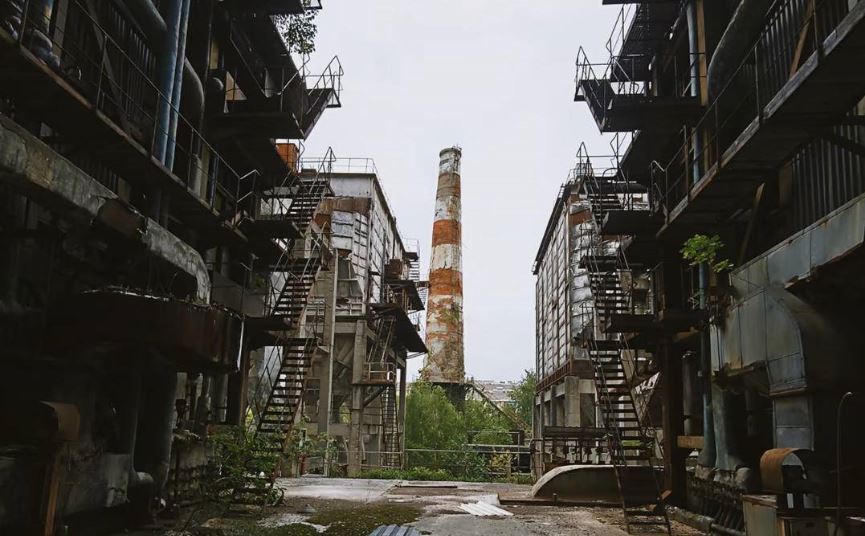
Ruins exploration in the mainland has become a trend where young people venture into abandoned factories, schools, unfinished buildings, and even air-raid shelters to capture photos for online sharing – a visual strategy that has become a popular traffic-generating tactic.
Many enthusiasts have shared methods to evade security and scale fences at abandoned sites online, forming an under-the-radar guide to ruins exploration.
Analysts suggest this trend stems from China's accelerated industrial transformation and urbanization, which has left behind many abandoned structures.
On Chinese social media, searching keywords like “exploring ruins” or “urban exploration” brings up images of urban decay shared by web users.
This trend has formed an urban exploration movement known as “UrbEx."
A recent post titled “The Abandoned Ruins of Nanjing's Central District" has garnered much attention. A web user documented a small thermal power plant in Nanjing's Jiangning District; the post not only detailed the plant's history – built in 2001 and shut down after over a decade – but also included photos of vacant factory buildings and rusted pipes. Unexpectedly, the post went viral and attracted over 100,000 comments.
Similar posts are increasingly common. Explorers flock to these buildings to take aesthetic or cosplay photos. Some even host small concerts in ruins or convert them into temporary battlefields for war games.
Some influencers organize “ruins exploration tours” charging around HK$700 to HK$1,000 per person. Production companies offer abandoned site wedding photography or role-playing shoots, and even costume rentals; they charge over HK$500 per hour.
Meanwhile, web users monetize their adventures, with monthly earnings exceeding HK$100,000.
However, trespassing into these sites carries multiple risks. Apart from penalties for illegal trespassing, the structures harbor significant hazards such as harmful chemical residues, heavy metal dust, and fiberglass.
The General Office of the State Council required localities to improve construction waste management, preventing abandoned sites from posing safety risks while ensuring companies do not leave hazardous traps.











![Li Yize (left). [Photo/Xinhua]](https://image.hkstandard.com.hk/f/1024p0/0x0/100/none/399a4165531eaa3229fa92a4d708a6de/2026-06/f_3.jpg)