Germany's trade surplus with the United States reached a record level, data from the statistics office showed, as countries wait to learn how US President Donald Trump will impose tariffs on imported goods.
Germany's trade surplus with the U.S. expanded to €70 billion (HK$563.1 billion) in 2024, well above the previous record of €63.3 billion reported for the full year 2023.
"It would be hard to imagine worse timing," said Holger Goerg, from the Kiel Institute for the World Economy.
Trump substantially raised tariffs on steel and aluminum imports on Monday to a flat 25 percent "without exceptions or exemptions".
German Chancellor Olaf Scholz said in response the European Union was still awaiting formal notice of any new tariffs but that any such move would be met with retaliatory measures.
The increase in trade surpluses could reverse, Goerg said, if Trump imposed new tariffs on German imports, a measure the US president says would boost US manufacturing.
Germany, Europe’s biggest economy, was last year the only G7 country posting a contraction for two consecutive years and a trade conflict with the US, its main trading partner, would deliver a big hit to output.
German exports to the US, led by cars and pharmaceutical goods, increased by 2.2 percent year-on-year to a record €161.3 billion in 2024, consolidating the US position as the top buyer of goods "Made in Germany".
Imports from the US fell by 3.4 percent to €91.4 billion last year.
Goerg said the US trade deficit reflected a lack of international competitiveness of US goods which will not be solved by tariffs.
"On the contrary, I would assume that this would have a negative impact on the US export performance," Goerg said.
The situation is completely different in trade in services, where the US has a strong export surplus, including to the EU and Germany, he noted. "Mr. Trump should include that in his calculations," Goerg said.
REUTERS
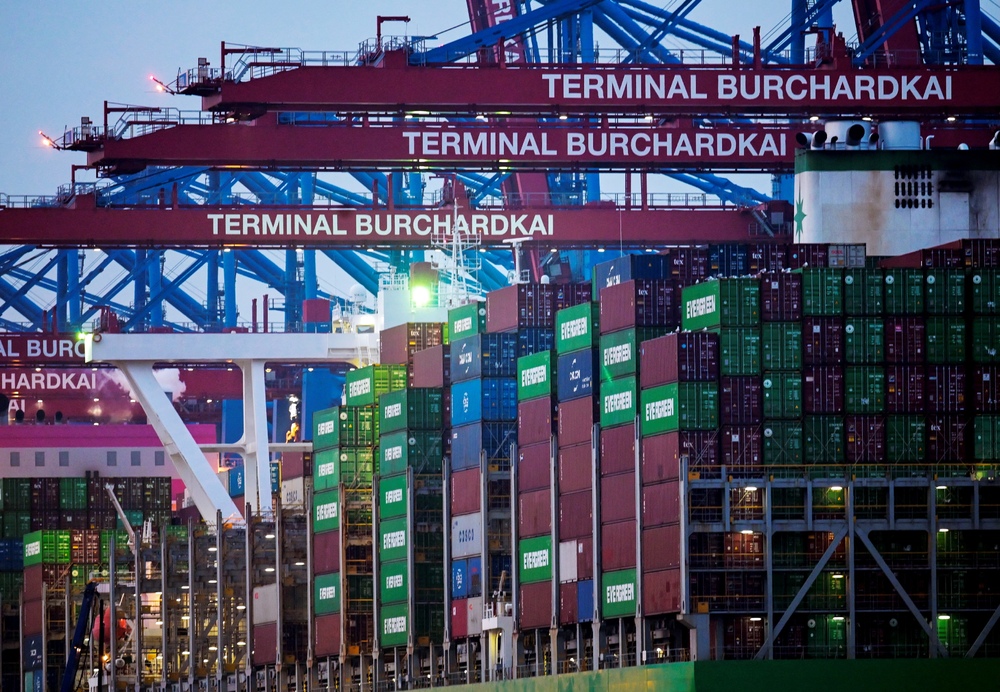
Panama-flagged container ship 'Ever Goods' is seen at the loading terminal 'Burchardkai', in the port of Hamburg, Germany, February 8, 2025. REUTERS