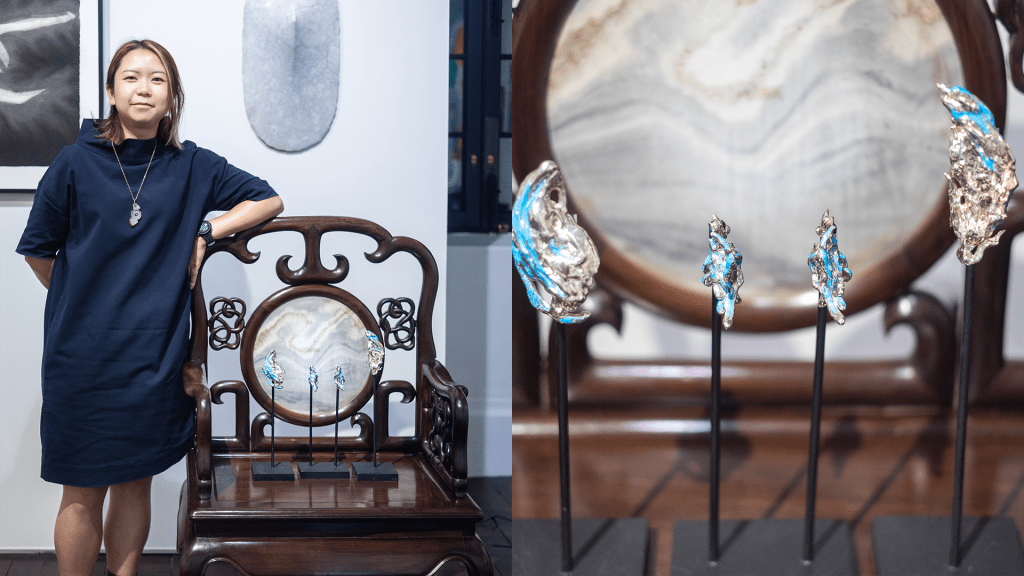
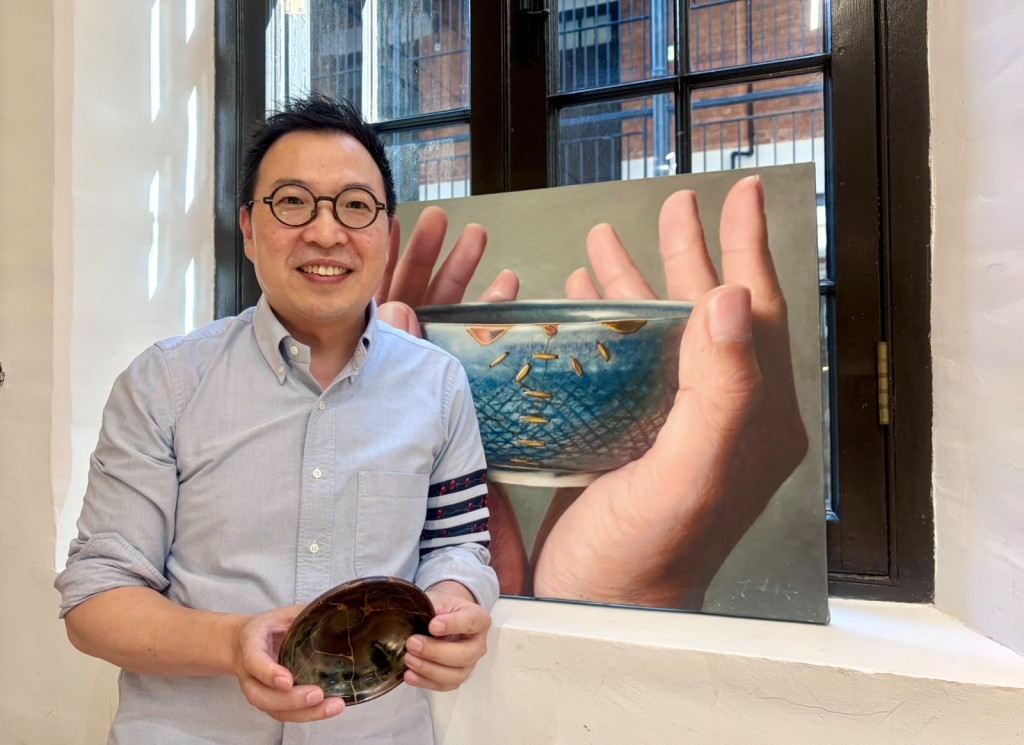
A treadmill belt. A ceramic hand. An antique chair. Even the colors of a Macau casino.
For independent curator Zoie Yung, all of these offer a way of looking at shanshui — literally “mountains and water,” a concept traditionally rooted in Chinese landscape painting.
In Yung’s latest exhibition, The Pleasure-Dome of Hills: A Curated Hallucination of a Modern Literati at Ora-Ora in Tai Kwun, 13 artists are brought into conversation with Chinese furniture from different periods, opening up new interpretations of shanshui.
“It’s about how you see it — its structure, and how you put it into a composition,” she said.
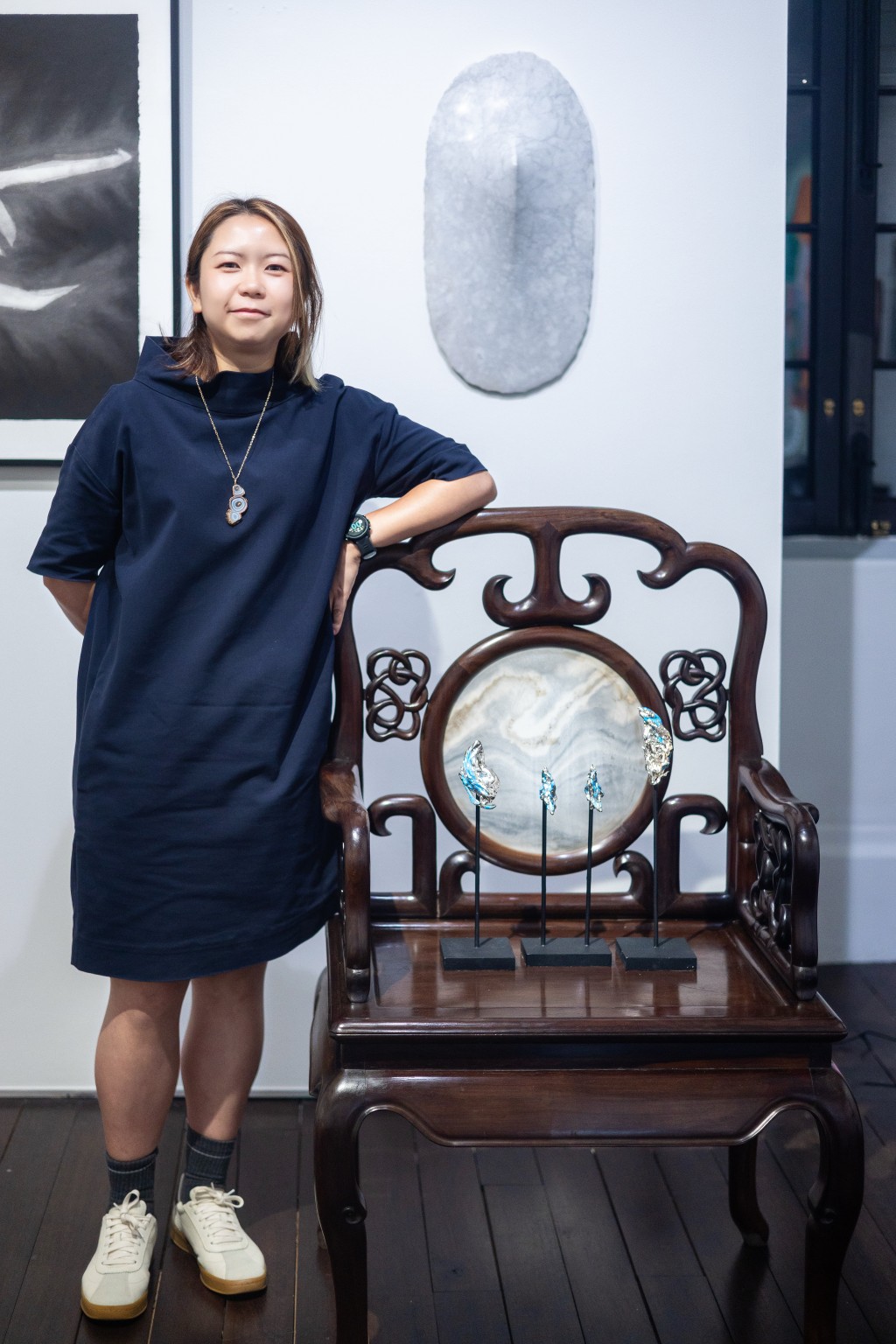
Zoie Yung hopes to bring Hong Kong’s disappearing landscapes into the present through shanshui.
Old objects, new connections
For Yung, the exhibition is not simply a record of what Hong Kong has lost, but a way of bringing those traces back into the present.
The gallery is imagined as a modern literati study, where furniture from the Ming, Qing and Republican eras lives alongside contemporary paintings, installations and wearable art — all part of a fictional scholar’s room.
Yung’s starting point was Hong Kong writer Ellen Cheung Yin’s 1975 work Shops, which documented old Sheung Wan and its disappearing businesses. Inspired by its portrait of the neighbourhood, she brings the culture of Hollywood Road, long shaped by its antique furniture trade, into the gallery.
The approach was also inspired by vintage markets in the UK, where art, craft and furniture are casually juxtaposed. Rather than separating them by category or period, Yung wanted the works to be encountered as part of the same visual world — closer to a Wunderkammer, or cabinet of curiosities.
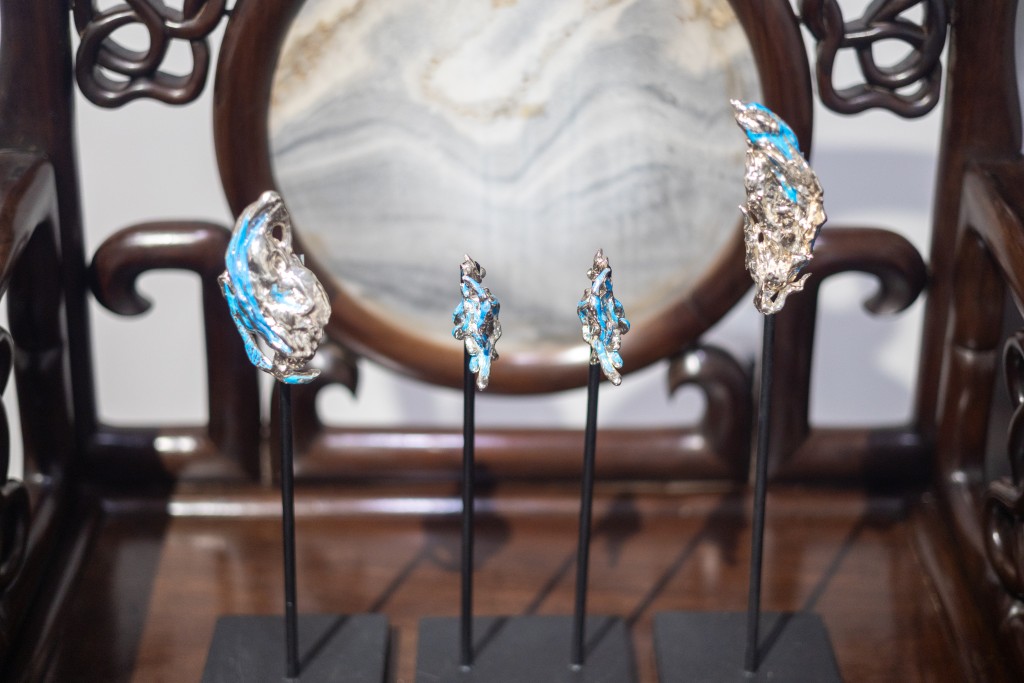
On one such Republic-era chair sits Vann Kwok’s Continuum 01, 02 and 03. Flowing metal forms evoke the bone-like structure of mountains, while the earrings and pins are larger than Kwok’s usual scale, marking her first time working at such a size.
Vann Kwok’s Continuum 01, 02 and 03 combine “fluid osteology” with auspicious cloud motifs and flowing metal forms.
The pieces draw on Kwok’s family connection to Chinese furniture. Her father was a carpenter who worked with traditional Chinese furniture, a detail that emerged as Yung and Kwok discussed the work. From that conversation came auspicious cloud motifs and hand-painted enamel, layered onto Kwok’s signature flowing metal forms.
When everyday life becomes shanshui
For Gerald Mak, shanshui conjures the world of the literati — scholars, their spaces and the objects within them. His own practice, meanwhile, is shaped by everyday life in Jingdezhen.
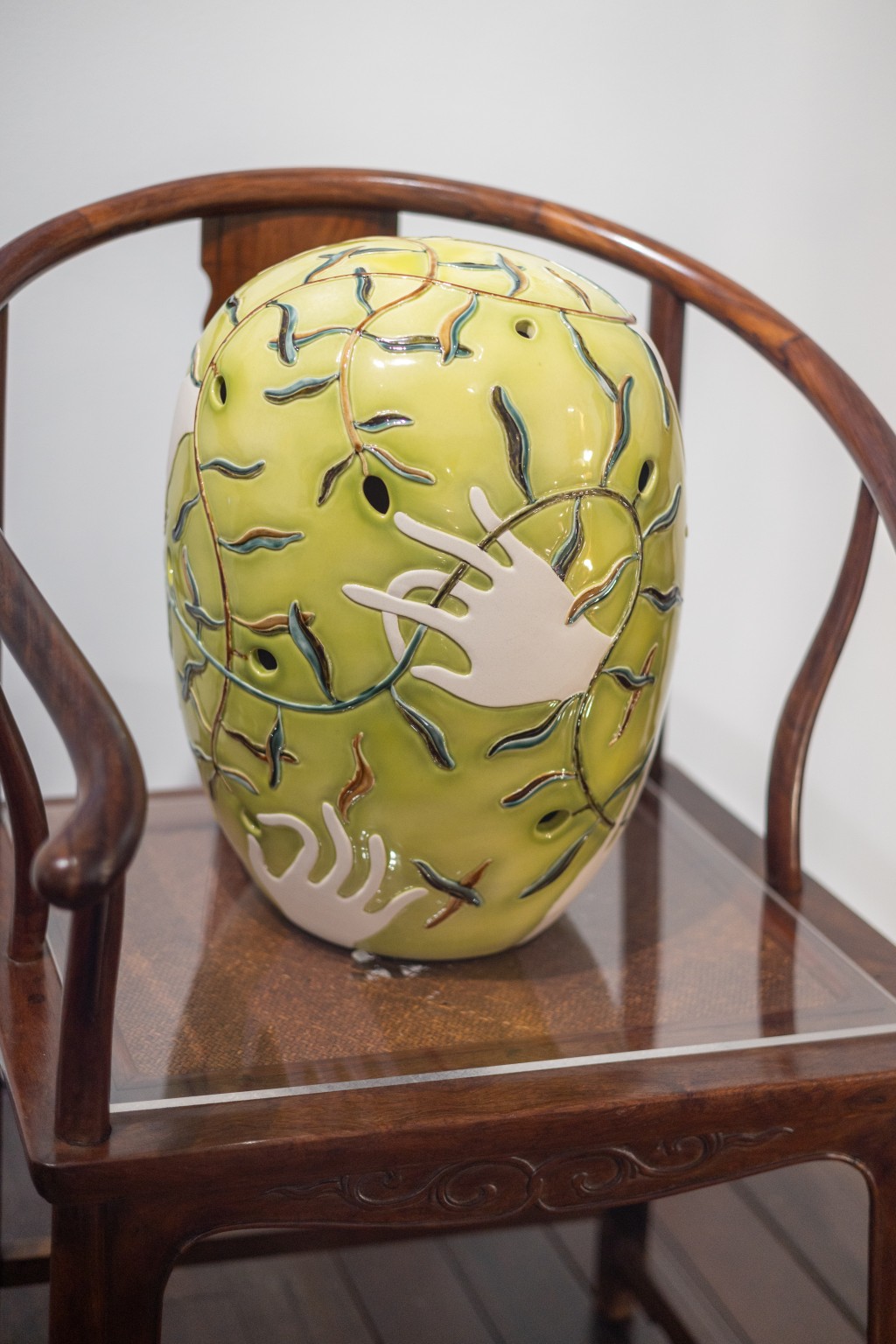
Gerald Mak’s Gourd with Intertwining Olive Branches (Granny Smith), where hands and olive branches meet.
In the exhibition, ceramic hands, winding olive branches and a work inspired by mahjong bring that everyday sensibility into the gallery. They are intimate gestures and familiar objects, drawn from the rhythms of making, playing and living.
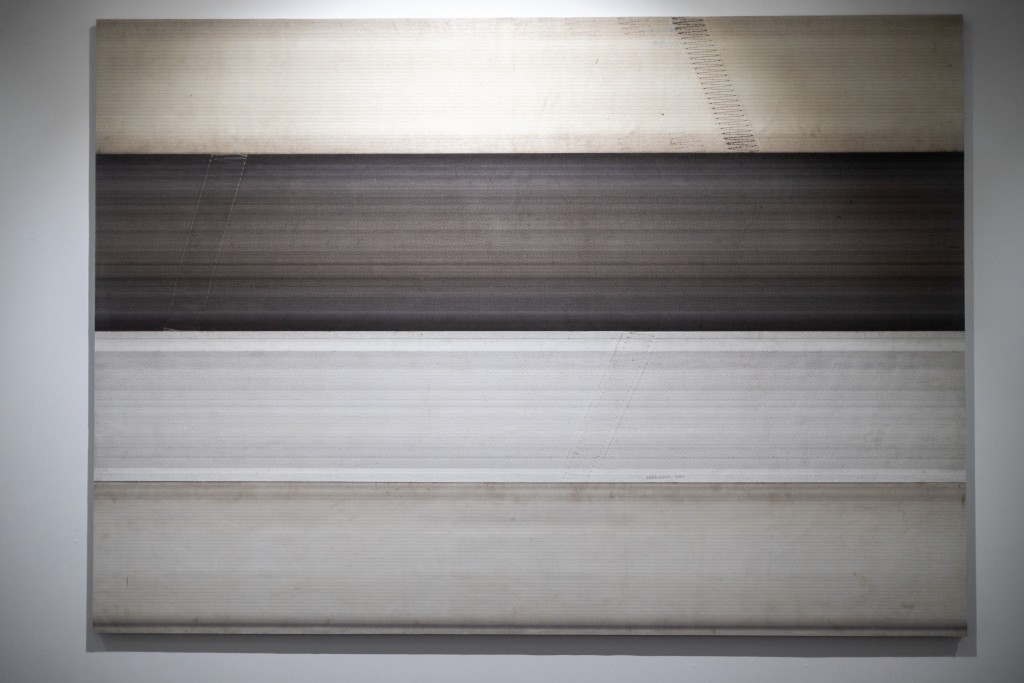
In Dave Chow Yui-wang’s Constancy, meanwhile, the mountain becomes a treadmill.
Ink-like marks across the work are actually impressions left by the underside of a treadmill belt. The varying lines record the distances and inclines covered by runners, turning repetitive exercise into a contemporary landscape.
Dave Chow’s Constancy, where treadmill-belt traces resemble the brushstrokes of a shanshui landscape.
The modern literati
For Yung, the modern literati is not necessarily a scholar steeped in classical culture. It could be someone who visits a vintage shop, buys a designer chair, collects art or mixes contemporary pieces with antiques.
What matters is the curiosity to look closely and draw connections between art, furniture, design and everyday life.
That curiosity, she believes, is something Hong Kong still needs. The city needs people who can read broadly across culture, recognize what makes a place beautiful and articulate why it matters. Without that broader aesthetic appreciation, she said, a city can become “quite boring.”
Yung is also a key facilitator of the HART Curatorship Incubation Programme 2026, which explores contemporary curatorial practice across new media, post-media and machine intelligence. She believes the curator’s role is partly to keep these conversations open — and make the art world easier to enter for those who may not already feel at home in it.
“Hong Kong, generally speaking, still needs the concept of the literati,” Yung said.