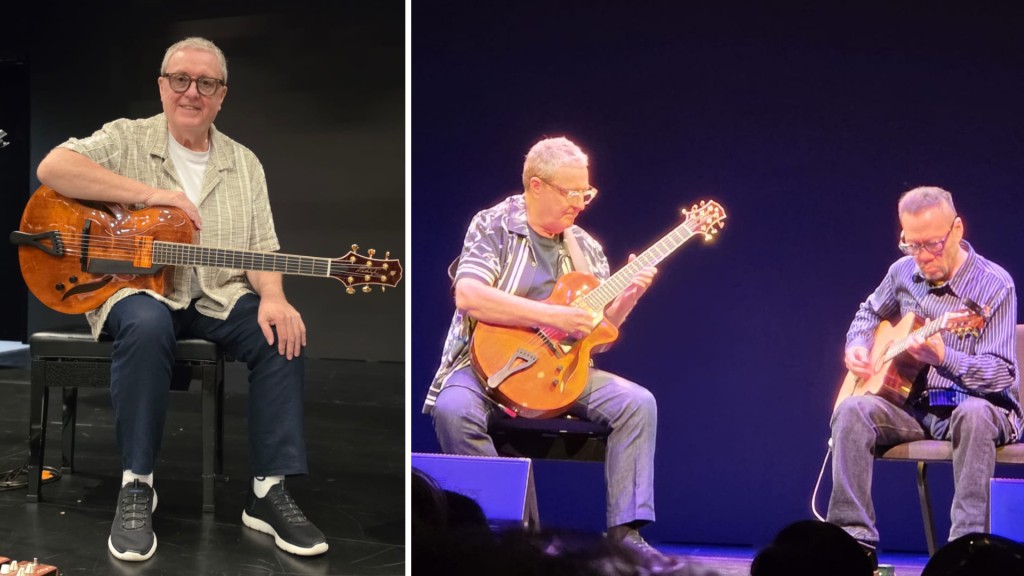
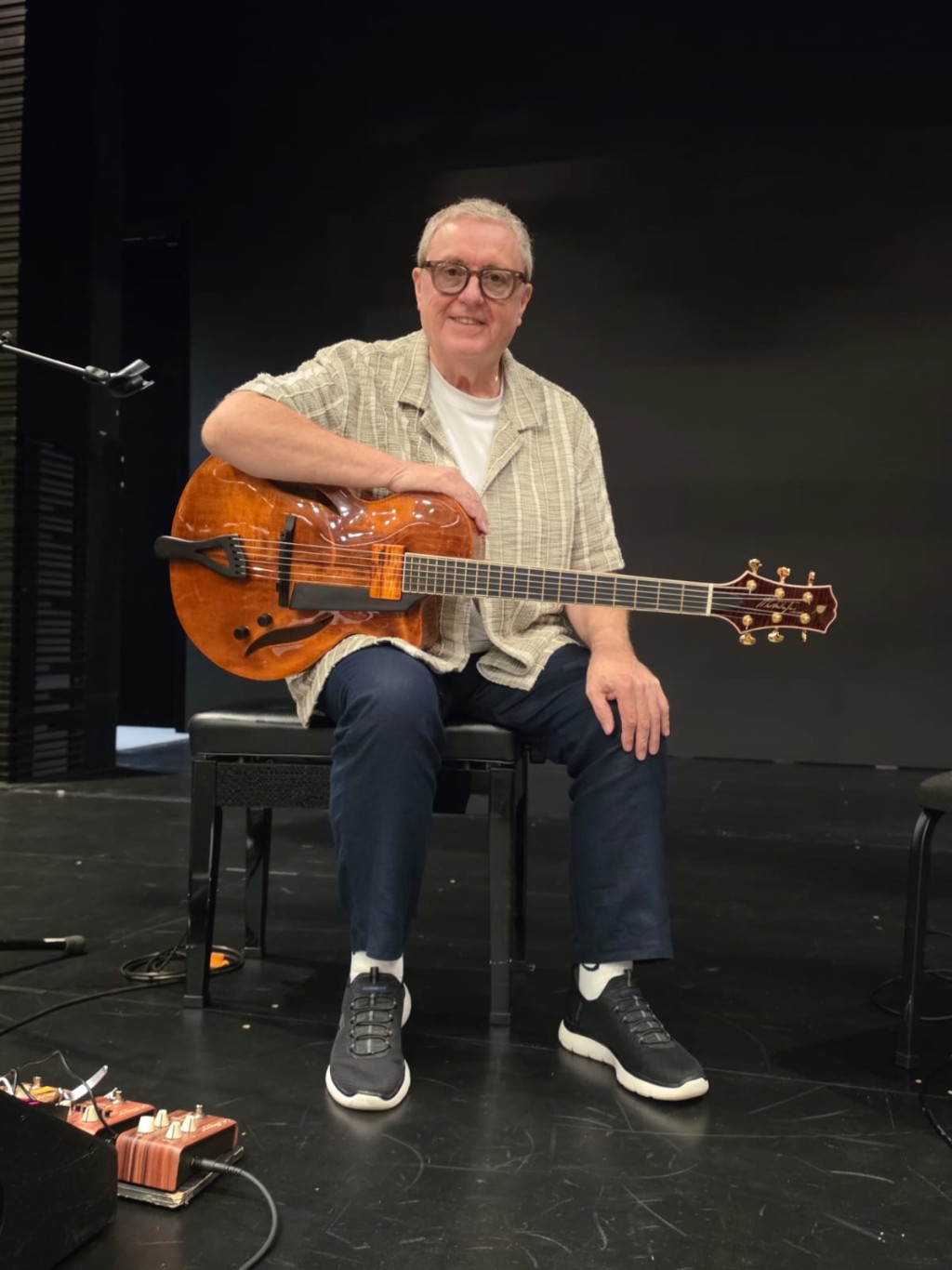
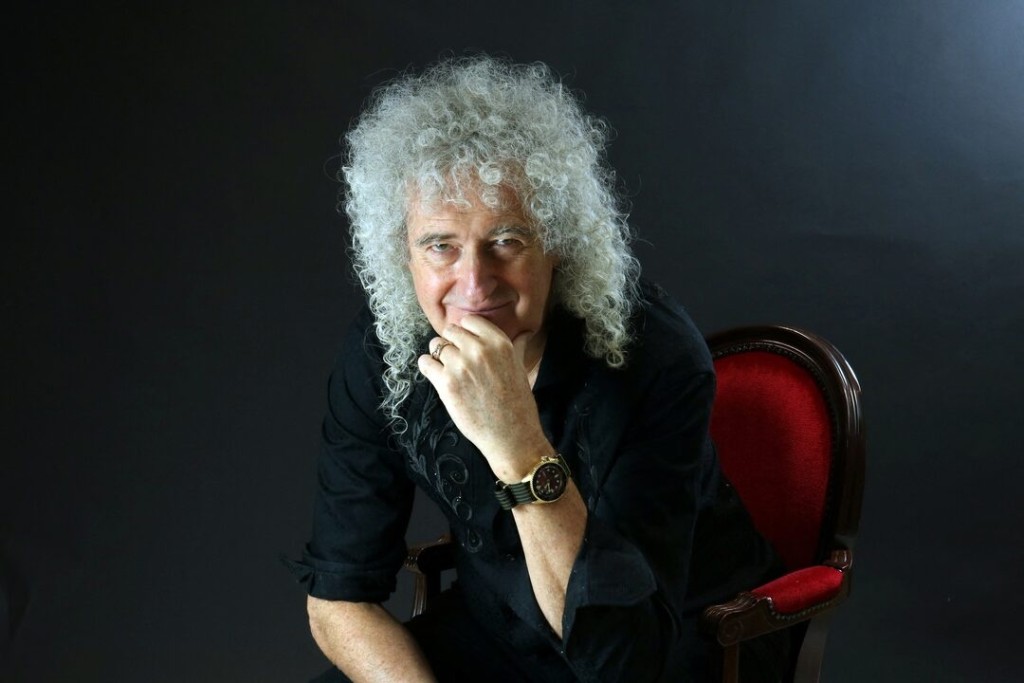
He received an MBE for his services to jazz music, and is hailed as "the world's greatest exponent of solo jazz guitar." Yet Martin Taylor never had a formal music lesson.
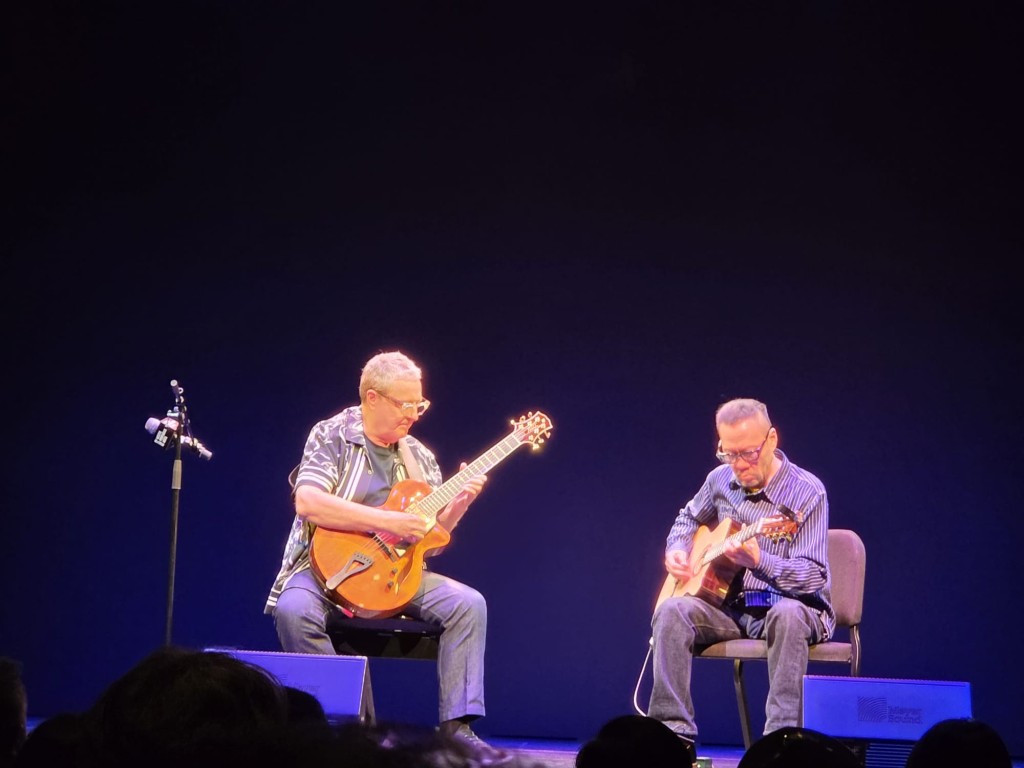
Before his Hong Kong reunion with Eugene Pao at the Xiqu Centre – 35 years after they first played together at the Jazz Club in Central – the 70-year-old reflected on a five-decade career marked by two near-collapses and a deep affinity with Asia.
The repertoire showcased Taylor's remarkable range. Mancini classics Two for the Road and Days of Wine and Roses showcased Taylor's lyrical touch, while Girl Talk and Billie's Bounce revealed his swinging virtuosity. A highlight was I Won't Last a Day Without You – a tender tribute to duet partner Tommy Emmanuel – while Down at Cocomos closed with a joyful Caribbean coda. Each piece was transformed through Taylor's "internal dynamics", turning a single guitar into a full orchestra.
Martin Taylor and Eugene Pao
From Django to Grappelli: A self-taught prodigy
Taylor learned by listening to his father's Django Reinhardt records. By 22, he was playing alongside gypsy jazz violinist Stéphane Grappelli, who was 50 years his senior. "I told myself every night: remember this feeling. I still can hear his bow scraping against the strings," he told The Standard.
Grappelli taught him to communicate with audiences, not just play for himself. "He told stories. That's what I try to do – invite people into a little club."
When Grappelli's heart attack cancelled touring in the 1980s, Taylor sold his guitars. Picking one up again, he discovered his path: solo guitar – or as he calls it, the "lone arranger" – playing melody, harmony and bassline simultaneously.
The second crisis came in 2005 when his younger son died. For three years, he could barely play. "Then I woke up and thought: I can't go on like this. An ending is always a big beginning."
Playing from the mind: improvisation, dynamics, and AI
For Taylor, improvisation begins long before his fingers touch the strings. "I never play anything I can't hear and can't sing," he explains. "I vocalize what's in my head. George Benson does the same – he plays along with his singing. When I can hear a melody, I expand it, move it by semitones. I'm actually playing in my mind first."
"I turn mistakes into opportunities. If you hear a wrong note, you'll never play the same mistake the same way twice. It becomes part of the flow."
This internal practice is constant – sometimes to a fault. "There's always music in my mind. It can be quite annoying sometimes," he admits with a laugh. "I need to practice stillness."
Time, he insists, is not intellectual but physical. "It's not in your head – it's in your body. Rhythm must be felt."
Taylor is known for his fingerstyle concept "internal dynamics" – treating each note differently to create a three-dimensional, multi-layered soundscape. "That comes from life. AI can't replicate that."
He is no technophobe – his son James Taylor is a well-known speaker on AI and creativity – but remains wary. "At a restaurant, the background music was AI-generated. For musicians, it's annoying. It gets close, but can't give heart."
For young musicians, his advice is simple: "We all copy our heroes at the beginning. But then you have to move on. Otherwise, you become a photocopy."
Home in Asia: Buddhism and the next generation
A recent discovery is Taiwanese guitarist Ponpon Chen, whom he describes as "very special" and "understands jazz". He jokes that she reminds him of Guanyin – standing still in a long dress, letting the guitar speak.
A Buddhist since he was young, Taylor feels deeply at home in Asia. "My wife and I feel more at home here. Hong Kong has unique energy."
He runs an online academy with thousands of students worldwide.
Now 70, he is scaling back but still returns to Asia frequently. "I never had a plan," he admits. "Things just arrived. Just follow the path."