Read More
With its millions of visitors every year and the buses, supply trucks, noodle shops and fridge magnets, Japan's Mount Fuji is no longer the peaceful pilgrimage site it once was.
ADVERTISEMENT
SCROLL TO CONTINUE WITH CONTENT
Now authorities have had enough, saying the number of hikers trekking up the world-famous volcano -- night and day -- is dangerous and an ecological embarrassment.
"Mount Fuji is screaming," the governor of the local region said last week.
On a grey, rainy Saturday a steady stream of tour buses arrive at a base station of Japan's Mount Fuji depositing dozens of lightly dressed foreign tourists in front of souvenir shops and restaurants.
The scene evokes a theme park image, not the veneration most Japanese would expect below the 3,776-metre (12,388 ft) mountain worshipped as sacred by the Japanese, and a source of pride for its perfectly symmetrical form.
"Hey, no smoking here!" a souvenir store attendant barked, addressing a man dressed in shorts and holding a can of beer in front of the red 'torii' gate symbolizing the entrance to the Shinto shrine up ahead.
Mt Fuji, which straddles Yamanashi and Shizuoka prefectures in eastern Japan, has always been popular with local and overseas tourists.
But a recent surge in inbound tourists to Japan has led to extreme levels of pollution and other strains, authorities say, adding they may be forced to take drastic measures such as restricting the number of visitors by making the mountain only accessible by a yet-to-be-built tram system.
"Fuji faces a real crisis," Masatake Izumi, a Yamanashi prefecture official told reporters during a tour for foreign media on Saturday, the last weekend before the trails close for the year.
"It's uncontrollable and we fear that Mt Fuji will soon become so unattractive, nobody would want to climb it," he said.
Mt Fuji was listed as a UNESCO World Heritage site 10 years ago, further boosting its popularity. But the distinction came with conditions that Japan reduce overcrowding, environmental harm from visitors and fix the artificial landscape, such as the large parking lots constructed to accommodate tourists.
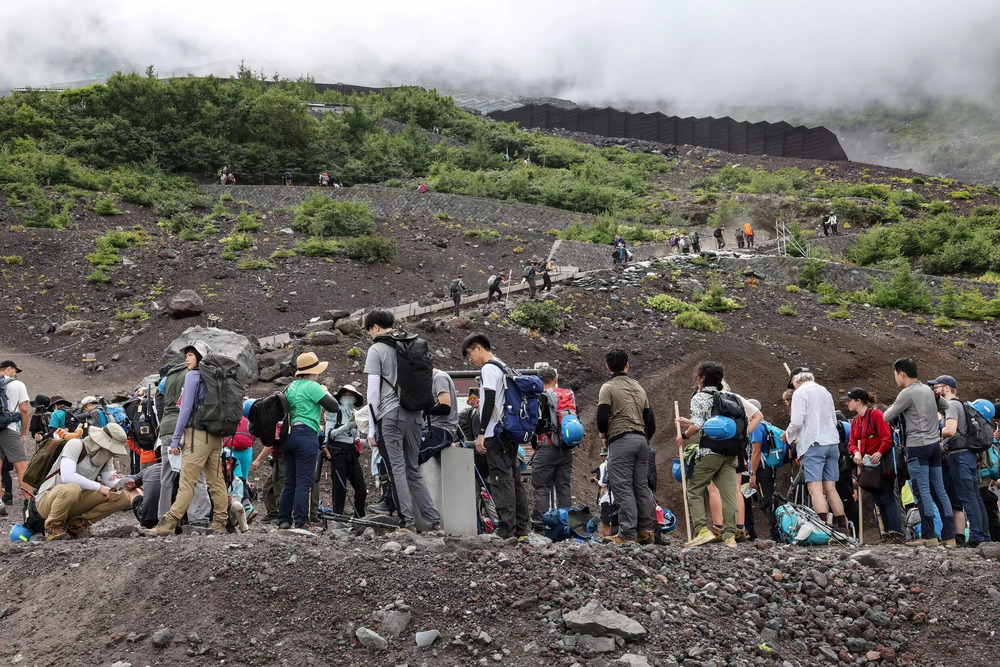
However, overcrowding has worsened. "Subaru", the fifth and largest base station, had about 4 million visitors this summer, a 50 percent jump from 2013.
Despite the frenetic pace of cleaning by janitors, businesses, and volunteers, social media is rife with posts about soiled bathrooms and mounds of litter along the climbing path.
"I saw a lot of food waste and empty bottles of drinks lying around the hand-washing area of the toilet," complained Japanese hiker Yuzuki Uemura, 28.
"Bullet climbing", where climbers attempt to scale Japan's tallest peak for sunrise and descend on the same day, is also a growing headache, authorities say.
Rescue requests totaled 61 this year, up 50 percent from last year, with non-Japanese tourists accounting for a quarter, according to Shizuoka prefecture police. An official said most were poorly equipped, suffering hypothermia or altitude sickness. Yamanashi police had no comparable data.
Izumi said the high numbers of people increased the risk of accidents.
Some people who climb at night "get hypothermia and have to be taken back to first aid stations", he told AFP.
At least one person has died so far this season.
For an optional access fee of 1,000 yen (US$6.80), visitors get a booklet in Japanese -- there is a QR code for the English version -- with some dos and don’ts.
But some don't realize how tough the five-to-six-hour climb is to the top, where oxygen levels are lower and where the weather can change quickly.
"It's almost winter up there, it's really cold," Rasyidah Hanan, a 30-year-old hiker from Malaysia, told AFP on her way down.
"People should be filtered a little bit because some people were not ready to climb Mount Fuji. They were like in really light clothes... Some of them really looked sick."
As tourist numbers get back to pre-pandemic levels, it's not only Mount Fuji whose returning crowds have authorities worried.
This week government ministers met to discuss measures to tackle what Kenji Hamamoto, a senior Japan Tourism Agency official, called "overcrowding and breaches of etiquette" across heavily touristed sites.
For Mount Fuji, authorities announced last month that they would impose crowd control measures for the first time if paths got too busy.
The announcement alone had an effect and, in the end, no such measures were taken, Izumi said.
Visitor numbers are expected to be down slightly this year from 2019, but in 2024 they could rise again as tourists -- particularly from China -- return.
Yamanashi's governor Kotaro Nagasaki said last week Japan needed to take measures to ensure Mount Fuji did not lose its UNESCO designation.
One solution, he said, could be constructing a light rail system to replace the main road leading to the main starting point for hikers.
"We firmly believe that with regard to Mount Fuji tourism, a shift from a quantity approach to a quality one is essential," Nagasaki said.
One local visitor said restrictions may be inevitable.
"Any Japanese person would want to climb Mt Fuji at least once in their life," said 62-year-old Jun Shibazaki, who arrived on a tour. "But it's so crowded. Limited entry might be something we have to live with."
"I think that Mount Fuji is one of the things that makes Japan proud," said Marina Someya, 28, a Japanese hiker.
"There are a lot of people, and lots of foreigners."
(AFP/Reuters)
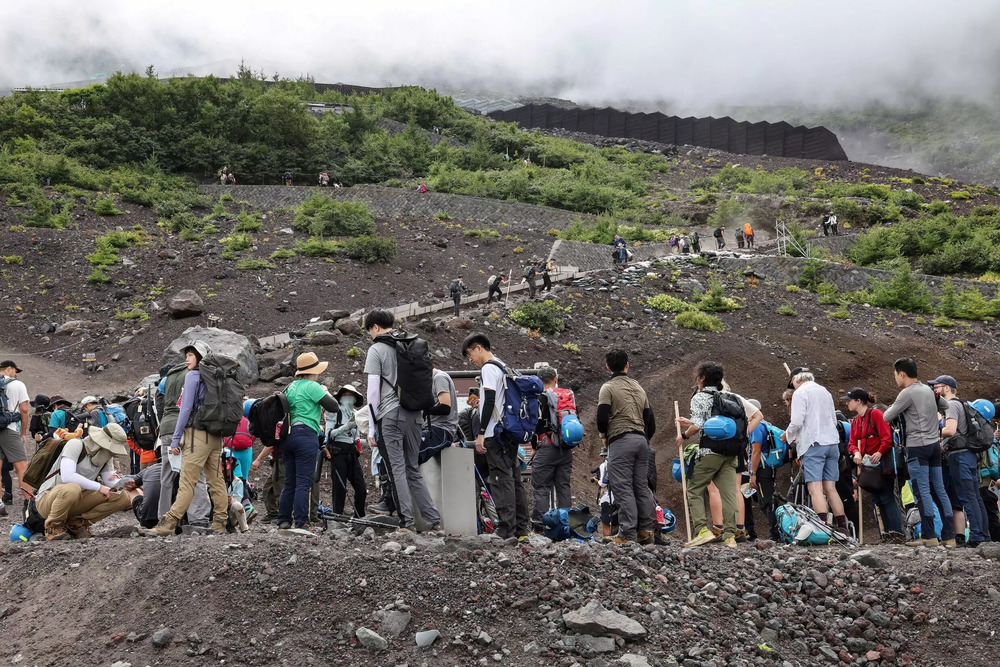
A stream of people trudges through the volcanic grit on their way up the 3,776-metre mountain. (AFP)