In recent years, freeze-dried fruit snacks marketed as natural and healthy have become popular. However, consumers need to be wary of potential food safety crises. A food company owner in mainland China voluntarily disclosed that their freeze-dried strawberries tested positive for over 20 types of pesticides, with heavy metal levels seriously exceeding the limit by 14.5 times. Research also indicates that this heavy metal can damage the liver and kidneys.
According to a report by The Beijing News, in January 2026, Ms. Lin, the person in charge of Fujian Zhangzhou Taihugu Valley Food Co., Ltd., proactively disclosed to the public that the company's sugar-added freeze-dried strawberries not only had cadmium levels 14.56 times higher than the standard but also tested positive for over 20 types of illegal pesticide residues. She stated that after testing, the problem was confirmed to originate from the raw strawberries provided by upstream suppliers, and she had repeatedly reported the issue to the market regulatory authorities in the suppliers' location. However, the upstream manufacturers argued that the national standards do not set limits for cadmium and pesticide residues in freeze-dried strawberries.
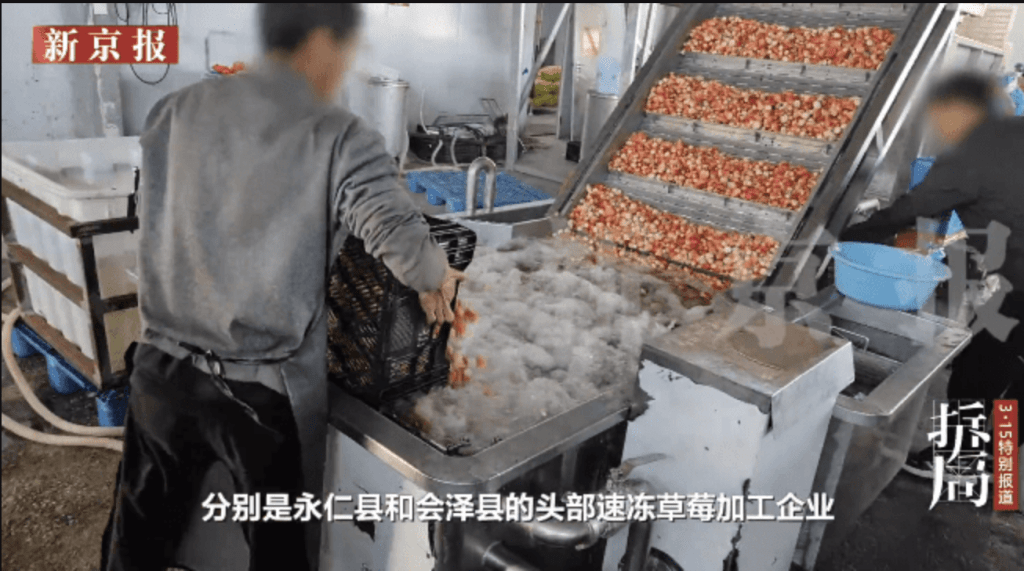
Following the supply chain, reporters traced the source to Yunnan Lijiang Huaping Golden Mango Ecological Development Co., Ltd., which is responsible for purchasing fresh strawberries from farmers for processing. A staff member admitted that since the beginning of strawberry cultivation, heavy metals and pesticide residues have been two persistent problems that cannot be overcome. Even when knowing the fresh fruit exceeds limits, purchasing companies feel helpless.
In early February 2026, reporters conducted field investigations in Yongren County, Chuxiong Prefecture, and Huize County, Qujing City, Yunnan Province – the main strawberry procurement areas for Lijiang Huaping Golden Mango Ecological Development Co., Ltd. In the strawberry plantations, large quantities of pesticides used beyond the permitted scope were found, such as chlorpyrifos and dichlorvos. Manufacturers of these pesticides stated that these chemicals should not be used on strawberries. The head of a local agricultural supply store bluntly stated that due to long-term overuse, pests have developed strong resistance, and the pesticides have become almost completely ineffective locally.
The overuse of pesticides directly leads to immense difficulties for purchasers and processors. Heads of two leading purchasing companies in Yongren and Huize counties both admitted that they cannot guarantee products free from pesticide residues. To cope with client testing requirements, a set of "unspoken rules" has formed within the industry: either bribe testing companies to provide a "pass report" or submit specially prepared "pesticide-free samples" for testing to deceive authorities.
"Toxic" Freeze-Dried Strawberries Recycled and Ground into Powder for Use in Ice Cream
After Ms. Lin spoke out online, several industry insiders contacted her, offering to "help" dispose of the problematic dried strawberries. One buyer explicitly stated they could sell them slowly as genuine products, with specifications and production dates that could be "filled in casually." Another company indicated that even with heavy metal and pesticide issues, or even if expired, they could recycle the products, grind them into powder, and then use them in the production of other items like ice cream. Concerned about the heavy metal and pesticide problems, Ms. Lin has not sold the batch of freeze-dried strawberries to date.
Following the exposure, Yunnan provincial authorities paid close attention. According to Xinhua News Agency, the Yunnan Provincial Department of Agriculture and Rural Affairs quickly formed a joint investigation team with public security and market regulation departments. The team went to the three prefectures/cities involved to conduct on-site inspections of the strawberry production bases, processing companies, and circulation markets at every stage. Authorities emphasized that any violations of laws or regulations discovered would be dealt with seriously according to the law.
What are the Health Effects of Cadmium and Lead in Food?
Regarding cadmium in food, the chance of acute poisoning from dietary intake is extremely low. Acute cadmium poisoning can damage gastrointestinal, liver, heart, and kidney function. In chronic cadmium poisoning, the primary organs affected are the kidneys. Cadmium can lead to:
- Impaired renal tubular function
- Proteinuria/aminoaciduria, leading to "kidney stones"
- Diabetes
- Osteomalacia (bone softening)
- Osteoporosis
The International Agency for Research on Cancer believes that dietary intake of cadmium does not appear to have significant genotoxicity and is unlikely to cause cancer in humans.
On the other hand, consuming lead-contaminated food is far more dangerous. Infants absorb lead at a rate of 50%. Once absorbed, lead travels through the blood to soft tissues throughout the body and then deposits in bones. Lead is excreted by the kidneys, with a small amount excreted via bile; unabsorbed lead from food is excreted in feces. Lead can damage the following organs:
- Kidneys
- Cardiovascular system
- Immune system
- Hematopoietic organs (blood-forming organs)
- Central nervous system
- Reproductive system
Infants, young children, and fetuses are more susceptible to lead poisoning, particularly damage to their central nervous systems. Small amounts of lead intake in children can cause delays in cognitive and intellectual development. Short-term intake of large amounts of lead in adults can cause gastrointestinal discomfort, anemia, brain damage, and death.