Four award-winning project design proposals by Hong Kong secondary students have the chance to be recommended for future national aerospace missions and potentially operated by payload specialists aboard China’s space station, says Jeff Sze Chun-fai, undersecretary for Education.
Sze made the announcement yesterday at an award presentation ceremony for the Hong Kong Secondary Student Space Station Popular Science Payload and Science Experiment Design Challenge, held at the Hong Kong University of Science and Technology.
The event celebrated the innovative work of students from around 100 local secondary schools.
Sze commended the participating students for demonstrating a strong integration of mathematical knowledge, technological skills, and innovative thinking acquired through their schools and training.
He noted that the four Special Gold Award-winning proposals are currently being optimized under the guidance of expert teams and could be recommended for the "Space Station Hong Kong Popular Science Satellite" initiative.
Zhong Hongen, deputy chief engineer of the Chinese Academy of Sciences' Technology and Engineering Center for Space Utilization, emphasized that aerospace science education is crucial not only for disseminating knowledge but also for inspiring young people’s passion for science and fostering national pride.
Tim Cheng Kwang-ting, vice president for research and development at HKUST, said the challenge provided an invaluable platform for young talent to showcase innovative thinking and practical capabilities.
The competition was jointly organized for the first time by the Education Bureau, the Chinese Academy of Sciences, and HKUST, with support from the Department of Educational, Scientific and Technological Affairs of the Liaison Office of the Central People's Government in Hong Kong.
Launched in February, the challenge drew an overwhelming response, with around 750 students participating.
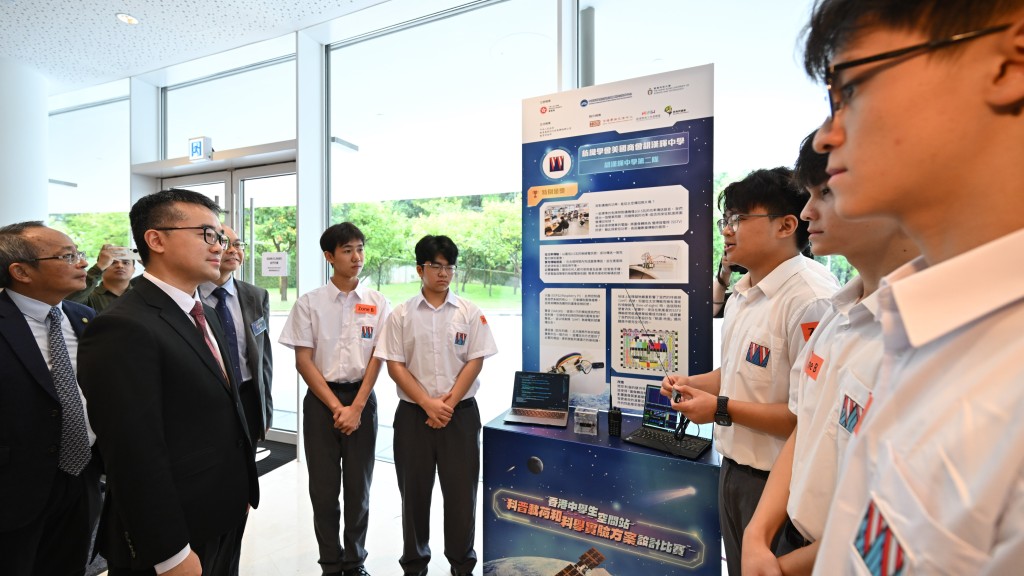
Following the ceremony, guests, teachers, and students visited an exhibition featuring the learning outcomes and experiment proposals of the 16 Gold Award-winning teams.