Read More
Exhibitors span early-stage founders seeking distributors and clinical-stage firms preparing to list.
ADVERTISEMENT
SCROLL TO CONTINUE WITH CONTENT
Hong Kong’s strong delegation of 20 tech companies has wrapped up its participation at Mobile World Congress (MWC) in Barcelona, with founders ranging from former university athletes developing AI sports tools to biotech executives preparing for a public listing.
Organised by Hong Kong Science and Technology Parks Corporation (HKSTP) and the Hong Kong Trade Development Council, the delegation exhibited at both MWC and the start-up event 4YFN from March 2 to 5.
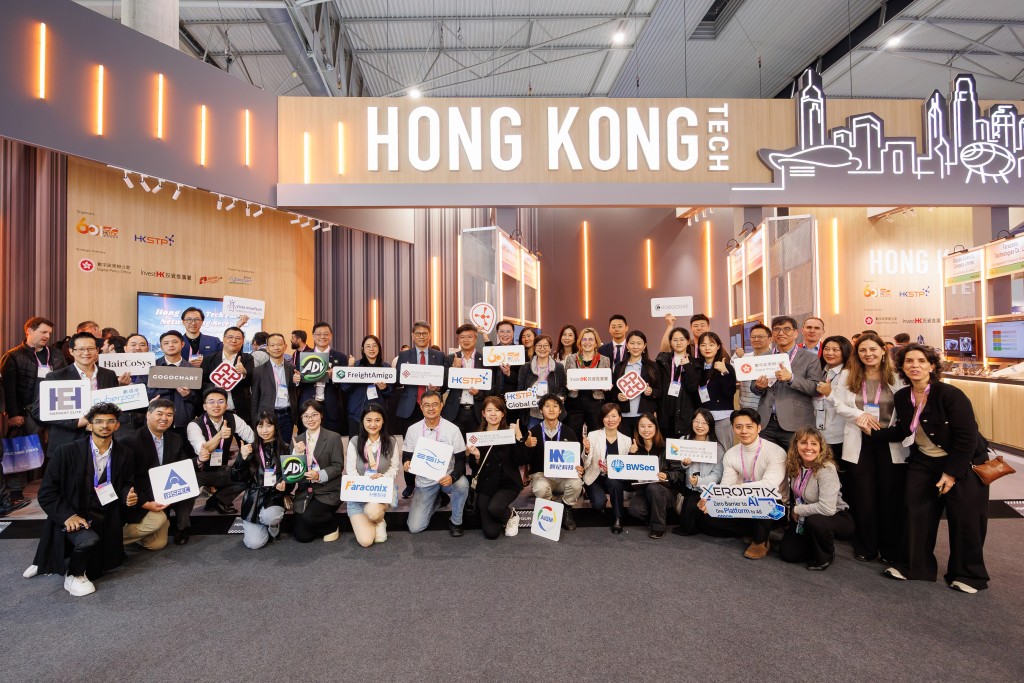
The Hong Kong tech delegation at Mobile World Congress in Barcelona, March 2026.
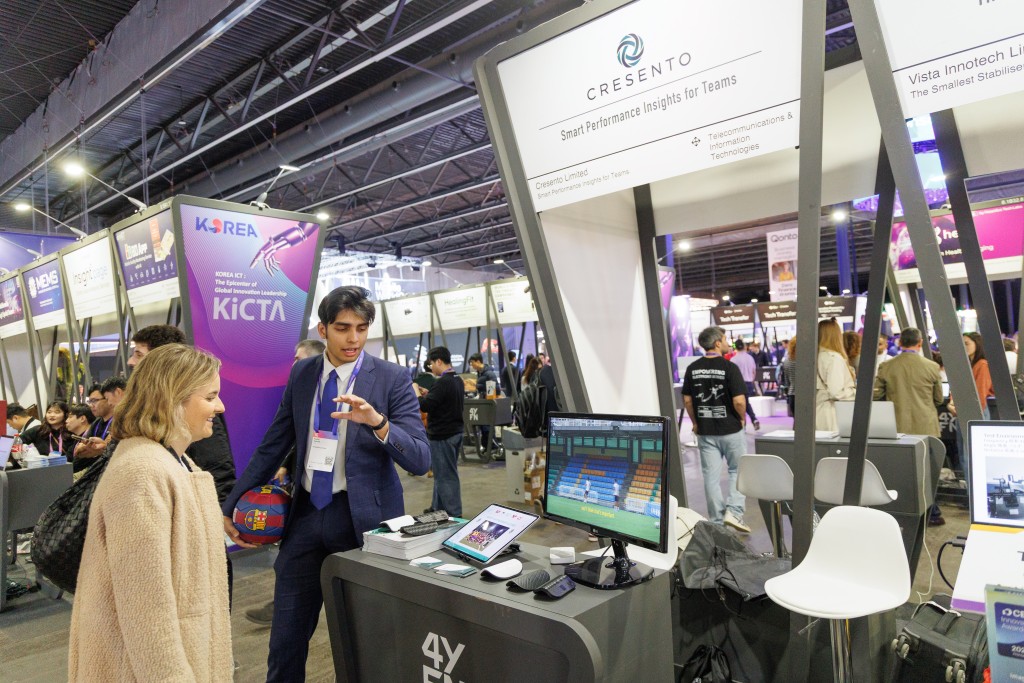
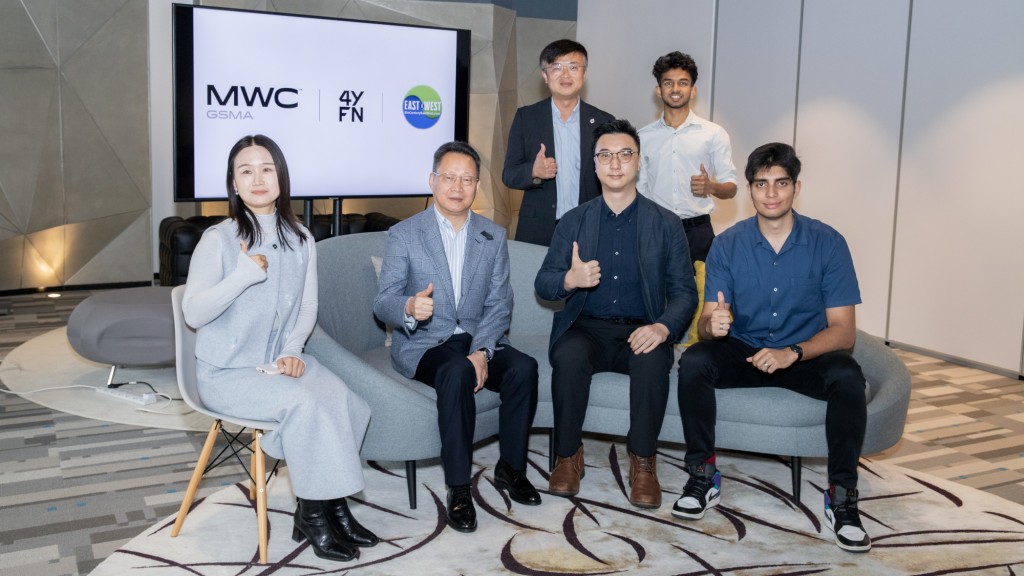
Cresento, joining the Hong Kong Tech delegation at startup-centric 4 Years From Now in Barcelona, March 2026.
AI sports analytics targets European clubs
Among the exhibitors was Cresento, a sports tech start-up founded by university students. The company presented an AI-powered shin guard designed to track player performance and predict fatigue.
Struan Gerard Dsouza, founder and CEO, said the idea arose after he analysed his own matches and discovered predictable patterns. “Eighty per cent of my passes were to the right side of the field,” he said. “That leads to easy interceptions and counterattacks.”
Access to personalised coaching remains limited, he argued. “For every registered coach, there are 873 players,” he said. “It’s impossible for all of them to get the right feedback.”
Kushaj Dwivedi, co-founder and CTO, said the device relies on in-house machine learning models to convert match data into recommendations. “We’re not just providing data,” he said. “We actually tell players how to get better based on their historic performance.”
Positioned on the legs rather than the chest, the sensor tracks shooting and passing alongside speed and acceleration.
Millimetre-wave systems for industry and low-altitude networks
Infrastructure development also featured in the delegation. Asmote, also known as Shannon & Turing, is developing millimetre-wave communications systems for industrial networks, low-altitude drone corridors and satellite connectivity.
Irina Yao, director of financing at Shannon & Turing, said sixth-generation mobile technology would allow high-speed transmission alongside integrated sensing.
“The core technology allows both communication and precise detection,” she said, adding that commercial revenues had already been generated in mainland China and that overseas expansion was under way, including in Saudi Arabia and Japan.
Biotech firms court investors in Seoul
Separately, two biotech firms backed by HKSTP travelled to Seoul from March 9 to 11 to attend the BioCentury-BayHelix East-West Biopharma Summit, a conference focused on cross-border investment and partnerships in life sciences.
Immuno Cure, a Hong Kong biotech company developing DNA-based therapeutic vaccines, including a candidate targeting HIV, joined the Seoul conference to engage international investors and pharmaceutical partners.
Dr Xia Jin, CEO and co-founder, described the firm as built on decades of virology and immunology research. “Our core product is a therapeutic DNA vaccine,” he said, adding that a phase one clinical trial had shown favourable safety and immunogenicity data.
The company is preparing to begin a phase two study and is working towards a listing under Hong Kong’s Chapter 18A regime for pre-revenue biotech groups.
“We have already met the key hard requirements,” Xia said, citing regulatory clearance for further trials and backing from institutional investors. He added that the company is targeting a valuation of HK$7bn to HK$8bn at listing.
AI-driven drug discovery targets mid-sized molecules
AI was also presented as a tool for earlier-stage drug discovery. Ken Koo, chief operating officer of AilsynBio, said many AI platforms treat molecules as symbolic patterns rather than physical entities.
“We combine generative models with real physical laws,” he said, adding that the company integrates a physics-based engine into its system to improve molecular design accuracy.
AilsynBio was the other Hong Kong biotech firm that joined the Seoul summit. It is focusing on mid-sized molecules, an area between traditional small-molecule drugs and antibody therapies. “This is a relatively under-served space in commercial drug discovery,” Koo said.
The company has entered collaborations with seven pharmaceutical groups and aims to advance candidates towards human trials next year.