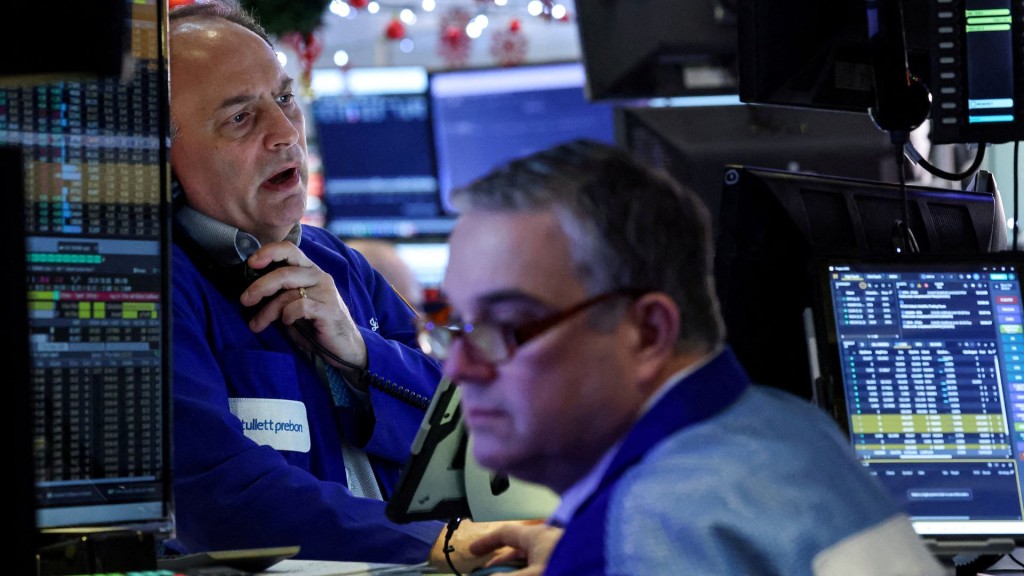
Wall Street ended sharply lower on Wednesday after the Federal Reserve held interest rates steady, with AI-related chip stocks adding to recent declines ahead of quarterly reports from Microsoft and Meta Platforms and the Nasdaq 100 index marking an 11% drop from its June record high.
The Fed's widely expected decision to leave the benchmark interest rate in the 3.50%-3.75% range drew dissents from three of the 12 members of the policy-setting Federal Open Market Committee who "preferred" a quarter-percentage-point hike at this meeting.
The benchmark S&P 500 .SPX hit its lowest level in a month, while the tech-heavy Nasdaq Composite index.IXIC was down about 9% from its June record high.
The Nasdaq 100 index .NDX dropped 2.1%, extending recent losses as investors unloaded AI-related stocks due to ongoing concerns about heavy capital spending. That index is composed of the Nasdaq exchange's most valuable non-financial companies.
Investors had mostly expected the Fed to keep rates unchanged. Inflation has been running above the central bank's target for more than five years, and up until last month it was accelerating as the war in the Middle East pushed up global fuel and food prices.
“The Fed held pat, as expected. The bigger question now though becomes, how much pressure will they have to hike in September? Inflation is running hot and with surging crude oil, the market expects the next hike to indeed be in September,” said Ryan Detrick, chief market strategist at Carson Group.
Investors worry that major U.S. companies are deepening a web of AI-linked investments and continuing to funnel billions into the emerging technology at the expense of free cash flow.
Meta Platforms META.O dropped 4% in extended trade after the social media company said it now expects 2026 capital expenditure to be between $130 billion and $145 billion, compared with its prior forecast of $125 billion to $145 billion.
Also after the bell, Microsoft MSFT.O climbed 0.6% after it topped Wall Street estimates for quarterly cloud revenue growth, a sign its massive spending on AI infrastructure was paying off.
Meanwhile, competition from China has been heating up, both in the race to develop advanced chips and as Chinese firms roll out cheaper AI models.
Speaking to reporters, Fed chief Kevin Warsh said spending on AI was laying the groundwork for future growth.
AI-related chipmakers added to recent losses after a sixfold jump in SK Hynix's 000660.KS quarterly profit fell short of lofty investor expectations. The South Korean company's shares fell 10%.
AI infrastructure company Vertiv VRT.N slumped 17% after missing quarterly revenue expectations.
The S&P 500 declined 1.52% to end the session at 7,316.15 points. The Nasdaq declined 1.74% to 24,442.94 points, while the Dow Jones Industrial Average declined 2.19% to 51,594.14 points.
Eight of the 11 S&P 500 sector indexes declined, led lower by industrials .SPLRCI, down 3.24%, followed by a 2.5% loss in information technology .SPLRCT.
Analysts on average expect S&P 500 aggregate second-quarter earnings to jump 40% from a year ago, with AI-related stocks accounting for much of that growth, according to LSEG I/B/E/S.
Strong earnings forecasts and Wall Street's recent decline have left the S&P 500 trading at about 20 times expected earnings, just above its 10-year average of 19, according to LSEG data.
Ford Motor F.N gained 2.1% after raising its annual profit outlook for a second time this year. Lennox LII.N tumbled 21% after the HVAC solutions maker lowered its annual profit forecast.
Visa V.N rose 0.6% after the company beat estimates for quarterly profit, helped by World Cup-fueled travel demand.
Declining stocks outnumbered rising ones within the S&P 500 .AD.SPX by a 1.8-to-one ratio.
The S&P 500 posted 32 new highs and four new lows; the Nasdaq recorded 121 new highs and 230 new lows.
Volume on U.S. exchanges was relatively heavy, with 17.7 billion shares traded, compared to an average of 17.3 billion shares over the previous 20 sessions.
Reuters