Read More
The Trump administration’s best hope for bringing about the lower 10-year Treasury yields they want may be to sell less of them — a tactic administration officials before taking office characterized as market manipulation, strategists at Deutsche Bank Securities said.
ADVERTISEMENT
SCROLL TO CONTINUE WITH CONTENT
Treasury Secretary Scott Bessent last week said he and President Donald Trump “are focused on the 10-year Treasury” when it comes to lower borrowing costs, not the overnight interest rate set by the Federal Reserve. The US 10-year yield is, of course, below its late 2023 peak of about 5 percent reached after the Fed raised rates 11 times to beat back inflation. But now at about 4.5 percent, the rate remains higher than at any previous point since 2007.
Because Treasury yields are determined by supply and demand in the bond market, the administration’s power over them is limited to measures that affect one or the other, Deutsche Bank’s Matthew Raskin, Matthew Luzzetti and Steven Zeng said in a Feb. 12 report.
Among the most realistic of these, the strategists said, is curtailing the supply of long-maturity Treasury fixed-rate securities relative to short-term bills. This “can dampen net public-sector supply of duration and put downward pressure on term premia.” They consider it among the highest-likelihood measures the government might take to try to bring about lower yields.
It would be “notable,” though, they wrote, because Bessent and other administration officials assailed the tactic during last year’s presidential campaign.
Trump’s team alleged that the late-2023 decision to slow the growth in long-maturity auction sizes and sell more short-maturity debt was calculated to benefit the economy before the November election.
Bessent in June said then-Treasury Secretary Janet Yellen had acted in a way that “eased financial conditions substantially.” The following month, Stephen Miran, Trump’s nominee to chair the Council of Economic Advisers, and the economist Nouriel Roubini estimated that the administration had reduced 10-year yields by about a quarter percentage point over the last year by changing the average maturity of Treasury borrowings. They said the department was “manipulating the amount of interest rate risk owned by investors.”
The new administration last week, in its first quarterly communications with investors about Treasury supply trends, left intact the Yellen Treasury’s guidance that auction sizes were probably adequate “for at least the next several quarters.”
Several Wall Street dealers had been predicting auction size increases later this year based on federal budget trends and expected the new guidance to ratify their views. With a committee of industry advisers to the department also in favor of changing it, the decision not to signaled “a potentially cautious approach to issuance under Bessent,” the Deutsche Bank report said.
Among the other ways the strategists say the administration could attempt to lower long-term Treasury yields, some are either long shots (such as making Treasuries tax-exempt) or one-shots (such as marking to market the gold on the Fed’s balance sheet).
Another one they deem likely to boost demand for Treasuries is regulatory changes that would allow banks to exclude them from the calculation of an industry risk ratio. Fed Chair Jerome Powell this week backed the change, spurring outperformance by Treasuries relative to interest-rate swaps. But Deutsche Bank predicted “less spillover to broader US rates than other measures” would have.
BLOOMBERG
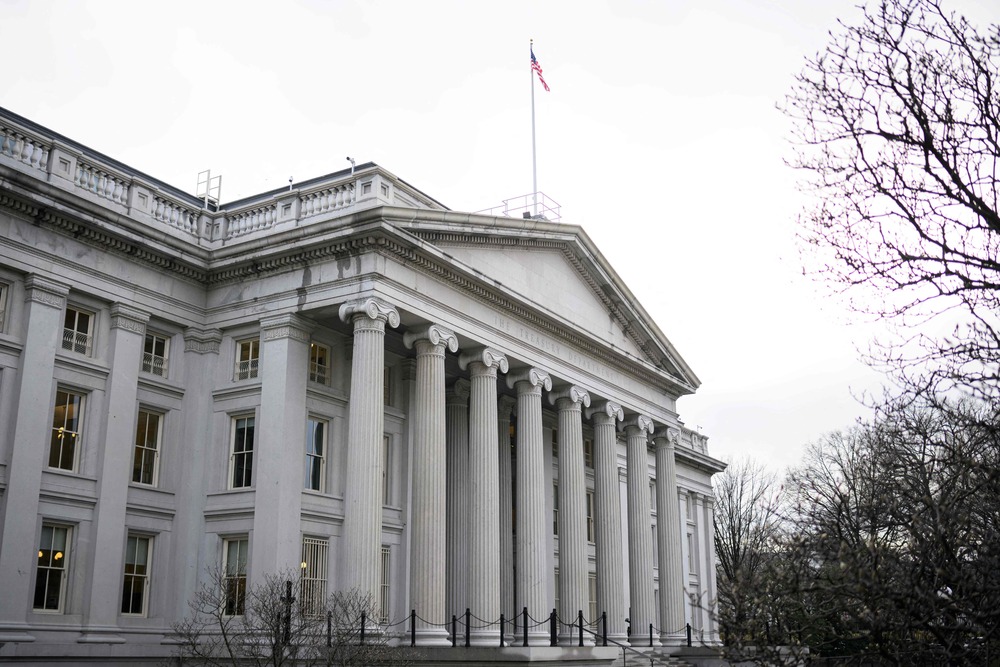
A February 6, 2025 photo shows the US Treasury in Washington, DC. AFP