Founded in 1975 and commencing its railway service in 1979, MTR strives to live up to its purpose of “Keeping Hong Kong moving” as it connects and grows communities with caring, innovative and sustainable services. The company does so not only as the city’s major public transport operator, but also as a driver for the development of sustainable communities around its stations and network.
MTR’s aspirations
MTR applies Environmental, Social and Governance (ESG) principles in managing its business through best in-class governance, helping individuals and the whole community thrive, and contributing to the fight against climate change. Their revamped corporate strategy in 2020 set not only financial objectives, but also social objectives which encompass social and environmental elements. One key area is seeking to ensure that each individual in society is able to access a safe, affordable and sustainable transport system.
Award recognition
The corporation is honoured to receive the HKMA Hong Kong Sustainability Award and five special recognition awards at the Hong Kong Sustainability Award 2020/21. These awards recognize their commitment to and relentless efforts in sustainability and creating remarkable social and economic value for their stakeholders. Gill Meller, Legal & Governance Director, expressed her thanks towards HKMA for raising the profile of sustainability and recognising its importance in society.
The pioneer of Hong Kong Green Finance
Sustainable finance arrangements are a key part of MTR’s financing strategy and, since 2016, the corporation has raised over HK$ 23 billion to fund the development/extension of railway lines, replacements of railway assets, improvements in energy efficiency and nature conservation projects, such as the management of the Lok Ma Chau wetlands.
In 2020, the largest single tranche green bond for corporations in Asia Pacific (US$ 1.2 billion) was successfully issued. A new Sustainable Finance Framework was established which reaffirmed their commitment to sustainable finance.
MTR’s Sustainable Finance Framework has contributed to the decarbonisation of Hong Kong’s transport sector while providing socioeconomic benefits. The company’s social objectives have three strategic pillars focused on social inclusion, reducing greenhouse gas emissions, and promoting advancement and opportunities for its employees and the community.
Social objectives
The public transport operator has implemented various measures to foster social inclusion within the community. Through direct dialogue with stakeholders and NGOs, the company is able to better understand and aid their beneficiaries. For those who are hard of hearing, masks with a transparent perspex window have alleviated communication problems between passengers and employees.
The company hopes the public will respond positively to their manifestation of enhanced services and upgraded station facilities that are fit-for-purpose and provide an easy-access station environment. Lifts, stair lifts, wide gates, portable ramps and accessible toilets are a few of the many facilities installed for those with mobility impairments.
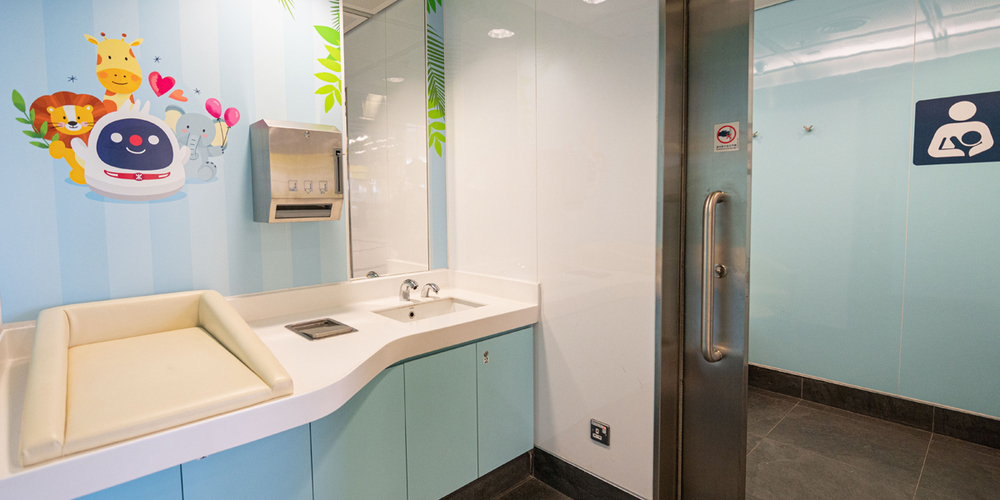
Age-friendly initiatives such as giant signage, additional seats, special alphabet cards in the customer service centre, and double handrails along long corridors at particular stations have also been implemented. Babycare rooms will also be part of the new standard design of railway stations. For those travelling with infants or toddlers, there are currently 25 MTR stations with babycare rooms and breastfeeding areas.
During the pandemic, MTR’s imperative has been to safeguard the health of its passengers, employees and contractors by increasing the frequency of intensive cleansing routines, deploying sanitising robots to thoroughly disinfect trains and even applying Nano-Photocatalyst coating in their trains. The cleaning robots can get into hard-to-reach areas and help staff in handling cleaning chemicals. Staff are also provided with appropriate personal protective equipment and surgical masks.
Advancing communities with opportunities
Future skills and innovation is another key focus area of the company in its R&D collaborations with local universities and other academic institutions. Working with their suppliers and business partners creates growth opportunities in the city and the corporation is also focused on supporting the personal and professional development of staff. Two noteworthy examples include the ‘Train’ for Life’s Journeys programme which supports students’ career and life planning as well as all-encompassing development; the other is the MTR Academy, a global training and research hub in Hong Kong which develops railway professionals around the world.
MTR’s three-fold carbon strategy
The company has installed solar panels on some of its properties, such as the MTR headquarters building and on the top of one of the new generation Light Rail Vehicles to support the development of renewable energy in Hong Kong. Their decarbonization strategy firstly aims to continue being a low carbon public transport provider in Hong Kong; secondly the implementation of suitable carbon reduction measures; and lastly the adaptation and resilience of their network and properties to adapt to increasingly extreme climate events.
MTR has already implemented a range of carbon reduction measures. Their regenerative braking technology makes use of kinetic energy during train braking and converts it into electrical energy which is then looped back into the power supply network through the overhead power system to be used by other trains. A large-scale chiller replacement project is simultaneously underway. As of 2020, nearly 60% of the chillers have been replaced. By the time the project is completed, expected to be in the first quarter of 2023, it is targeted to reduce electricity consumption by 30% compared to 2017.
The company is currently undertaking a decarbonisation study to set long term carbon reduction targets up to 2050. Installations of water dispensers at stations, the launch of the “Carbon Footprint Challenge” through the MTR mobile app, and development of a brand new mobile app “Carbon Wallet” are all part of MTR’s various initiatives to promote a low carbon lifestyle in the city.
Hin Keng Station
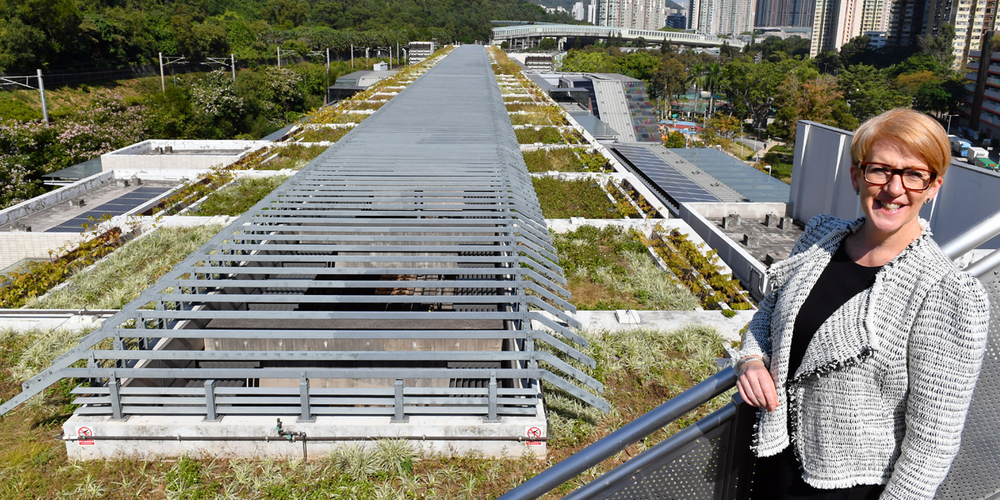
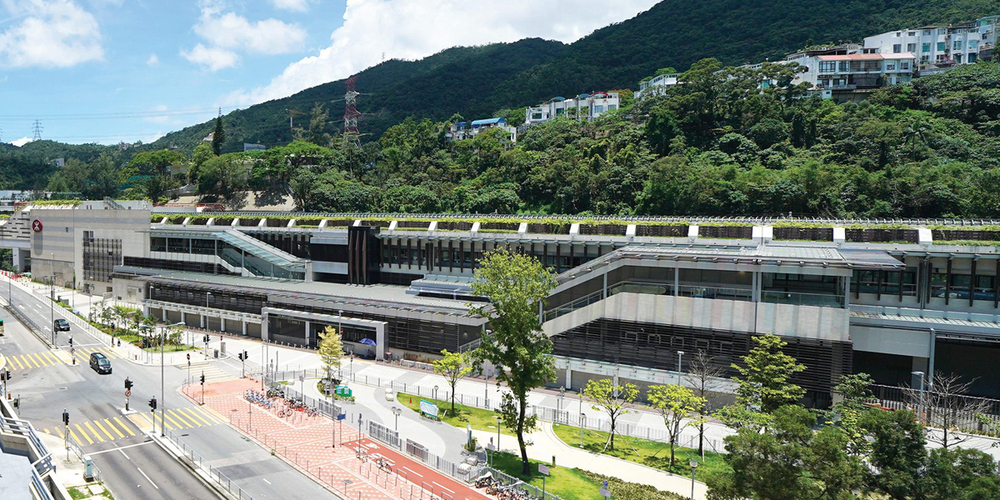
The station resembles MTR’s future green station model, utilising mostly natural lighting and cross-ventilation. The semi-enclosed station incorporates shading made from environmentally friendly materials and there is also a green roof of about 5,000 square metres on the station. Taking advantage of natural elements, Hin Keng Station has a green, low carbon and sustainable design.
Looking forward
Through MTR’s low-carbon transportation network and property developments, they enable cities and their people to move forward and make progress. With the new corporate strategy and social objectives in place, the corporation will continue to grow alongside the community and with their stakeholders to build a more sustainable and inclusive future, making them an internationally-recognised company that connects and grows communities with caring, innovative and sustainable services.
Gill Meller, Legal & Governance Director, at the green Hin Keng MTR station
Hin Keng Station - Instilling a green, low carbon and sustainable design
Babycare rooms will be part of the new standard designs of new railway stations