Roxanne Li
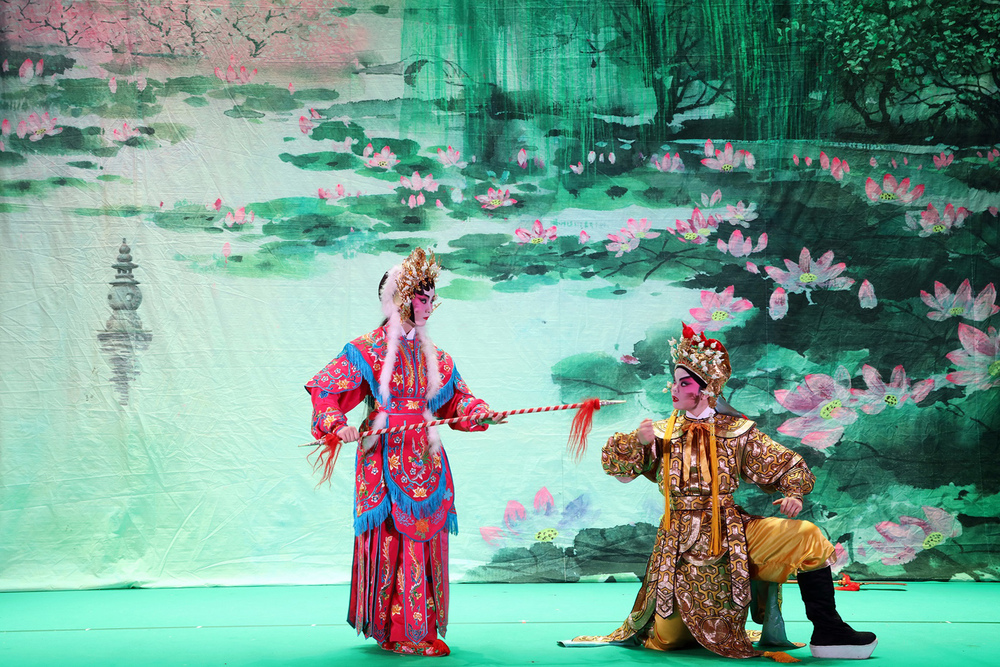
Don don don clang! Millions of Hongkongers have grown up with the Cantonese opera's distinctive gong and drum sound, known as lohgu in Cantonese.
The Research Center for Transmission of Cantonese Opera at the Education University of Hong Kong is exploring innovative ways to integrate modern technology and culture into this ancient art form.
Recently, the center developed and launched Yueju Accomp, an iPad app that serves as a Cantonese opera accompaniment tool, enabling people to learn and master Cantonese opera in one place.
In addition, the center conducted a survey in April to identify the motivating factors for watching Cantonese opera performances in Hong Kong, clarifying the profiles and characteristics of the viewers.
The survey also provided solutions for expanding the audience and promoting public education.
"The work of the center is mainly focused on three areas: education, research and promotion," said director Leung Bo-wah, who is also a professor at the university.
"Established in 2018, the center's objective is to preserve and promote the art of Cantonese opera and to develop high-quality teaching and learning materials of Cantonese opera in the contexts of formal and non-formal education," said Leung.
He added that Cantonese opera has transformed from a leisurely entertainment activity to a sophisticated modern art form.
"Similar to classical music, which mainly appeals to the middle class, Cantonese opera also requires a greater number of individuals to appreciate it."
Raising interest from public groups and educating young performers are Leung's intention to lead the development of Yueju Accomp.
Leung team developed the app, which was released in March, to allows user to manipulate sounds and notes with multi-touch gestures on tablets using an expression grid.
Ten default scores are preloaded into the app, such as Song of a Barbaric Land from the Romance of the Phoenix Chamber and Fragrant Sacrifice.
Twelve types of melodic instruments (including the erhu, pipa, guzheng and violin) and 14 types of percussion instruments (such as cymbals and mukjyu), along with five sins (such as keys and scales), are available under each finger click.
"During the process of learning Cantonese opera, young performers may lose confidence because of inaccurate pitch and singing out of tune. But this application will solve these problems," said Leung.
Earlier the center established an In-Service Music Teachers on Cantonese Opera Education workshop for and trained primary and secondary school music teachers to learn Cantonese opera teaching skills under the invitation of the Education Bureau of Hong Kong.
"Hong Kong's school music curriculum now encourages the study of Cantonese opera, but many teachers do not like to teach it in school, often due to their background in Western music. That is why we need to train teachers," said Leung.
"Schools are the best place for universal education. According to our survey on audience motivation, most Cantonese opera audiences belong to older age groups. This further highlights the need for younger generations to join the audience, as they are the ones who will appreciate this art in the future."
One of the center's most notable works is its 3D computerized kinetic chain assessment and learning system.
Along with 3D body sensing and motion-capture technology, the system includes Cantonese opera movements demonstrated by local Cantonese opera master Yuen Siu-fai and artist Ng Lap-hei.
Additionally, the system is equipped with 19 sensors to track joint movements of body parts and provide users with instant feedback on their body shape when they wear the system equipment to train their body movements.
"Remember those days when we were learning Cantonese opera, and we were used to being scolded and punished by our masters?" said Yuen. "Now we can make use of modern technology in training. You can also view your performance."
"Students will think that Cantonese opera is very old, but it is actually very trendy."
EdUHK professor Magdalena Mo Ching-mok said: "With the same concept, the system can be modified and fitted for other assessment and training programs. In fact, other than just using this system for Cantonese opera, we applied this system in another project for training children with autism spectrum disorders. The result is very satisfactory."
Leung also mentioned the commercialization of Cantonese opera development.
"Nowadays, the development of Cantonese opera is becoming increasingly modernized. There is no doubt that the quality of actors' and cast members' performances need improvement, and the performance content evolved from pure improvisation in the past to modern, rigorous script creation.
"Additionally, the program effects and installations of performances should be more advanced and modern, and the script should also be updated in line with the times," he said.
Market forces should also play a part, he added."The number of performances needs to strike a balance between supply and demand. The market should be a mechanism that eliminates the weak and retains the strong. We should not let bad performers drive out good ones and dilute the audience.
"We need competition; only then can we make progress and cultivate better performers."
roxanne.li@singtaonewscorp.com