Read More




Powering Hong Kong’s data-driven future | Nuts and Bolts | Edmund Leung
16-09-2026 00:05 HKT


Standards on moving ground | Human Reinvented | Frank Ng & Ryan Ng
15-09-2026 01:59 HKT



The three-runway system of Hong Kong International Airport was successfully commissioned in 2024, providing the capacity to meet the passenger and cargo air traffic demand, and allowing for long-term growth.
Constructing the system required reclamation to provide new land for expanded airport infrastructure, including runways and taxiways, the new concourse and other airport facilities. Some critics might have been concerned with its effects on nature and biodiversity.
Being a responsible organization, the Airport Authority would mitigate all and any deterioration in ecology and biodiversity, and a lot of planning has gone in place to ensure minimal impact to environment, incorporating many compensating actions.
In my previous articles, I have already described the construction of the system using deep cement mixing method to stabilize the seabed, which contained contaminated mud pits without need for dredging.
Another innovative construction method used was horizontal directional drilling to intersect two 5.2-kilometer-long pipelines in the rock stratum from opposite ends of the airport island and Sha Chau. It is a world record for longest pipelines installation using this method.
Moving from the three-runway system to a broader scope of biodiversity, the AA has worked with other organizations to formulate a clear strategy on marine ecology and fishery enhancement.
This includes the establishment of two funds: the marine ecology enhancement fund - or MEEF - and the fisheries enhancement fund - or FEF. These funds, with a total initial capital injection of HK$400 million, enabled a series of projects run by local universities, research organizations and fisheries industry associations to be executed.
The funds are set up for the purpose of enhancing marine environment for the benefit of ecology, including Chinese white dolphins, and fisheries resources in the vicinity of the project area, in Hong Kong's western waters and further afield into the Pearl River Estuary. The FEF also provide support and assistance to affected fishers, and to encourage more sustainable fishing operations.
Here I must declare interests as I have been appointed a director of the trustees of the funds from their inception.
Examples of some projects supported by the funds include pilot projects for pearl farming in Hong Kong's marine waters and for crayfish farming in an industrial godown, studies on the ecological risks of microplastics on horseshoe crabs and on the value of mangrove forests in the Pearl River Estuary as fish habitats. The former two are embryo projects for commercial production of pearls for jewelry and exquisite seafood for boutique restaurants, and the latter two are for supporting the development of ecology conservation and management measures.
In addition, the AA has provided key support to the government on the designation of the North Lantau Marine Park in 2024 that aims to protect the marine habitat in western waters and to compensate for any impact of the three-runway system.
Combined with the adjacent existing marine parks, this provides a 4,570-hectare protected area that is expected to enhance the habitat of the Chinese white dolphins, a precious and protected species of marine mammals in the South China Sea, apart from the rich fisheries resources in the area.
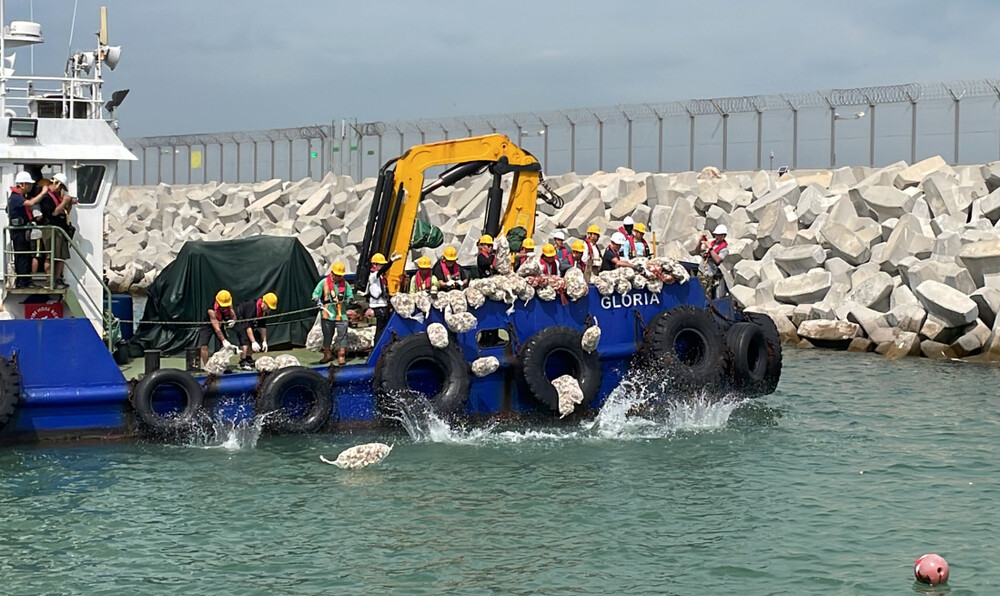
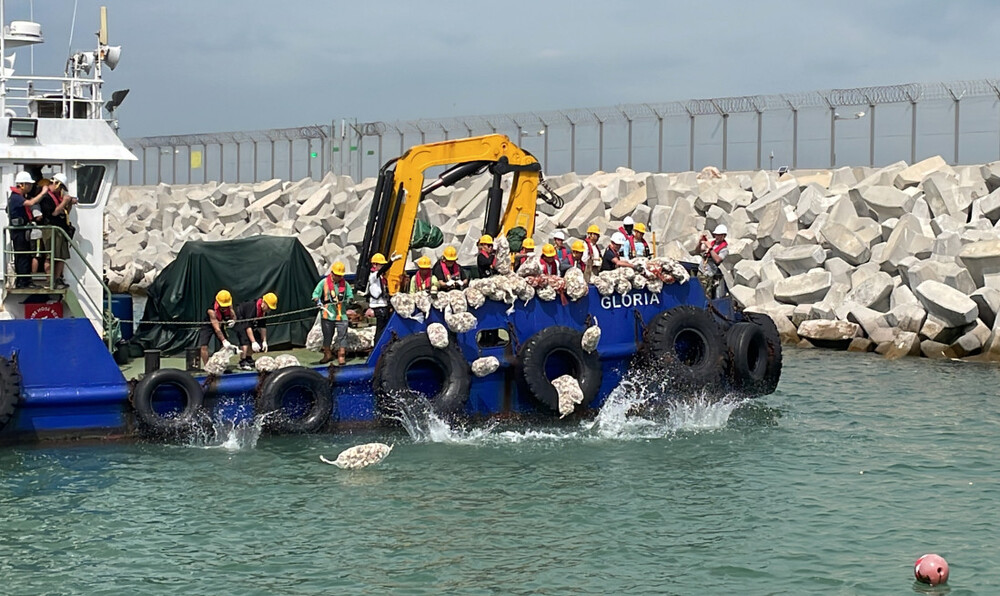
Artificial reefs and shellfish reefs provide safe habitats for marine growth, and already we are seeing a much wider variety of shellfish, and up to five times more species than when the project started in 2021.
The AA has also implemented large-scale fish restocking, releasing over 28,000 fish fingerlings and 1,000,000 shrimp fry into the Lantau waters in recent years as it aims to assist with sustained fishery growth.
In recognition of these efforts, HKIA was awarded platinum recognition by the ACI Asia-Pacific and Middle East Green Airports Recognition program in 2024.
Within Hong Kong, HKIA also received three awards last year in the climate disclosure contribution category at the Hong Kong Green and Sustainable Finance Awards, organized by the Hong Kong Quality Assurance Agency, as the first organization to disclose climate-related financial information.
With these accolades, the AA can proudly claim to be the greenest airport in this region. Building large-scale infrastructural projects are vital for development of Hong Kong, but we must ensure that in constructing them, we do not ignore the need to preserve the environment for our sustainable future.
Veteran engineer Edmund Leung Kwong-ho casts an expert eye over features of modern life