Read More
China has developed innovative green business models in windbreak and sand fixation efforts on desertified land, adopting a comprehensive approach that integrates electricity generation, planting and grazing.
ADVERTISEMENT
SCROLL TO CONTINUE WITH CONTENT
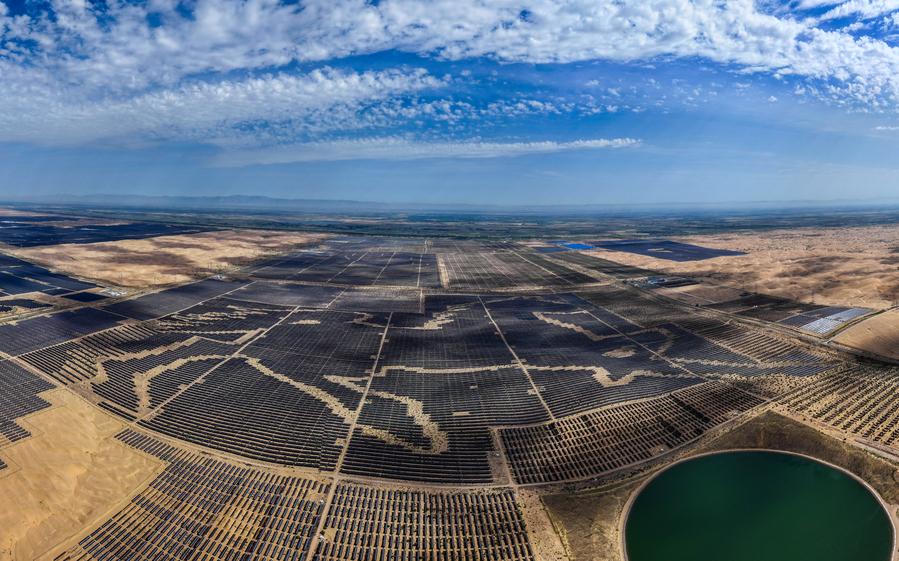
An innovative method using photovoltaics to combat desertification has been implemented in the Three-North region – a vast and ecologically fragile area spanning China’s northwest, north and northeast, characterized by drylands and extensive sandy, desertified terrain.
This multi-dimensional control model allows solar panels to absorb sunlight and convert it into electrical energy above ground, while drought-resistant plants are cultivated beneath the panels. Livestock such as cattle and sheep graze in the spaces between the solar arrays, reported East Week magazine, sister publication of The Standard.
The Three-North region is also leveraging unique desert resources to cultivate industries such as Chinese herbal medicine, forage grass, fruit forests and desert tourism, thereby stimulating local economic development.
In Jimsar County, located in Xinjiang, a “grazing-photovoltaic complementarity” model has transformed over 500 hectares of Gobi desert into a power generation base where sheep graze among the solar panels.
The base produces more than 400 million kilowatt-hours of electricity annually, saving 130,000 tonnes of coal and reducing carbon dioxide emissions by 330,000 tonnes each year.
Meanwhile, the nation has accelerated the development of new mechanized tools for forestry and grassland management tailored to the Three-North Shelterbelt Forest Program.
According to a catalog of mechanical equipment released by the National Forestry and Grassland Administration, tree-planting robots, sand barrier installation machines, and intelligent photovoltaic desert control robots have all been deployed.
To support research and development, the Chinese Academy of Forestry plans to establish 15 sci-tech innovation hubs and set up high-quality development research institutes in the Three-North region.
Researchers are also tackling one of the shortcomings of solar power generation – its dependence on weather conditions – by developing improved methods for storing the electricity produced.
Upon completion, the integrated photovoltaic and all-vanadium redox flow battery energy storage project in Jimsar County will allow electricity to be stored for up to five hours, compensating for the lack of sunlight at night.
Transforming the “Sea of Death” into an “Oasis of Solar Panels”
China has adopted another approach to combat desertification by partitioning deserts with cross-desert roads for targeted management, leveraging local resources to develop various industries and support rural revitalization.
Located in Inner Mongolia, the Kubuqi Desert was once known as the “Sea of Death,” plagued by relentless sandstorms. It has now been transformed into a “blue sea and green oasis,” with layers of solar panels covering the landscape.
This remarkable change follows the Kubuqi solar desert control project, operated by China General Nuclear Power Corporation, which has effectively restored 2,266 hectares of desertified land.
The project has built six solar power stations with a total installed capacity of 820,000 kilowatts, generating about 1.5 billion kilowatt-hours of electricity annually – enough to benefit approximately 400,000 people.
“Photovoltaic components can block and reduce wind, while the foundation piles beneath them help stabilize the sand,” explained a manager of the Gesang Power Station. “The solar panels form a shield-like formation, effectively hindering the movement of sand dunes.”
He added that the photovoltaic panels are equipped with sun-tracking functionality, allowing them to rotate like sunflowers following the sun and continuously convert sunlight into electricity.
The power station also uses straw checkerboards to stabilize shifting sand and sows drought-resistant plants such as sand willow and Mongolian apricot. Beneath the photovoltaic panels, economic crops are cultivated, enhancing the project’s economic returns.
A Cool Climate Makes an Ideal Location for Data Centers
Beyond solar energy projects, advanced desert farming techniques have also contributed to China’s efforts to combat desertification.
With the launch of the Kekeya Afforestation Project in the Aksu region, a cumulative total of 80,000 hectares of trees have been planted, successfully establishing an artificial forest where the famous Aksu apples are grown.
Due to its high latitude and an annual average temperature of only 7 degrees Celsius, Inner Mongolia also offers an ideal location for computer data centers, as supercomputers require cooling during high-speed operations.