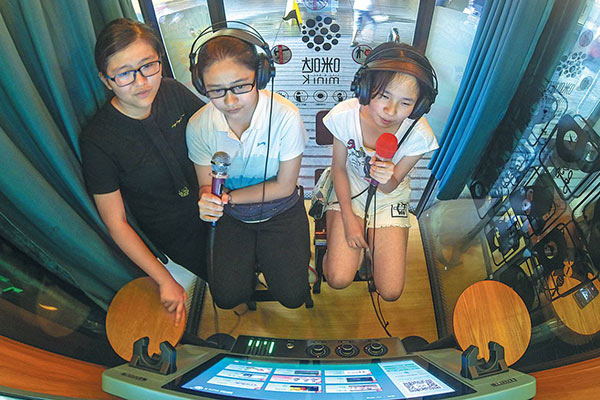
China will establish a list of karaoke songs to ban those containing "illegal content" at karaoke venues across the country starting from October 1, the Ministry of Culture and Tourism said, Reuters reports.
This follows many attempts in music censorship by the Chinese authorities, which had taken down many Cantopop songs it deemed undesirable in the past and censored Hong Kong singers such as Denise Ho Wan-see and Anthony Wong Yiu-ming.
Such content includes that which endangers national unity, sovereignty or territorial integrity, violates state religious policies by propagating cults or superstitions, or which encourages illegal activities such as gambling and drugs, the ministry said on its website on Tuesday.
Content providers to such karaoke venues will be responsible for auditing the songs, it said, adding that China has nearly 50,000 entertainment outlets with a basic music library of over 100,000 songs, making it difficult for venue operators to identify illegal tracks.
The ministry said it encouraged content providers to supply "healthy and uplifting" music to these venues.
China heavily regulates and scrubs content like violence, pornography, or politically sensitive commentary from social media and websites and has in recent months punished livestreaming to video platforms for hosting content it deems "low taste".
Although the Chinese government has not issued an official list of banned songs in the past, music censorship in the Mainland is nothing new as many Cantopop song had been taken off shelf in the past.
Many of these songs were censored because they were deemed “politically sensitive” by the Mainland authorities. These include “Queen's Road East” by Lo Ta-yu for portraying Hongkongers' anxiety to the 1997 handover. The theme song of the Hong Kong movie “A Chinese Ghost Story II” was also censored as its lyrics were believed to be hinting about the Tiananmen Square Massacre in 1989.
The works of some local singers were also taken off shelf in the Mainland due to the artists' pro-democracy political stance. Examples include Denise Ho Wan-see and Anthony Wong Yiu-ming, who were vocal supporters of the 2014 Occupy Central Movement.
In July this year, the song “Galactic Repairman” by Dear Jane was taken off shelf by the Mainland music streaming service provider QQ Music after its lyrics, which included the words “chaos” and “confront”, sparked political controversies in the city.
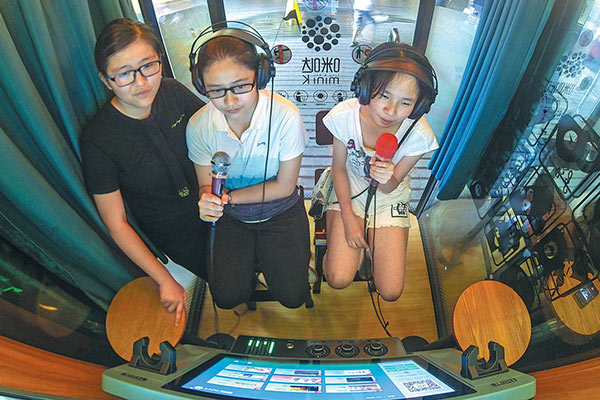
Music fans sing in a self-service karaoke booth at a shopping center in Chengdu, capital of southwestern Sichuan province.







![A Kinetica 1-Y5 commercial carrier rocket with 15 satellites onboard blasts off from a commercial aerospace innovation pilot zone in Northwest China, Nov 11, 2024. [Photo/Xinhua]](https://image.hkstandard.com.hk/f/1024p0/0x0/100/none/9d75efaf2880111bc04de3f4e79a2647/2026-04/v.jpg)