Read More
Japan's unmanned Moon lander woke up after surviving a second frigid, two-week lunar night and transmitted new images back to Earth, the country's space agency said Thursday.
ADVERTISEMENT
SCROLL TO CONTINUE WITH CONTENT
"We received a response from SLIM last night and confirmed that SLIM had successfully completed its second overnight," the Japan Aerospace Exploration Agency (JAXA) said in a post on the official X account for its Smart Lander for Investigating Moon (SLIM) probe.
"Since the sun was still high in the sky last night and the equipment was still hot, we recorded images of the usual scenery with the navigational camera, among other activities, for a short period of time," it added.
A black-and-white photo of the rocky surface of a crater accompanied the post on X, formerly Twitter.
The SLIM lander touched down in January at a wonky angle that left its solar panels facing the wrong way.
Around three hours after the landing -- which made Japan only the fifth nation to touch down on the Moon -- JAXA decided to switch SLIM off with 12 percent power remaining to allow for a possible resumption later on.
As the sun's angle shifted, the probe came back to life in late January for two days and carried out scientific observations of a crater with a high-spec camera.
But the spacecraft was not designed for the freezing, fortnight-long lunar nights, when the temperature plunges to minus 133 degrees.
So space agency scientists had cause for celebration when it was successfully revived in late February after its first lunar night.
JAXA has dubbed SLIM the "Moon Sniper" for its precision landing technology.
The aim of the mission is to examine a part of the Moon's mantle -- the usually deep inner layer beneath its crust -- that is believed to be accessible.
Thursday's news came after an uncrewed American lander called Odysseus -- the first private spaceship to successfully land on the Moon -- was unable to wake up, its manufacturer said on Saturday, even after its solar panels were projected to receive enough sunlight to turn on its radio.
AFP
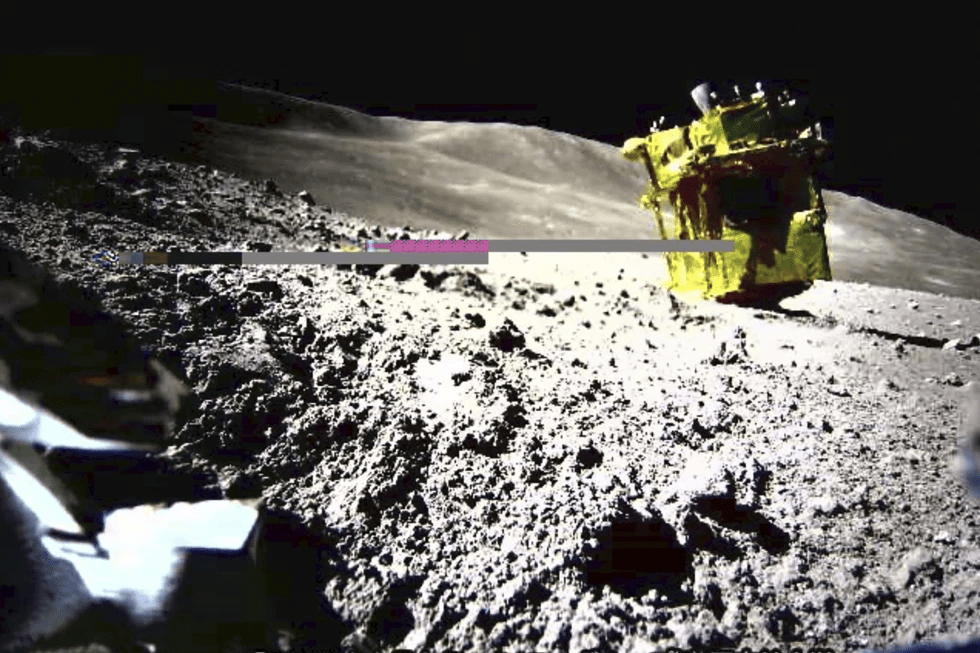
FILE - This image provided by the Japan Aerospace Exploration Agency (JAXA)/Takara Tomy/Sony Group Corporation/Doshisha University shows an image taken by a Lunar Excursion Vehicle 2 (LEV-2) of a robotic moon rover called Smart Lander for Investigating Moon, or SLIM, on the moon. A Japanese moon explorer, after making a historic “pinpoint” lunar landing last month, has also captured data from 10 lunar rocks, a far greater than expected work that could help find the clue to the origin of the moon, its project manager said Wednesday, Feb. 14 , 2024. (JAXA/Takara Tomy/Sony Group Corporation/Doshi