Staff reporter
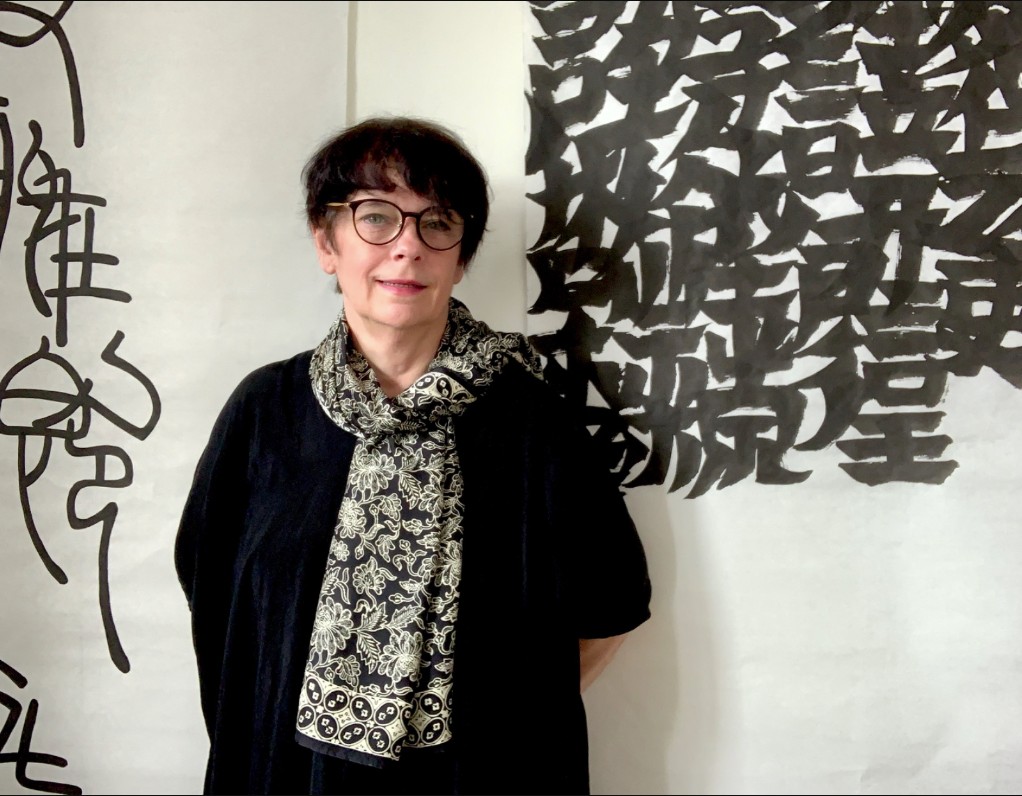
In her Hong Kong apartment, Belgian artist Hilde Mertens carefully studies a sheet of mulberry paper hanging on what she calls her "drywall" – a space where her unfinished calligraphy works await completion. Sometimes a piece might hang there for months before she knows exactly where to place the next brushstroke. One mark too many, and "it goes into the bin."
This meticulous approach to Chinese calligraphy might seem surprising coming from a European investment banker. But Hilde has carved out a unique artistic space that bridges Eastern and Western traditions while exploring a fundamental question: "Is one stroke still art or does it just totally fall into the ditch?"
Hilde's journey to becoming a calligraphy artist began with her academic pursuit of Chinese studies and economics. "I told myself, if you want to talk about it, you go to China and get a job," she explains. Her first position in Beijing launched a career that would take her through London, Singapore and, eventually, Hong Kong, where she now works in change and leadership consulting.
Throughout her banking career, Hilde kept her artistic pursuits private. "I would never tell my colleagues that I was doing art in the weekend," she admits, "because I thought they would think, what is she doing?"
Her entry into Chinese calligraphy came through frustration. After seeing works by Western artists like Cy Twombly and Brice Marden who were influenced by Eastern brushwork, Hilde became curious about the technique behind their fluid strokes. She realized these Western artists had been fascinated by Chinese calligraphy but lacked access to proper training during China's closed periods.
Through a Chinese art friend, Hilde was introduced to a master who taught her the northern Beiwei system at the level of individual brushstrokes. "The technique, you will not compromise," she emphasizes. "A calligraphy stroke has a beginning, middle, and end."
What makes Hilde's work distinctive is how she has freed herself from traditional character forms while maintaining authentic brushwork technique. Rather than focusing on the meaning of characters, she concentrates on the energy and form of the strokes themselves.
"I practice the technique," she explains, "but I pull it out and start playing with the form, with the flow, with the empty spaces." The result is art that immediately registers as calligraphy to Chinese viewers but appears in an unexpected format.
Her works range from pieces inspired by oracle bone script (the earliest form of Chinese writing) to flowing abstractions based on running script. Some pieces evoke landscapes without directly depicting them. "I wrote a landscape," she says of one work, emphasizing that she's writing rather than painting.
The philosophy of emptiness is central to her approach. Unlike Western painting traditions that fill canvases completely, Hilde embraces negative space. "If I had filled up that open space," she says, pointing to an area in one painting, "then the painting is gone."
The liminal space between cultures fuels her exhibitions, which she organizes with her friend Annie Tsoi. These events bring together Eastern and Western audiences, encouraging dialogue about cultural differences in art and language. "Art is the easiest way to bring people together," Hilde believes.
Looking ahead, she dreams of creating a Chinese calligraphy version of Monet's Water Lilies room – an immersive, oval space filled with brushstrokes from different calligraphic styles that would create a meditation-like environment.
For now, though, she continues exploring the endless possibilities of brushwork, ink, and paper. "If you have 3,000 years of calligraphy," she says, "I will always find another book and another master and another piece."
In bridging East and West through the ancient art of calligraphy, Hilde has found not just artistic expression but a philosophical approach to navigating between worlds.