Japan's relaxation of its weapons-exports rules opens a path for talks that could one day lead to Tokyo supplying military equipment to help Ukraine resist Russia's invasion, Kyiv's ambassador to Japan told Reuters.
"This allows us to talk," Yurii Lutovinov said in an interview at Ukraine's embassy. "Theoretically, it's a very big step forward."
Prime Minister Sanae Takaichi's move last week to ease export rules - Japan's latest shift away from a strict postwar pacifist stance - has sparked broad interest as conflicts in Ukraine and the Middle East strain Western arms production.
While the overhaul maintains controls on exports to conflict zones, it allows exceptions that serve Tokyo's security interests, a caveat Kyiv hopes to benefit from.
UKRAINE SEEKS INVESTMENTS FOR MISSILE DEFENCE
Japan has linked Ukraine's fate to its own security as it faces China's growing military power. With Japanese territory stretching to within 110 km (70 miles) of Taiwan, Tokyo worries that any attempt by Beijing to seize the island could draw it into a conflict.
Soon after Russia launched the war against its smaller neighbour in 2022, Japan's then-Prime Minister Fumio Kishida warned that "Ukraine today could be East Asia tomorrow". He approved Japan's biggest military buildup since World War Two, a plan Takaichi has accelerated since taking office in October.
"If Ukraine falls, it's going to be a big domino effect," Ambassador Lutovinov said. "That's why the Indo-Pacific and the European continent are inseparable from the point of view of our security."
Japan's Foreign Ministry and the Prime Minister's Office did not immediately respond to requests for comment.
Takaichi has given no public indication she would support arms exports to Ukraine. She told President Volodymyr Zelenskiy in November that “Japan stands with Ukraine” and supported its "efforts toward achieving a just and lasting peace" as soon as possible, her office said in a readout of their phone call.
Like other countries eyeing Japanese military gear, Ukraine would need to conclude a defence and equipment technology transfer agreement with Tokyo. Japan has made such agreements with 18 countries, including Germany, Australia, the Philippines and Vietnam.
Lutovinov said Ukraine was treading carefully because of the sensitivity of defence exports in Japan.
More immediately, he said, Tokyo could help fund Kyiv's development of an air-defence system that would reduce its reliance on U.S.-made Patriot missiles, which are in increasingly short supply.
"We have all necessary industrial capacities for production. But we need investment. We need funds," he said.
JAPAN COULD JOIN NATO ARMS-FUNDING PLAN, ENVOY SAYS
Discussions are also under way about Japan contributing to NATO's Prioritised Ukraine Requirements List, or PURL, a programme that funds purchases of U.S.-made equipment for Kyiv, Lutovinov said.
The programme has supplied more than $4 billion of equipment and munitions, with Australia and New Zealand last year becoming the first non-NATO countries to join.
"Every country can participate in this mechanism respecting its own legal framework. It can be non-lethal weapons as well," Lutovinov said.
Japanese firms could help Ukraine diversify the sources of electronics and micro-components it needs for the thousands of drones it has deployed on the front lines, he said. Chinese-made components have historically dominated Ukraine's drones, according to a 2025 report by Ukrainian think tank Snake Island Institute.
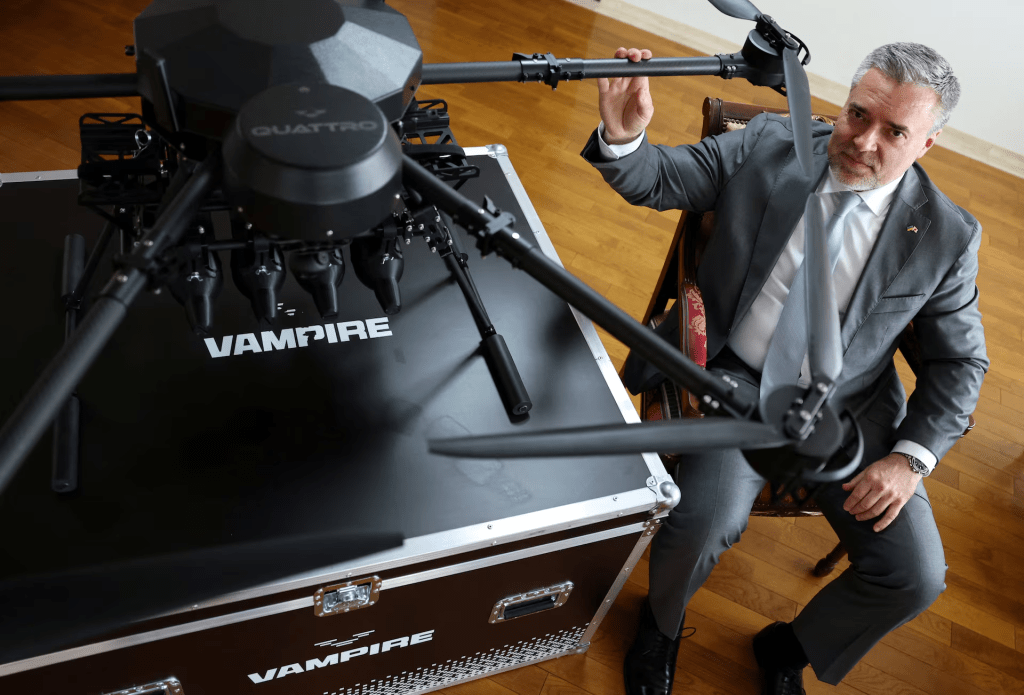
Behind Lutovinov in the embassy reception room sat a Vampire bomber drone built by Skyfall, a leading Ukrainian manufacturer of low-cost drones that says it now has enough production capacity to export.
Takaichi's administration plans to unveil a defence strategy and military procurement plan this year that is expected to call for a significant increase in the air, sea and land drones of the kind that Kyiv has used to repel Russian attacks.
"We are not the country that would like to just ask. We are the country that is going to provide as well," said Lutovinov. "The technology of Japan and experience of Ukraine, if we can put them together, it would be a high-class product."
Reuters