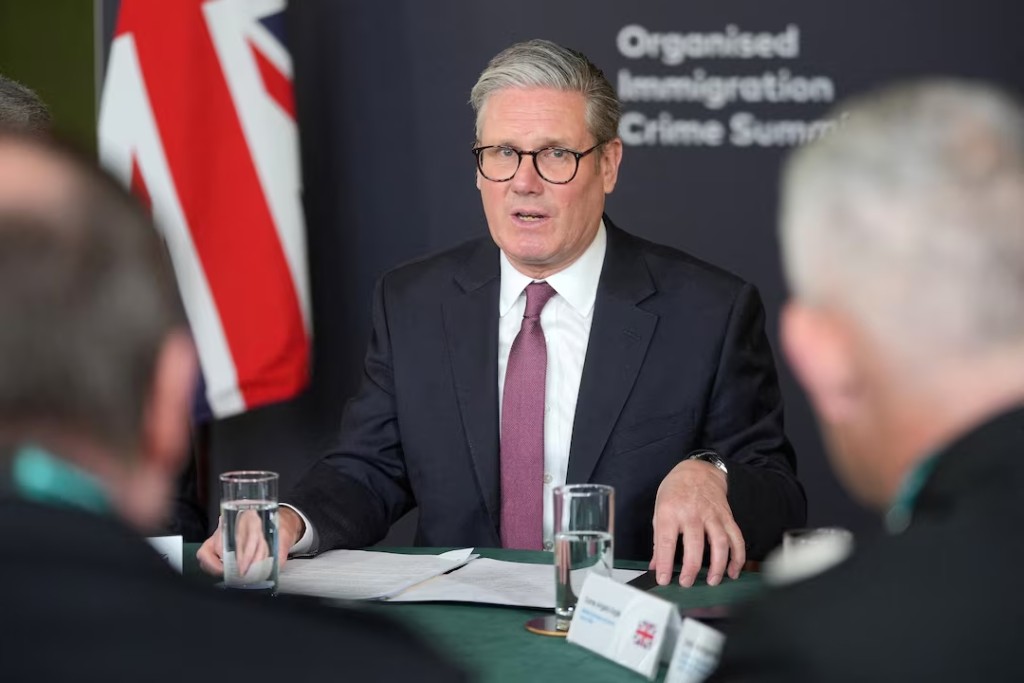
The British government outlined plans on Sunday to end what it called the "failed free market experiment" in mass immigration by restricting skilled worker visas to graduate-level jobs and forcing businesses to increase training for local workers.
British Prime Minister Keir Starmer is under pressure to cut net migration after the success of Nigel Farage's right-wing, anti-immigration Reform UK party in local elections this month.
Under the government's new plans, skilled visas will only be granted to people in graduate jobs, while visas for lower-skilled roles will only be issued in areas critical to the nation's industrial strategy, and in return businesses must increase training of British workers.
The Labour government said the changes will be part of a policy document, known as a white paper, to be published on Monday setting out how ministers plan to reduce immigration.
Starmer wrote on X on Sunday that previous Conservative governments had "lost control of our borders".
"I won't stand for it. I promised to restore control and cut migration, and I'm delivering with tough new measures," he added.
Labour promised in its general election manifesto last year to significantly reduce net migration, which stood at 728,000 in the 12 months to last June.
High levels of legal migration were one of the major drivers behind the vote to leave the European Union in 2016 with voters unhappy about the free movement of workers across the bloc.
After Britain eventually left the EU in 2020, the then Conservative government reduced the threshold to allow workers in categories such as yoga teachers, dog walkers and DJs to be eligible for skilled worker visas.
"Net migration must come down," interior minister Yvette Cooper wrote in the Sunday Telegraph, a day before she presents the government's Immigration white paper to parliament.
"We inherited a failed immigration system where the previous government replaced free movement with a free market experiment," Cooper said. "We are taking decisive action to restore control and order to the immigration system."
Cooper's Home Office on Sunday said that the plans will include new powers to deport foreign criminals committing offences in the UK.
Currently, the government is only informed of foreign nationals given prison sentences, while deportation arrangements generally focus on those sentenced to more than a year in prison.
"Under the new arrangements, the Home Office will be informed of all foreign nationals convicted of offences.... and will be able to use wider removal powers on other crimes," said the ministry.
"Those who come to the UK should abide by our laws," said Cooper.
"The system for returning foreign criminals has been far too weak for too long. We need much higher standards," she added,
The "radical package of reforms" will also target lower skilled immigration, said Cooper.
Cooper said that she aims to cut 50,000 lower-skilled worker visas this year.
There will also be "clearer rules" in areas such as immigration on the grounds of family connections in an attempt to cut abuse in the system, said the minister.
"These changes are essential to end the chaos left by the Tories in the immigration system and to regain control," she added.
While post-Brexit changes to visas saw a sharp drop in the number of European Union migrants to Britain, new work visa rules and people arriving from Ukraine and Hong Kong under special visa schemes led to a surge in immigration.
Net migration, or the number of people coming to Britain minus the number leaving, rose to a record 906,000 people in the year to June 2023, up from the 184,000 people who arrived in the same period during 2019, when Britain was still in the EU.
(Reuters and AFP)