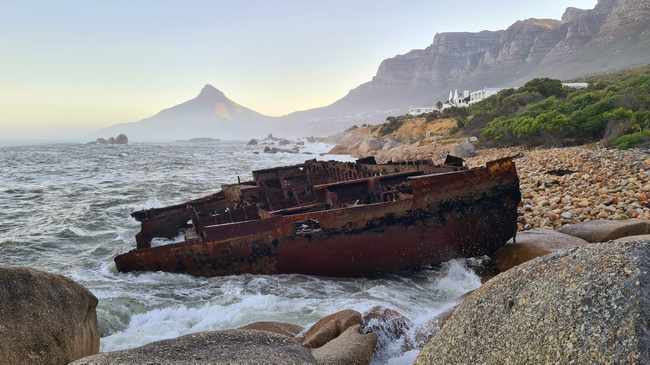
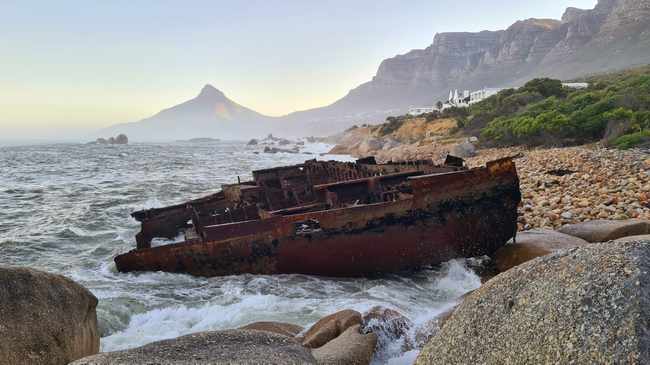
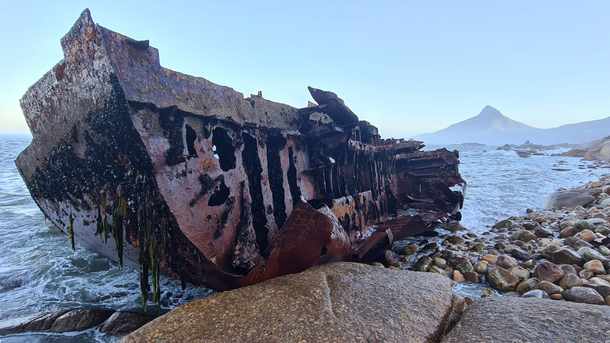
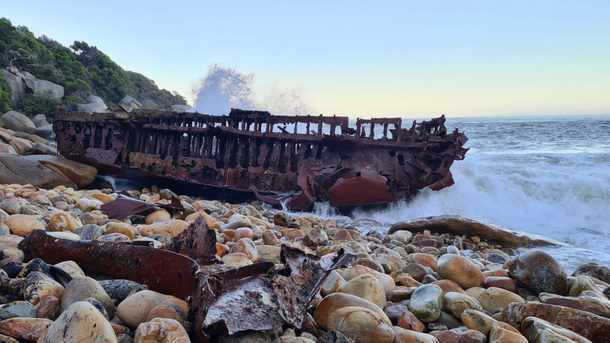
The rusted remains of the Greek ship ‘Antipolis,’ which sank 44 years ago, washed ashore at an area known as the 12 Apostles, south of Cape Town on Friday, according to the City of Cape Town and news outlet IOL.
The city said that the Greek tanker, built in 1959 and sinking in 1977, was dislodged from its watery resting place after intense wave and wind activity caused by the full moon 3 days ago.
In July 1977, along with another vessel called the Romelia, the ship was being towed by the small Japanese tug the Kiyo Maru 2 from Greece to a shipbreaker in Taiwan. As the flotilla approached Table Bay in South Africa, it was met by howling gale-force winds, common to The Cape of Good Hope. The rope holding the Antipolis to its tug snapped, and the vessel came adrift only to be slammed into a reef at Oudekraal, where it sank and was partially submerged.
The other ship, Romelia, causing its tug to flounder in the storm, was cut loose, and it too crashed into the rocky coastline at Sunset Rocks in Llandudno bay, a few hundred meters away. The Romelia broke in two and sank.
Antipolis’ wreck site was visible from shore at low tide, and the spot became extremely popular with divers.
Large swells on the Cape’s coast were reported On Wednesday, the result of an intense storm in the Southern Ocean – a mid-latitude cyclone, according to the South African Weather Service’s (SAWS) senior marine scientist Marc de Vos.
“Winds associated with the storm blew strongly over a large area of the ocean, generating large waves. These waves continue to radiate outward from their source, reaching our coastline on Wednesday,” de Vos told the media.
The unusual wave heights which dislodged the wrecked Antipolis and drove it to shore occur about once every five summers in the Western Cape province of South Africa.
The Antipolis has washed ashore at the 12 Apostles in Cape Town. (Photo: City of Cape Town)