Read More
Beijing's decision today to indefinitely suspend all activities under the China-Australia Strategic Economic Dialogue – the first formal freeze of a diplomatic mechanism since relations between the two countries soured – was an "act of pure symbolism" with "zero substantive effect,'' says Analyst Jeffrey Wilson, from the Perth USAsia Centre.
"The Strategic Economic Dialogue has been in abeyance for nearly four years; not to mention the fact that official interactions across the board have been wholly suspended by the Chinese side since April 2020," Wilson said, ABC News Australia reports.
"Specifically, it retaliates against the cancellation of Victoria's two [Belt and Road Initiative memorandums of understanding], and the announcement of another review of the Darwin Port lease".
Wilson said the announcement might also indicate that China had "run out of ammunition" to aim at Australia.
"China has placed sanctions against practically all major Australian exporters that it can, bilateral investment has collapsed, and intergovernmental discussions are non-existent.
"By going thermonuclear in 2020, China now has no substantive forms of leverage over Australia, and has to resort to largely meaningless acts of symbolism."
Monash University economy professor Heling Shi also played down the economic impact of the announcement.
"I think China still needs Australia's iron ore. China's economy is recovering, and to a huge extent, China still relies on iron ore from Australia, so the economic activities won't stop," he told the ABC.
Professor Shi said the framework was designed to discuss macroeconomic collaboration policies and strategies between China and Australia, but it did not cover all economic and trade events held by both countries.
The term of "indefinite suspension" was also "flexible,'' Professor Shi said.
"The so-called 'indefinite suspension' is a flexible term. From the Chinese government's perspective, it depends on Australian governments following actions.
"If the Australian federal government changes their current policy [to China], then the dialogue can be reinstated immediately," he said.
He also agreed the move was retaliation for Australia's decision to scrap Victoria's Belt and Road agreements, as well as the government's move to review the lease of Darwin Port to a Chinese company.
Federal Opposition Leader Anthony Albanese said the decision was "regrettable" and said Australia's trade with China could not be on Beijing's terms alone.
But he also said the episode highlighted the importance of building relations with other major powers in the region, accusing the government of damaging ties with India by bungling the announcement of its ban on travel from the country.
"What's also regrettable is that the government says it wants to have better relations with countries including the Quad and that of course includes the US, Japan and India [as well as Australia]," he said.
"If anyone thinks our relations with India have been improved in the last week, then they're kidding themselves."
But the Australia China Business Council warned the announcement could still hurt trade between the two countries, calling it "a new low in the relationship.''
"Some commentators are describing Beijing's announcement as largely symbolic with little immediate impact on trade. This misses the point," the ACBC said in a statement.
"Business and consumers in China take their cues from Beijing and there is no disguising the parlous state of the political relationship with Australia. This will have an impact over time as business and consumers look elsewhere."
ADVERTISEMENT
SCROLL TO CONTINUE WITH CONTENT
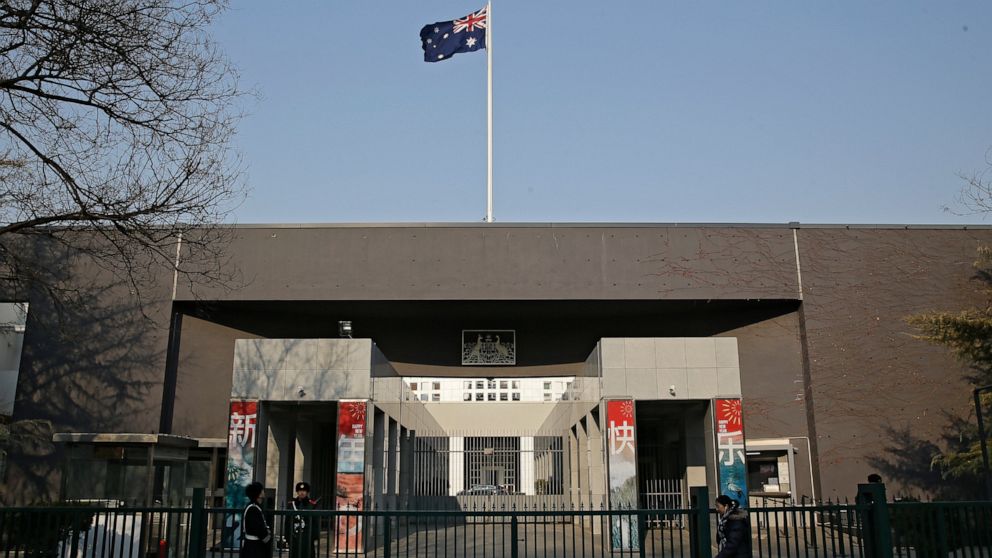
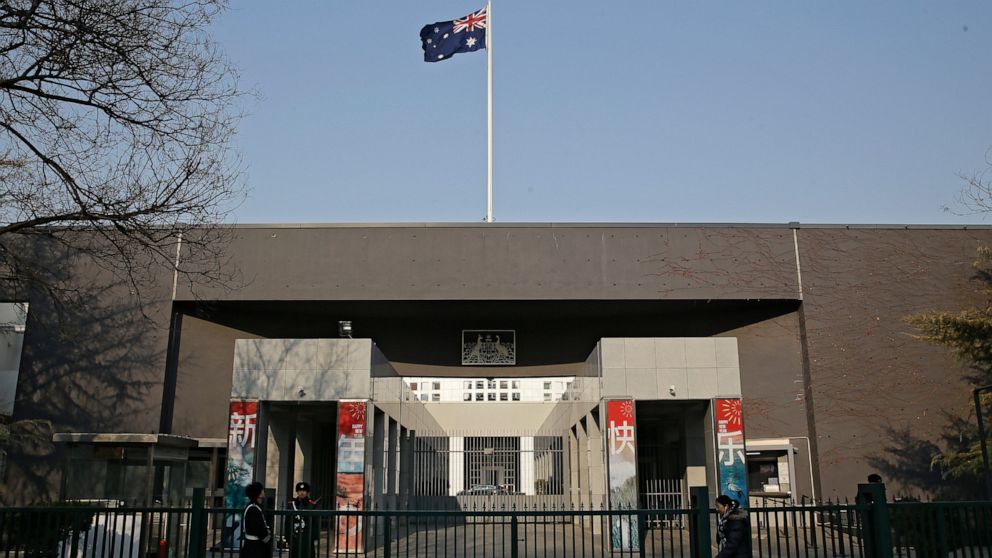
The Australian Embassy in Beijing.