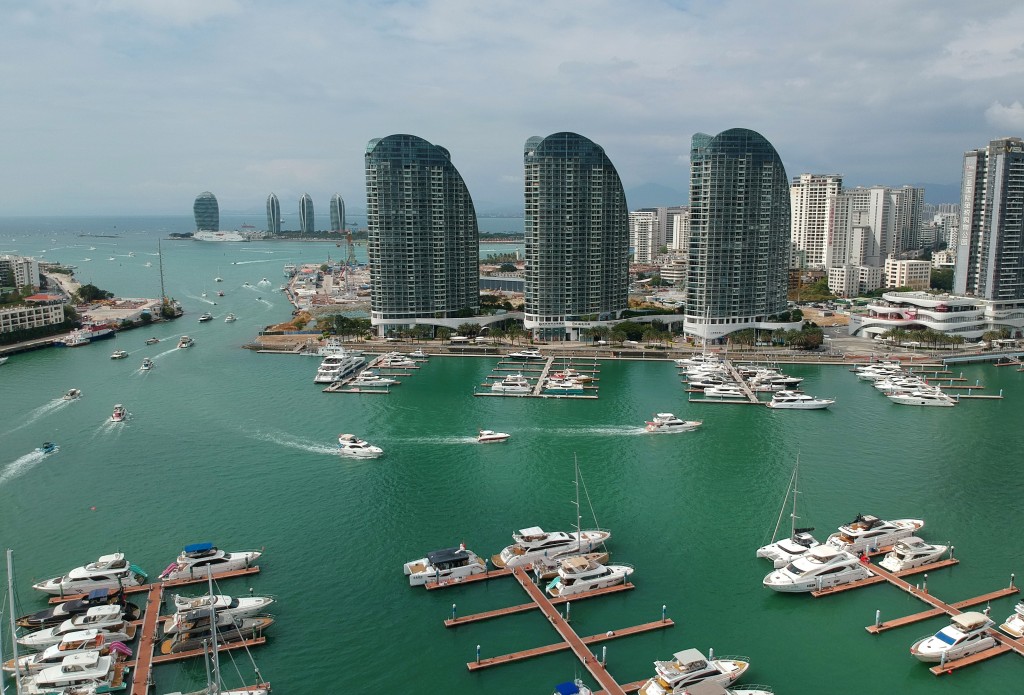
China will officially turn Hainan into a free trade port on December 18, allowing people from 85 countries to enter the Island without a visa and 6,660 types of goods to be duty-free.
The initiative, aiming to explore deeper market opening in China’s largest special economic zone, however, will not threaten Hong Kong’s status as an international hub of finance and trade, said economists.
National Development and Reform Commission deputy head Wang Changlin said in a press conference on Wednesday that Hainan’s free trade port system has been preliminarily established, enabling easier flow of people, logistics, capital and data.
In addition, residents of 85 countries will be able to have a visa-free visit to the southest province of China.
Hainan is one of the favourite tourist destinations for foreign tourists, with the number of visitor arrivals jumping 48 percent year-on-year to 663,000 in the first half, official data showed. The number even exceeds that of the mainlanders of 460,000.
In terms of trade, China’s Vice Minister of Finance Liao Min said the types of duty-free goods in Hainan will surge about 2.5 times to around 6,600 from the current 1,900. The coverage of duty-free goods will be expanded by 53 basis points to 74 percent.
Under the free trade initiative, the goods kept within Hainan will be exempt from import duties. For the goods entering other parts of mainland China from Hainan, those originating from Hainan are exempt from import duties but will still be levied import value-added tax or consumption tax.
NDRC’s Wang emphasized that the free trade initiative is not to separate the island from the mainland, but to facilitate the high-quality development of Hainan.
Wang noted that the launch date comes on the same day of a key party meeting in 1978 that started China’s historic economic reform and market opening, indicating the determination and confidence in persisting on high-quality opening of the world’s second-largest economy.
The Hainan Free Trade Port was proposed and drafted by Chinese President Xi Jinping in 2018 at the 30th anniversary of the establishment of Hainan Special Economic Zone. The initiative vows to support the island in exploring free trade policies and systems step by step.
As Hainan is still subject to the capital control, the initiative will have limited impact on Hong Kong’s role as an IFC, said CUHK associate economics professor Terence Chong Tai-leung.
Billy Mak Sui-choi, an associate professor at Hong Kong Baptist University, expected a limited impact on Hong Kong’s tourism, as the shift in spending habits of mainland tourists also affected Hainan despite the higher quota compared with the city.
Moreover, the logistics costs via Hainan are not necessarily cheaper than those through Hong Kong and Shenzhen, Mak added.
Mak thinks the initiative mainly aims to boost the economic growth of Hainan, as the island has scarce natural resources except for tourism.
THEMIS QI