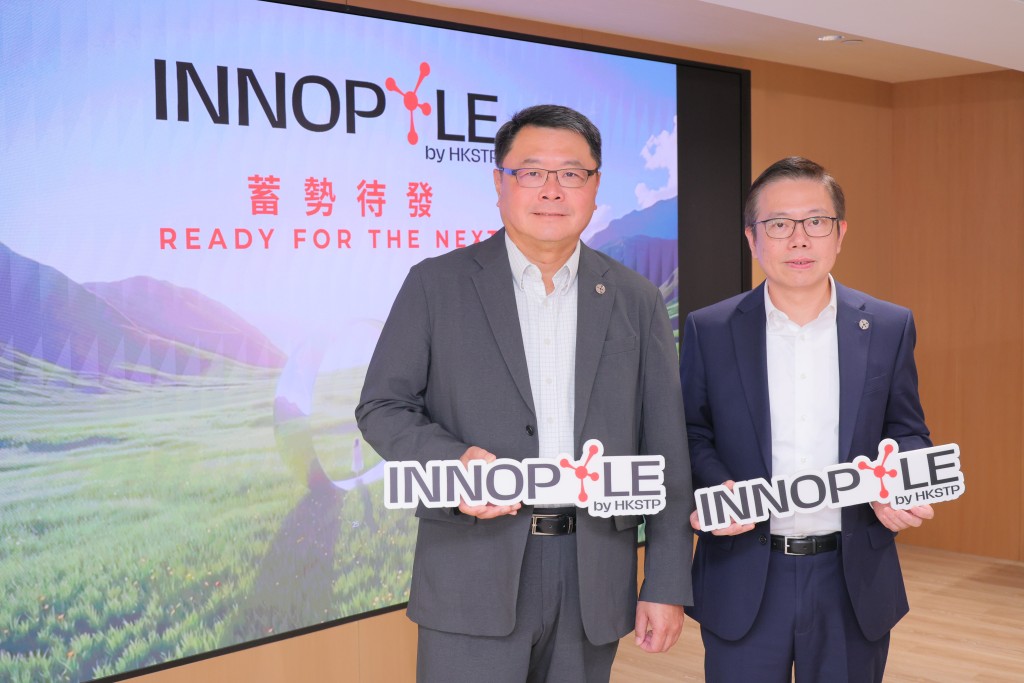
Dragages Hong Kong, a leading construction company, is teaming up with two park companies from Hong Kong Science and Technology Parks Corporation (HKSTP) to road-test construction tech on live jobs.
The collaborations see the deployment of CHAIN’s digital site management stack on two railway projects and CSC ROBO’s drilling and anchoring robots on a highway tunnel.
Their consensus is to deliver construction’s ‘iron triangle’ of safer sites, higher productivity and better quality, then use Hong Kong’s dense, complex works as proof points for export.
Why these partnerships
Client demand is what prompted Dragages Hong Kong to look beyond the standard 4S, DWSS and BIM toolset, according to Etienne Fayette, Head of Digital, Innovation and Transformation.
He said: “Hong Kong is a place where there is a strong appetite for digitalisation. As part of the construction industry, we have a responsibility to raise the bar and do something more.”
Fayette thanked HKSTP for bringing the parties together, calling HKSTP “instrumental” and a hub for solutions that help pilots kick off faster and move into deployment.
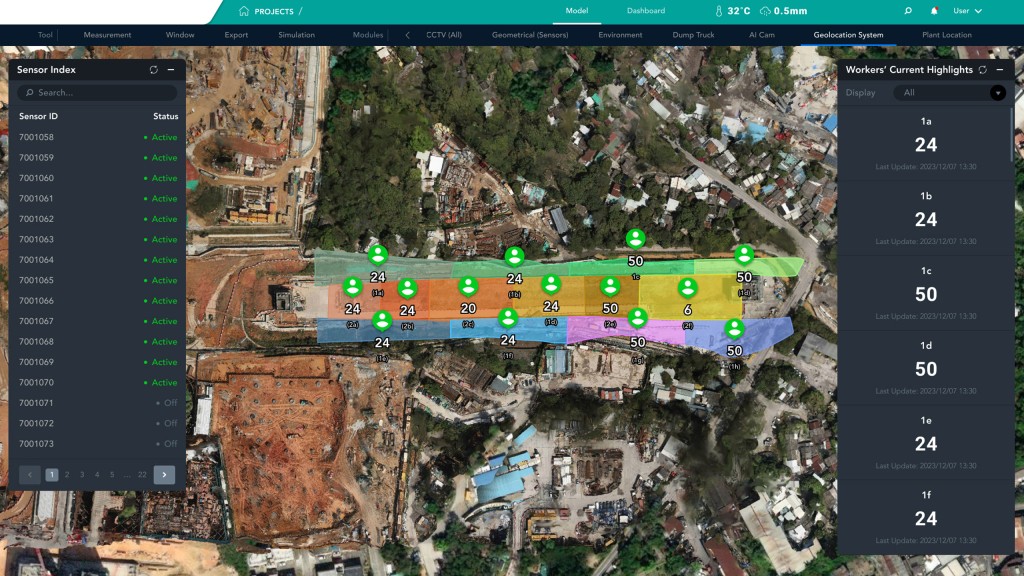
CHAIN Technology, on Antopia/DCSMS: a digital twin platform that fuses BIM, drones, IoT and AI for real-time site control.
What’s on site
DCSMS on rail. Dragages and CHAIN are standing up a Digital Construction Site Management System (DCSMS) across Tung Chung West Station and tunnels and Kwu Tung Station.
The platform pulls together safety, progress, environmental and workforce data into a single operational view.
CHAIN CEO Jackie Wong said the digital twin “links different IoT devices and cameras, and we use AI to provide insights,” from cross-checking access logs and headcount against milestones to flagging resourcing gaps early.
Monthly drone photogrammetry refreshes a photorealistic 3D model so design, as-built and programme line up in one place.
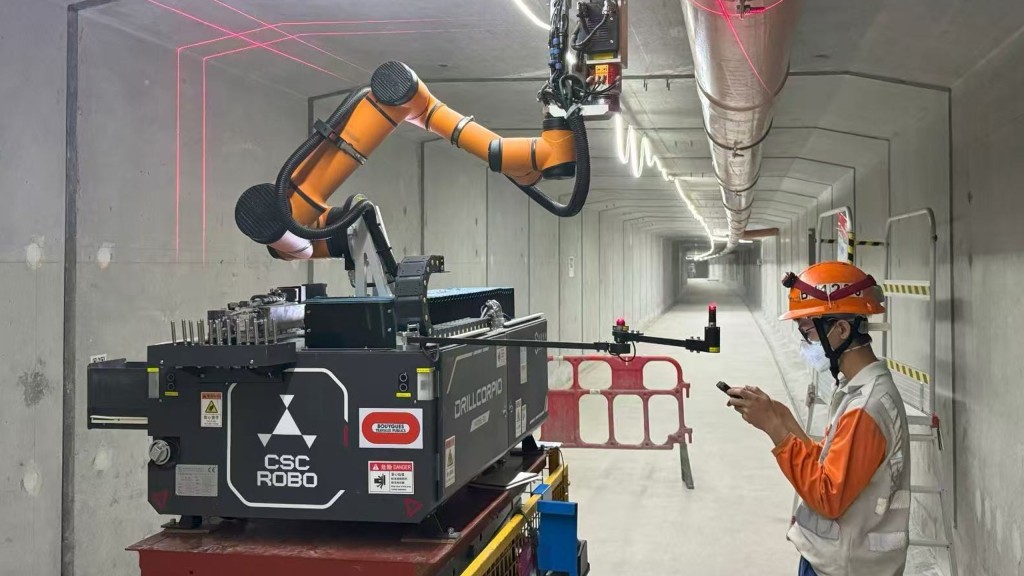
Robots in the tunnel. On Route 6 (T2), CSC ROBO’s Drillcorpio automates high-volume drilling and wedge-anchor installation for MiMEP modules in service galleries.
“It takes just two weeks on average to train a worker to operate the machine,” said founder and CEO Michael Ren.
In one phase, a single operator and one robot completed about 18,000 holes and anchors in roughly four months. Ren added that is a workload that usually takes six to eight months by hand.
CSC ROBO’s automated drilling system, designed to move crews off repetitive high-risk tasks and lift accuracy and throughput.
Ren said the system runs three to five times faster than manual teams, holds ±3 mm accuracy and uses integrated dust collection to clean up air in confined spaces.
“These robots let the same crews produce more. The goal is not to replace them.” Ren emphasized that robots enhance productivity and safety for workers, with drilling automation set to expand to Kwu Tung Station site.
Safety first, then productivity and quality
All three interviewees agreed that safety comes first.
Robotics pulls people back from repetitive, at-height and confined-space tasks. The digital twin helps supervisors spot issues sooner and head off non-compliances.
Fayette said safety measures are already paying off. “If there is a dispute, bring up the data. That’s the beauty of cold, objective information.”
He added that the growing evidence base builds trust among clients, contractors and subcontractors.
Wong added that the “single pane of glass” matters just as much as any specific sensor. The point is to line up data, surface the right alert and make it easy for site teams to act.
How they worked together
Dragages did not simply buy tools off the shelf. The teams co-designed workflows around Hong Kong constraints, from regulatory requirements to trade interfaces.
Wong said Dragages set out a clear digital roadmap, which let CHAIN ship core capabilities early and build them out in sprints as works progressed.
Ren said the standardised drilling patterns and predictable geometry keep the robot busy, spread training and integration costs over thousands of cycles, and turn a cool demo into day-to-day production.
The road ahead
Both start-ups see Hong Kong as a living lab that travels well. Digitalised practices such as monthly 3D models, continuous IoT telemetry and robotic workflows create playbooks that can carry over to other markets.
Down the road, Dragages wants to keep sites even safer, cut disputes and codify reusable playbooks for digitalised delivery on complex civils. “Technology that helps us anticipate, communicate and document will help in the long run,” said Fayette.