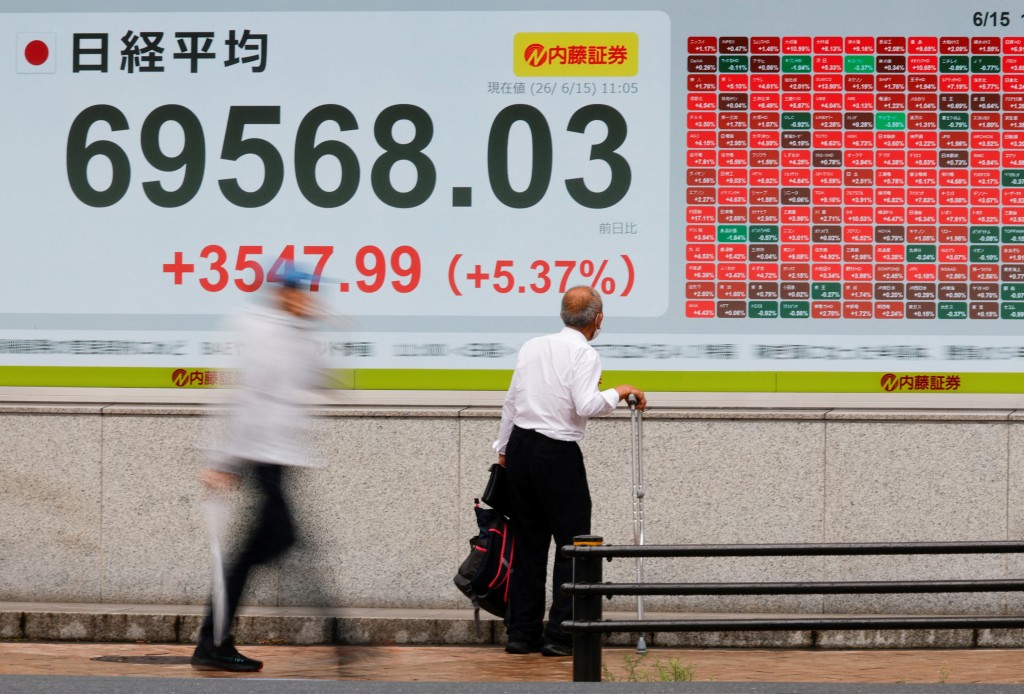
Japan’s exports grew for a ninth straight month in May, data showed on Wednesday, as a weaker yen, higher commodity prices and solid semiconductor demand offset the drag from major supply disruptions linked to the U.S.-Iran conflict.
The global artificial intelligence boom has cushioned parts of the world economy against war-driven risks, enabling import-dependent nations like Japan to absorb the immediate shock to growth and trade.
Total exports by value rose 17 percent year-on-year in May, government data showed, outpacing a median market forecast for a 16.2 percent increase and following a 14.8 percent rise in April. By volume, however, they rose just 0.5 percent last month.
Price effects, driven by the yen’s weakness and surging energy costs, were important drivers of both exports and imports, Koki Akimoto, an economist at Daiwa Institute of Research, said. “With the overall volume hardly increasing, exports lacked underlying strength,” he added.
Exports of electronic components drove overall growth, as strong demand from AI and data centres pushed up prices for memory chips and non-ferrous metals.
Exports to the United States rose 12.5 percent in May from a year earlier, while those to China were up 17.9 percent, the data showed.
Overall imports grew 12.5 percent in May from a year earlier, compared with market forecasts for a 12.8 percent increase, with the gains coming despite a plunge in crude oil import volumes, as the closure of the Strait of Hormuz sharply raised the prices of crude and related products.
Crude oil imports plunged 28.5 percent in value terms and 57.3 percent in volume terms, with per-unit cost in yen hitting an all-time high.
As a result, Japan ran a trade deficit of 378.7 billion yen (HK$18.5 billion) in May, compared with the forecast of a 564.6 billion yen deficit.
Separate data released earlier in the day showed Japan’s core machinery orders rose 8.7 percent in April from the previous month, better than a median market forecast of a 0.9 percent increase. The orders data suggest businesses might be beginning to raise investment.
Japan, heavily dependent on imported energy, has faced higher costs following disruptions to Middle Eastern supply routes. While the government has sought to diversify crude procurement by securing alternative supplies from the United States and elsewhere, those efforts have not fully offset the impact.
Crude oil imports from the Middle East tumbled 61.9 percent in volume terms last month, while those from the United States rose 24 percent.
U.S. and Iranian officials said on Sunday they had agreed on a framework for a deal to end the war, halt the U.S. blockade of Iran and reopen the Strait of Hormuz.
But analysts said a full normalisation of shipping will take time, citing damage to oil processing infrastructure, persistent security risks and the need to restore maritime insurance coverage.
“Higher oil prices driven by supply disruptions tend to erode Japan’s net exports over time, as worsening terms of trade and softer global demand combine to weigh on the export outlook,” Daiwa’s Akimoto said.
Reuters