Read More
The "Nantianmen Project" is transitioning from science fiction concept to potential reality, according to a recent article published by Chinese state broadcaster CCTV's military channel.
ADVERTISEMENT
SCROLL TO CONTINUE WITH CONTENT
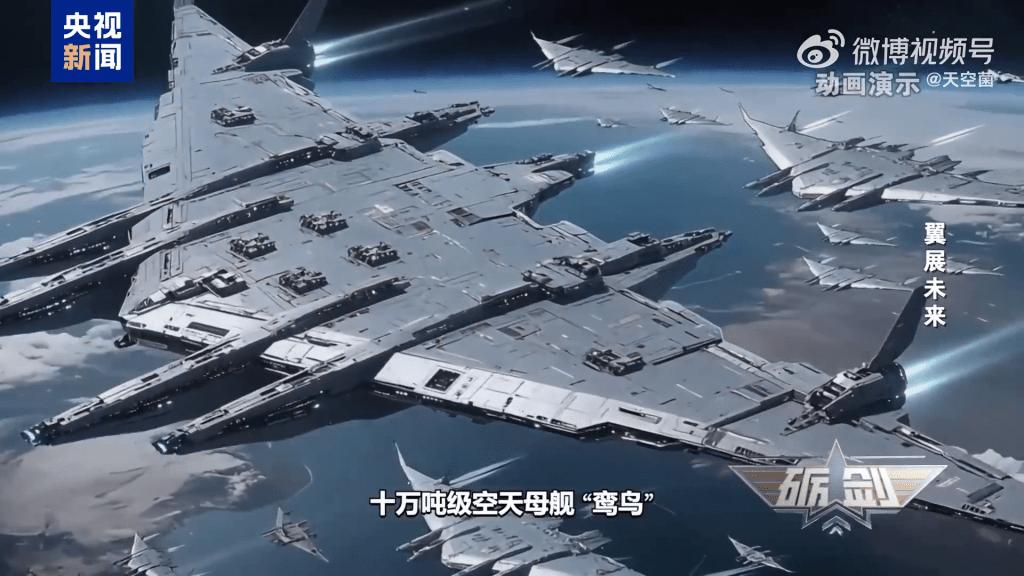
The project envisions a massive 100,000-ton-class space-based aircraft carrier, dubbed a “helicarrier.” The proposed carrier would measure 242 meters in length with a wingspan of 684 meters, have a maximum takeoff weight of 120,000 tons, and carry up to 88 unmanned fighter spaceplanes.
According to CCTV’s report, these spaceplanes would be unmanned combat aircraft featuring high maneuverability, stealth capabilities, and artificial intelligence. The craft is designed to operate both within Earth’s atmosphere and in space, equipped with hypersonic missiles for engagement capabilities.
The project moved from concept to tangible display when a full-scale model of the "Baidi Type-B" spaceplane was unveiled at the 2024 China International Aviation & Aerospace Exhibition in Zhuhai. The aircraft is said to employ cutting-edge technologies, including advanced stealth systems, the ability to switch between manned and unmanned operations, and modular mission systems that allow rapid reconfiguration for different combat roles.
The Nantianmen Project expanded further when the "Purple Fire" concept aircraft made its debut at the 7th China Helicopter Expo in Tianjin.
The Purple Fire design features artificial intelligence that enables the craft to transform its configuration and adapt to multiple mission types, including search and rescue, medical airlift, and disaster response. Developers project the aircraft will achieve speeds of 700 to 800 kilometers per hour and operate in extreme environments including low-gravity and thin-atmosphere conditions.
Wang Mingzhi, a Chinese military analyst, characterized the Nantianmen Project as "a forward-looking and innovative concept."
"These discrete cutting-edge technologies are not a question of whether they can be realized, but rather which ones will be realized first and when," Wang said, suggesting that implementation may be a matter of timing rather than feasibility.