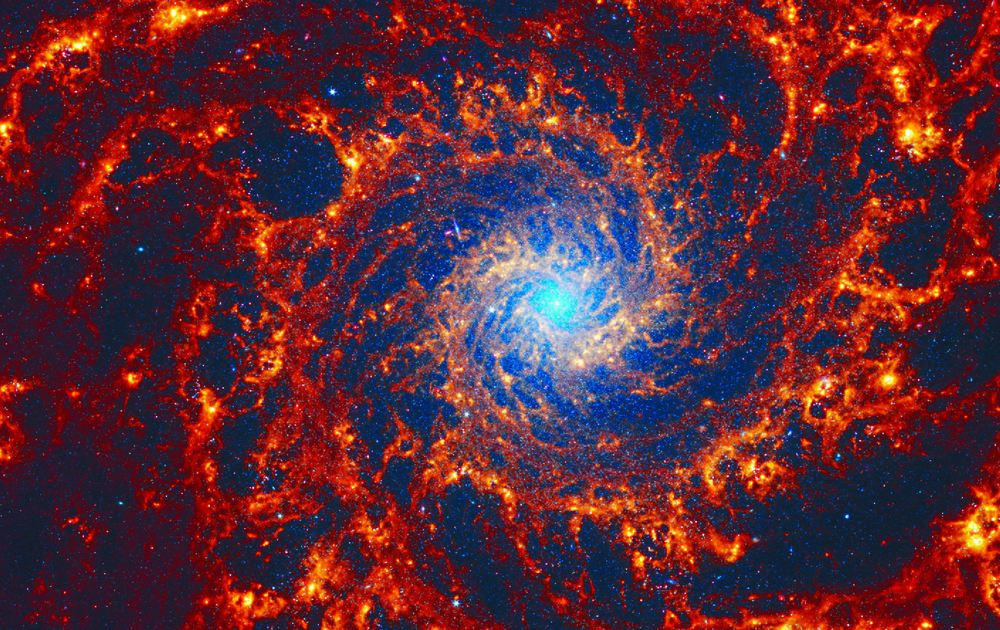
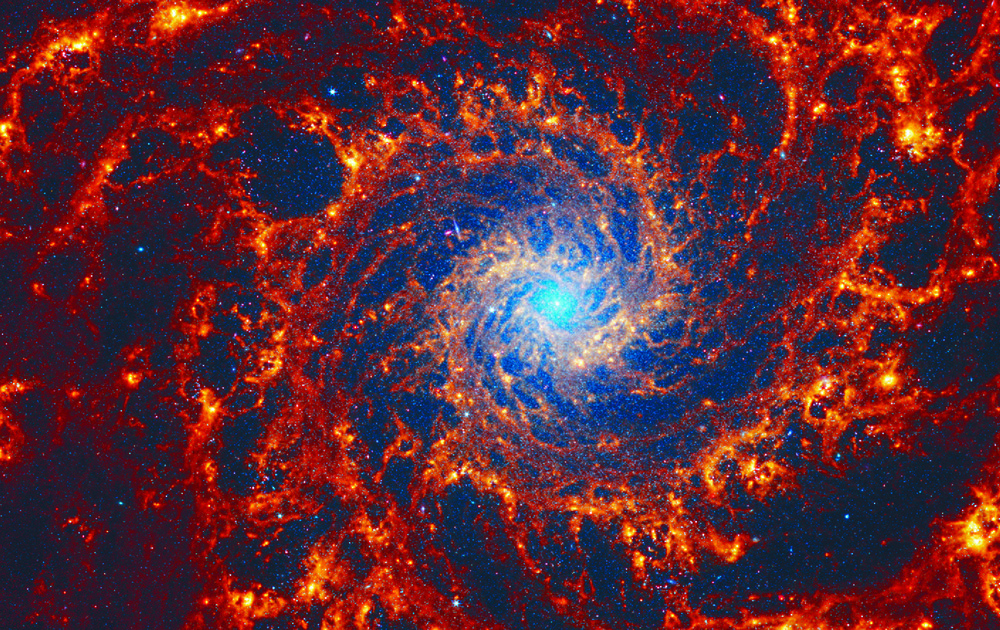
A batch of newly released images captured by the James Webb Space Telescope show in remarkable detail 19 spiral galaxies residing relatively near our Milky Way, offering new clues on star formation as well as galactic structure and evolution.
The images were made public by scientists involved in a project called Physics at High Angular resolution in Nearby Galaxies that operates across several major astronomical observatories.
The closest is NGC5068, 15 million light years away, and the most distant is NGC1365, 60 million light years far. A light year is the distance light travels in a year, or 9.5 trillion kilometers.
The telescope, launched in 2021, is reshaping understanding of the early universe, looking at it mainly in the infrared.
Spiral galaxies, resembling enormous pinwheels, are a common galaxy type. Our Milky Way is one.
"These data are important as they give us a new view on the earliest phase of star formation," said University of Oxford's Thomas Williams. "Stars are born deep within dusty clouds that completely block out light at visible wavelengths but these clouds light up at James Webb wavelengths. We don't know a lot about this phase, not even really how long it lasts, and so these data will be vital for understanding how stars in galaxies start their lives,"
A composite of the 19 spiral galaxies that are near our Milky Way offers a glimpse of the fiery birth of stars. Right: NGC 628, which is 32 million light years away.