Read More





Taleban fighters entered Kabul yesterday and sought the unconditional surrender of the central government as Afghans and foreigners alike raced for the exit, signaling the end of a 20-year western experiment aimed at remaking Afghanistan.
The government sought an interim administration but Had few cards to play.
Civilians fearing the Taleban could reimpose a brutal rule that all but eliminated women's rights rushed to leave the country, lining up at ATMs to withdraw savings. Helicopters buzzed overhead, some apparently evacuating personnel at the US embassy.
In a stunning rout, the Taleban seized nearly all of Afghanistan in just over a week, despite the hundreds of billions of dollars western nations spent over nearly two decades.
There was also a US military assessment it would be a month before the capital would come under insurgent pressure.
The Taleban has defeated, co-opted or sent Afghan security forces fleeing from wide swaths of the country, even though they had air support from the US military.
Fighters entered the outskirts of Kabul yesterday but kept their distance from the city center. Sporadic gunfire echoed at times, though the streets were largely quiet
Workers fled government offices, and smoke rose as US embassy staff burned documents.
Taleban spokesman Suhail Shaheen said the insurgents are "awaiting a peaceful transfer of Kabul city." But he acknowledged the Taleban wanted an unconditional surrender. With that in mind, Taleban negotiators headed to the presidential palace yesterday to discuss a transfer of power.
The negotiators on the government side included Afghan National Reconciliation Council head Abdullah Abdullah, a longtime critic of President Ashraf Ghani, who refused to give up power to get a deal with the Taleban.
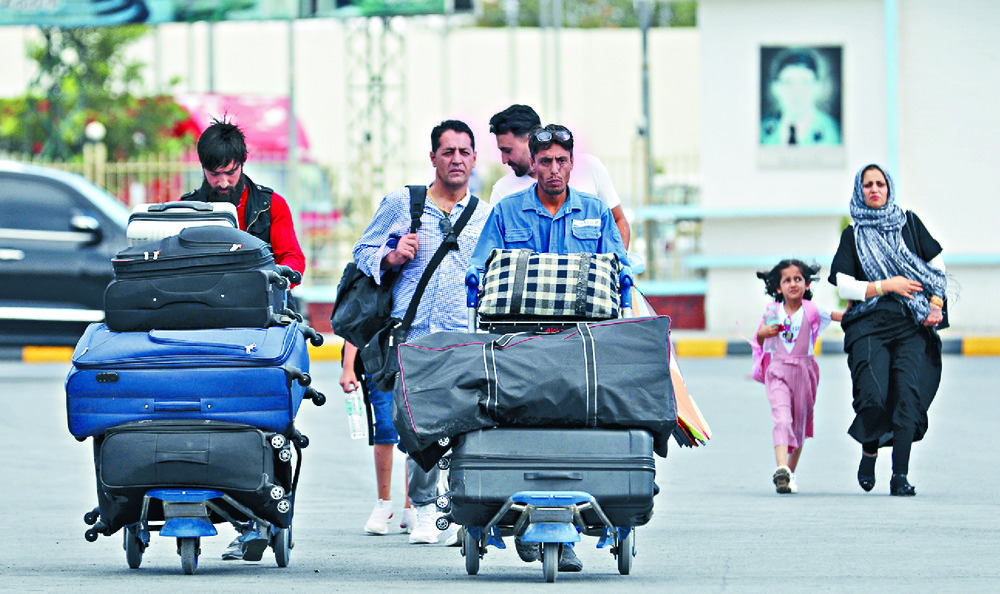
Despite assurances to the capital's residents and offers of an "amnesty" by the Taleban to those who worked with the government or foreign forces panic set in as many rushed to leave the country through the airport, the last route out as the Taleban now hold every border crossing.
Rapid shuttle flights of Chinook helicopters near the embassy began a few hours after the militants seized nearby Jalalabad, which had been the last major city besides the capital not in Taleban hands. Armored diplomatic SUVs were also leaving the area.
Smoke was seen near the US embassy's roof as diplomats destroyed sensitive documents. The smoke grew heavier over time in an area that is also home to other embassies.
Sikorsky UH-60 Black Hawk helicopters, which typically carry armed troops, later landed near the embassy. At least one attack helicopter could be seen overhead as helicopters launched flares to distract possible missile fire.
The United States decided a few days ago to send in thousands of troops to help evacuate personnel from its embassy.
And Kabul International Airport Afghan forces abandoned the facility to western military elements.