For more than two decades, Taiwan tried to buy a fleet of modern conventional submarines to fend off an existential threat – invasion by China. There were no takers.
The United States, Taiwan’s main ally, has a nuclear-powered fleet and hadn’t built diesel-powered subs in decades. Other nations balked, fearful of angering Beijing.
Now, as China under President Xi Jinping steps up its military intimidation of Taiwan, an array of foreign submarine-technology vendors, with the approval of their governments, are aiding a secretive program to build subs in Taiwan. Taipei has stealthily sourced technology, components, and talent from at least seven nations to help it build an underwater fleet with the potential to exact a heavy toll on any Chinese attack, a Reuters investigation has found.
Taipei’s chief foreign weapons supplier, the United States, has provided key technology, including combat-system components and sonars. But assistance is coming from far beyond America.
Defense companies from the United Kingdom, which like America operates a fleet of nuclear-powered ballistic missile and attack submarines, have provided crucial support.
A veteran of Britain’s Royal Navy submarine fleet, retired Commodore Ian McGhie, was a key figure in the drive to recruit submarine expertise, according to a person familiar with his role. McGhie helped a Gibraltar-based company hire engineers including former Royal Navy sailors, the person said.
Britain also has approved multiple export licenses in the past three years for UK companies to supply submarine components, technology, or software to Taiwan, according to information from the Department for International Trade obtained via a Freedom of Information request. The value of submarine technologies approved for export from the UK to Taiwan has grown exponentially in recent years, government data analyzed by Reuters shows.
Taipei also succeeded in hiring engineers, technicians, and former naval officers from at least five other countries: Australia, South Korea, India, Spain, and Canada. Based at a shipyard in the port city of Kaohsiung, the experts have advised the Taiwanese navy and state-backed shipbuilder CSBC Corporation Taiwan, the company building the new submarines.
Taiwan scoured the globe for this submarine engineering expertise, Rupert Hammond-Chambers, the president of the US-Taiwan Business Council, told Reuters.
“It’s a jigsaw,” Hammond-Chambers said. Taiwan had to search the international market for technology and components it was unable to source domestically. So, he said, it “cut down the pie to smaller pieces” to figure out which work required foreign assistance, such as help in completing the design of the submarines.
The Taiwanese project, which officially began in 2017, is formally known as the Indigenous Defense Submarine program. It is codenamed Hai Chang, which means “Sea Prosperity” in Chinese. Shipbuilder CSBC began construction last year and is aiming to deliver the first of the planned eight vessels by 2025, according to government statements. The value of the project is estimated at up to US$16 billion, according to the London-based International Institute for Strategic Studies.
Informed about the findings of this article, a spokesperson for China’s foreign ministry said the Taiwanese “authorities are colluding with external forces” on the program. The countries concerned, the spokesperson said in a written statement, should refrain from participating in the submarine effort, “stop military ties with Taiwan and stop supporting the ‘Taiwan independence’ secessionist forces.”
These countries are “playing with fire, and those who play with fire will get burned themselves,” the spokesperson said.
Taiwan’s defense ministry said the new submarines are crucial for “the national defense forces’ asymmetric warfare,” a reference to waging war against a superior military foe. It added that various challenges facing the program have been “eliminated” and it is being “implemented according to plan.”
CSBC declined to comment.
(Reuters)
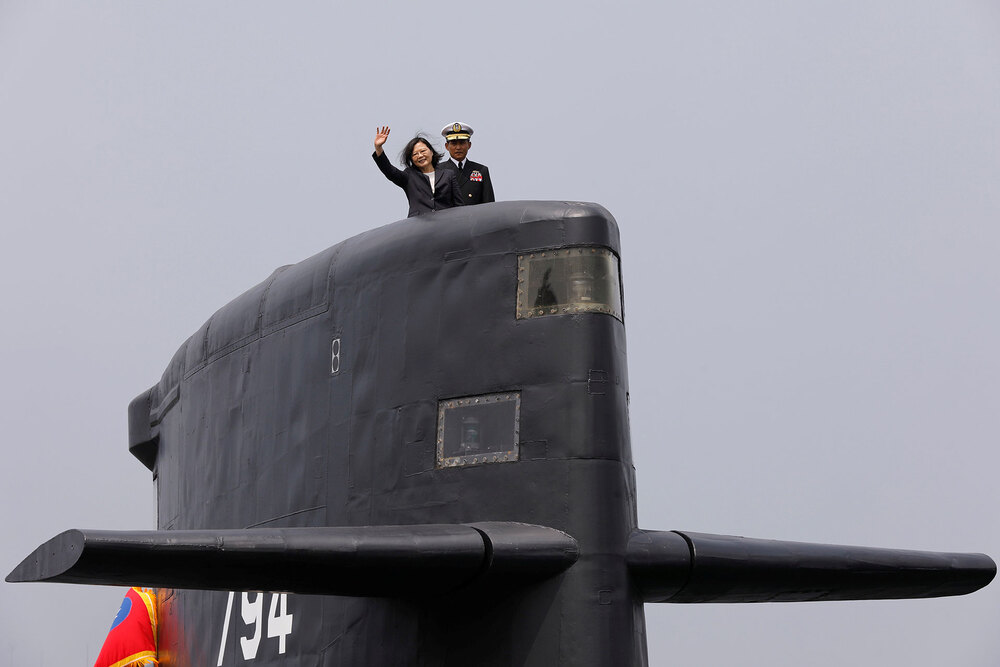
President Tsai Ing-wen has been a strong supporter of the new submarine program. She boarded one of Taiwan’s existing Sea Dragon subs on a 2017 visit to Kaohsiung. The new boats are being built at a shipyard there. (Reuters)