The Justice Department defended President Donald Trump's contentious White House ballroom project on Friday before a panel of skeptical appeals court judges.
The two Democratic appointees on the three-judge panel peppered a government lawyer with tough questions during a two-hour hearing in a Washington courtroom as part of a lawsuit brought by the National Trust for Historic Preservation.
The East Wing of the White House has already been demolished to make way for the $400 million ballroom project, which the Republican president has said is being financed by wealthy private donors including himself, not taxpayers.
The Trump administration has asked Congress for an additional $1 billion for security features for the ballroom, which is to include an underground bunker, but the request has been stymied so far by opposition from Democratic lawmakers and some Republicans.
A district court ordered a halt to construction of the ballroom earlier this year, saying it needed the approval of Congress, but the US Court of Appeals for the DC Circuit has temporarily allowed the project to go ahead while litigation continues.
Yaakov Roth, representing the Justice Department, asked the appeals court panel on Friday to lift the lower court order permanently and said only Congress could intervene, not the courts.
"Your position is this can't be stopped in court?" asked Judge Patricia Millett, an appointee of president Barack Obama.
"That's right," Roth said. "It can only be stopped by Congress."
Millett also asked whether anything could be done if the government decided, for example, to demolish the Statue of Liberty.
"If the government decides, very quickly, to bulldoze the Statue of Liberty... nothing can be done?" the judge asked.
"I think that's right, yes," Roth replied.
Judge Bradley Garcia, an appointee of Democratic president Joe Biden, also appeared skeptical of the government's arguments. But they were met favorably by the third member of the panel, Judge Neomi Rao, a Trump appointee.
- 'Safety and security' -
Roth said the ballroom project should also be allowed to proceed on national security grounds.
"The old East Wing was not adequate to protect the safety and security of the president and others in the White House," he said. "This project is designed to update those protective features to ensure that they are capable of withstanding modern weaponry like drones."
Tad Heuer, representing the National Trust for Historic Preservation, urged the court to halt the ballroom project.
"This case is about who controls federal property," Heuer said. "Is it Congress, its owner? Is it the president, its temporary tenant? The Constitution is clear, it is Congress."
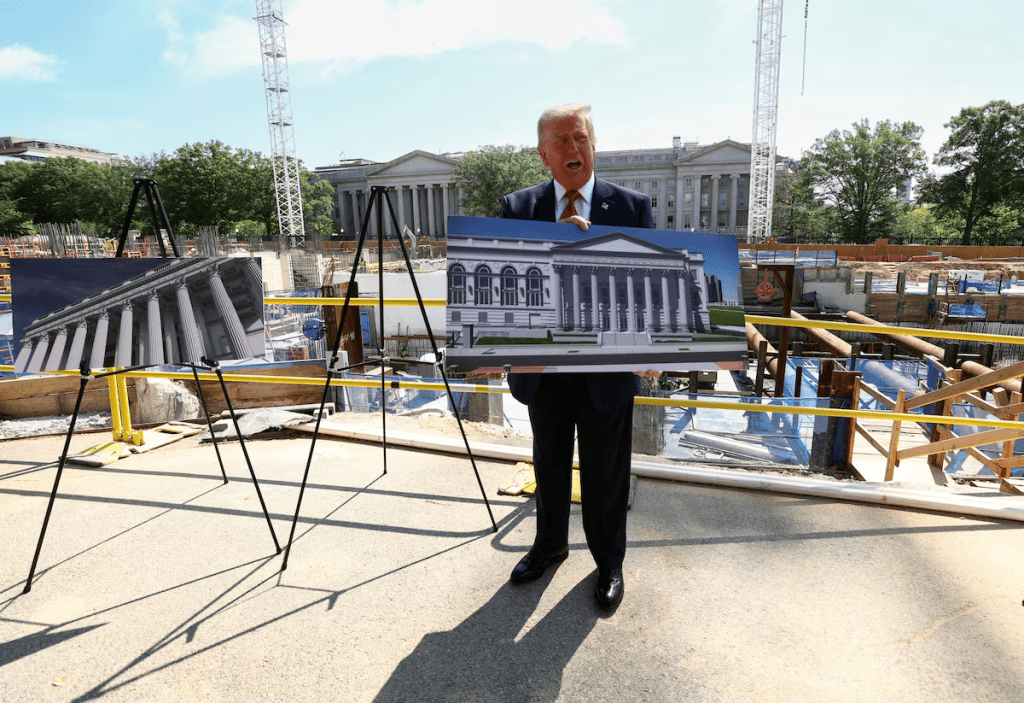
During a recent tour of the ballroom site for reporters, Trump said it would feature underground meeting rooms, a military hospital and a "drone-proof" roof.
The historic East Wing of the White House previously housed the offices of the First Lady.
Trump says the ballroom is needed to host grand banquets for foreign leaders, although it would barely be finished by the time his own second and final term ends in 2029.
AFP