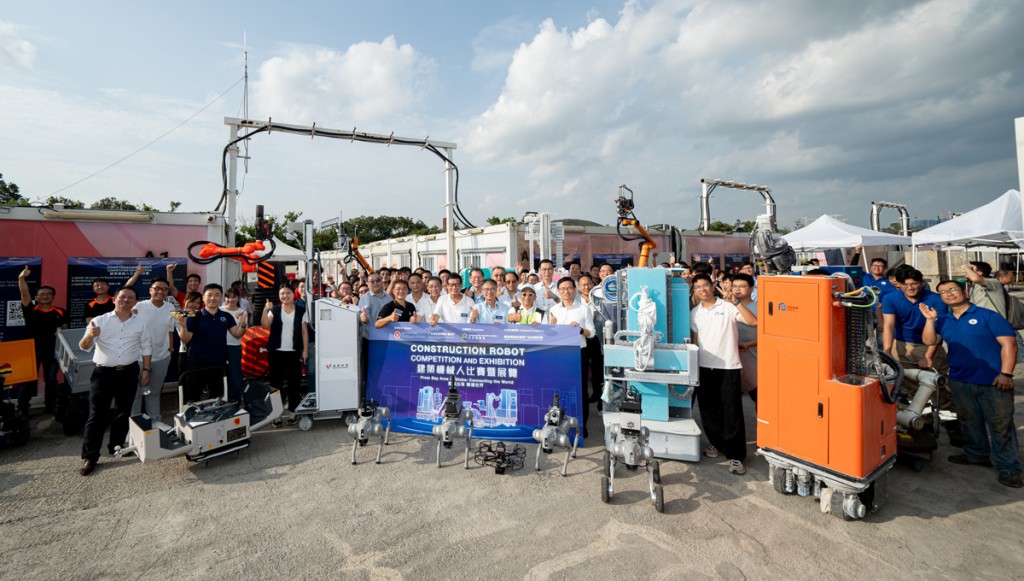
From July 9 to 10 the Construction Industry Council (CIC) staged two robotics showcases – first a Construction Robot Practical Competition at the HKIC - San Tin Training Ground, then a Construction Robot Challenge for secondary school teams at Kowloon Bay’s CIC - Zero Carbon Park.
The contests anchor CIC’s agenda of integrating technology trials, talent development and pilot policies into a self-reinforcing system that accelerates the creation, uptake and export of home-grown smart construction solutions.
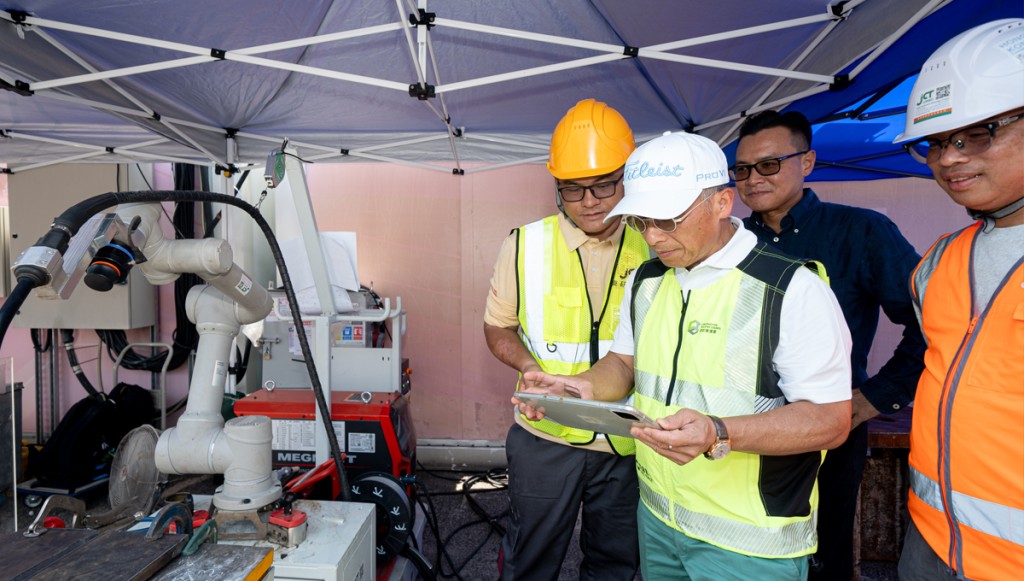
Ir Prof. Thomas Ho (2nd left), CIC Chairman, experiences a robotic welding trial before the Practical Competition at San Tin Training Ground.
Industry robots put through their paces
On the opening day, 24 robotics solutions from mainland and local firms competed in six functional categories-drilling, welding, material transport, painting, construction robotic dog and construction drone.
“This competition embraces the philosophy of ‘Proving True Skill in Practical’, establishing a platform where robotic systems can compete in a simulated site environment and spark breakthroughs,” CIC Chairman Ir Prof. Thomas Ho told in the opening remarks.
Each machine was evaluated on a 30-30-20-20 rubric: safety (30 per cent), speed (30 per cent), workmanship quality (20 per cent) and practicability/maintainability (20 per cent).
The field tests, staged on full-size mock-ups at the San Tin Training Ground, produced eye-catching benchmarks. A twin-arm welding robot finished a 400 mm seam in under three minutes, while an autonomous buggy hauled 200 kg of rebar across uneven ground without human intervention.
Another segment of “Construction Robot Performance Competition” will be shortlisted top 9 teams to present at the pitching competition of the upcoming Construction Robot Competition and Exhibition (July 31, Tea House Theatre, Xiqu Centre, WestK), where they will showcase and present their robotic system before an international jury and vie for the Best Performance Robot award.
The public exhibition (July 31 - August 2, Atrium, Xiqu Centre, WestK) will showcase construction robots from more than 15 companies, demonstrating how technology can revolutionise traditional construction methods.
Students meet real site challenges
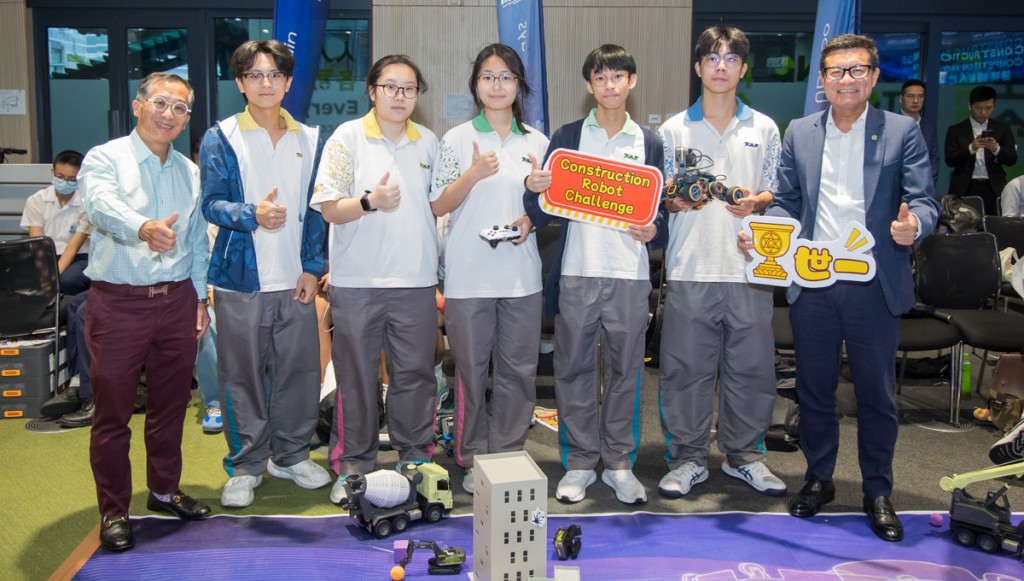
The following day 12 shortlisted school teams tackled seven tasks-slopes and stairs, waste removal, defect photography, box stacking, obstacle navigation and curved-path following.
Ho later called the outcome “truly rewarding”, praising the winners for addressing “each challenge item by item” and noting that the students “did far more than just write code; they thought through the robot’s design, adapted it to real site conditions and showed impressive operational control”, a standard he judged “far better than expected”.
And teachers agreed. Mak Tsz-fung of Lok Sin Tong Yu Kan Hing Secondary School said: “Construction sites contain hazardous corners that workers cannot access easily, so our robot was built to slip into those tight or risky spaces and handle simple yet essential tasks like gripping or moving objects, using code and adaptations the students developed largely on their own.”
Liu Tak-ching of Chang Pui Chung Memorial School added: “The students apply their knowledge of friction and force to fine-tune the robots for real construction scenarios; that’s why this competition is so valuable.”
The winning teams will display their robots alongside the winning systems from the Construction Robot Challenge during the three-day Construction Robot Competition and Exhibition at Xiqu Centre, WestK.
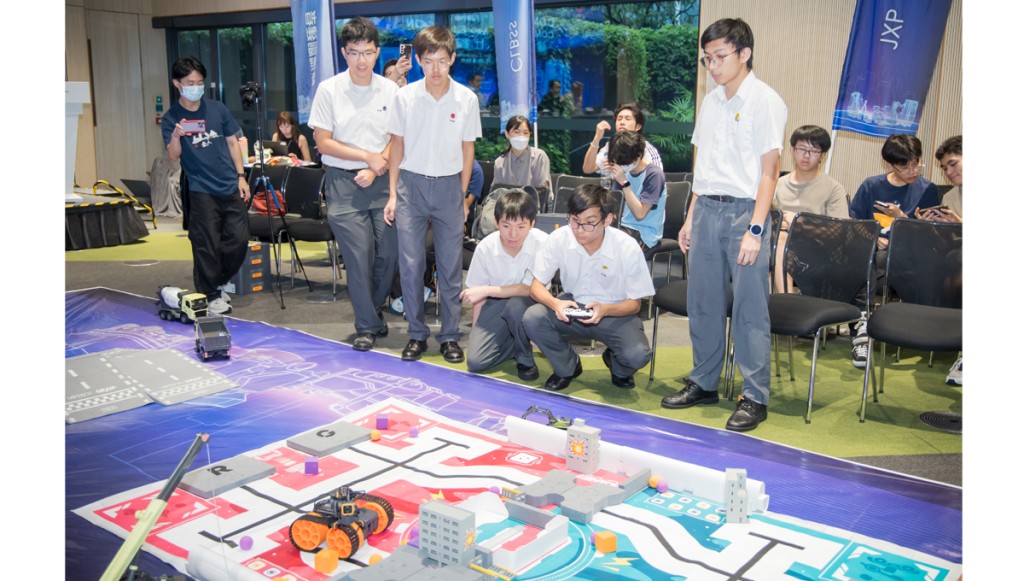
A participating team demonstrates their robot to the attentive judging panel during the Construction Robot Challenge.
Student competitors steer self-built robots across a simulated construction map.
Pilot, incentive, mandate
The robotics push dovetails with the government’s Construction 2.0 initiative, which advances every new technology through a three-step sequence – pilot, incentive, mandate.
Joseph Lo Kwok-kuen, Head of Project Strategy and Governance Office at the Development Bureau (DevB), told The Standard that the robot competition and exhibition follow the same pattern, as they act as safe “sandboxes” where site performance data can be gathered, benchmarked and shared before incentives and, ultimately, compulsory requirements are introduced.
“New methods are tested on government projects first, then incentives are provided, and finally they are made compulsory,” he explained, citing Modular Integrated Construction as a prime example of this model. MiC was first piloted on selected public works, then boosted by policy and financial support, and is now widely adopted in public and private projects.
Ho further noted that Hong Kong now has 150 MiC projects, 80 MiMEP (Multi-trade integrated Mechanical, Electrical and Plumbing) projects and 20 MiC-lift installations, with a further 2.5 million square metres in the pipeline over five years.
About half of the Housing Bureau’s next 330,000 public housing flats will use MiC, and the same MiC-MiMEP toolbox must inevitably extend to RMAA (repair, maintenance, addition and alteration) if Hong Kong is to cover the entire building lifecycle, according to Ho.
Public works contracts serve as low-risk test beds; once approaches prove their worth, schemes such as the Construction Innovation and Technology Fund (CITF) finance private uptake, and formal mandates lock in mass adoption, according to Lo.
The same path now applies to digital tools. Since 2020 all public projects run the Digital Works Supervision System (DWSS), while a the Integrated Capital Works Platform aggregates operational data so anomalies can be spotted early and corrective measures applied.
Habit-based safety with 4S
CIC and DEVB’s Smart Site Safety System Labelling Scheme (4SLS), now on 520 projects, uses IoT wearables and AI-CCTV for habit-based safety culture. “We are shifting safety culture from compliance-based to habit-based through continuous performance scoring,” Ho said, noting that 4S can be franchised overseas.
These systems can be franchised overseas, with Hong Kong safety trainers managing deployment, accreditation and ongoing support. Drills at the robotics events showed automated alerts cutting response times by 40 per cent.
“Only a united ecosystem of government, industry, academia and society can sustain continuous breakthroughs and deliver real value at scale,” Ho concluded.
Construction Robot Competition & Exhibition
Momentum from the two July contests now rolls into the public facing Construction Robot Competition and Exhibition, themed “From Bay Area to Globe: Connecting the World”.
The three-day programme, all at Xiqu Centre, WestK, begins on July 31 with a morning forum (09:30-12:35, Tea House Theatre) featuring award presentations and keynote talks.
That afternoon (14:00-17:35, Tea House Theatre) the Performance Competition puts the top nine industry robots through commercial robotic system before an expert jury and a live audience. A spotlight talk on quadruped robots in industrial settings rounds off the session, followed by prize-giving .
From July 31 to August 1 (09:00-20:00 Thursday to Friday, Atrium) and August 2 (09:00-18:00 Saturday, Atrium) the Exhibition turns the venue into an interactive showroom, showcase more than 15 industry robots, plus the student winners, will run continuous demos while guided toursand hands-on stations invite visitors to compare productivity data.